
It would be an egregious understatement to say that much has changed since Kimberlee Bassford presented a work-in-progress cut of Before the Moon Falls at a DocuClub screening, hosted by IDA and Hawaiʻi Women in Filmmaking, back in 2021. Since then, the filmmaker decided to incorporate her presence into the film, settled on a new title entirely (the project was originally called I of Water) and, perhaps most vitally, gained collaborators in editor Jessica Lee Salas and producer Linda Goldstein Knowlton. But radical (and ongoing) developments to their protagonist’s story keep the film’s scope from feeling truly all-encompassing.
Eight years in the making, Before the Moon Falls centers on celebrated Samoan author Sia Figiel. Her 1996 coming-of-age novel, Where We Once Belonged, won a Commonwealth Writers’ Prize and was the first book by a Samoan woman writer published in the U.S. In the years that followed, she struggled with complications of type 2 diabetes, undiagnosed mental health conditions, and fraught familial dynamics. Bassford’s film captures Figiel’s genuine desire to confront these issues, leading her to embark on a health-conscious mission to walk the length of America, seeking out a therapist, and moving back in with her children in Samoa after an extended absence. All in all, the promise of positive change was on the horizon, and the film originally concluded with a message of hope.
But on May 28, 2024, while the team was deep in the edit, Figiel was charged with murder. The victim was fellow Samoan writer Caroline Sinavaiana-Gabbard, featured in the documentary as the protagonist’s friend and mentor. Bassford and her team contemplated how to integrate this shocking news into the fabric of the film, opting for a cut of the ending that makes Bassford an interlocutor in her own film. Unfortunately, tragedy struck again on January 26, 2026, when just months after Figiel’s August trial, she was discovered dead in her jail cell.
As the film already had its world premiere at New Zealand’s Doc Edge Film Festival in June 2025, it’s unlikely that this distressing development will further shape the on-screen narrative of Before the Moon Falls. Regardless, the documentary succeeds in its unvarnished portrayal of Figiel’s spirit, described by Bassford as “larger than life.” Documentary spoke with Bassford via Zoom last fall to discuss how she modified her approach to Figiel’s story over nearly a decade of development. This interview has been edited.
DOCUMENTARY: Tell me about the origins of this project, specifically how you got connected with Sia Figiel.
KIMBERLEE BASSFORD: The project began in 2016. I read in the newspaper that Sia was coming to Honolulu. She was doing a launch for her latest novel, Free Love, so I decided to go.
I was curious about her because 18 years prior, when I was in college, I did a study abroad program in Samoa. I originally thought I would study abroad in Paris because that’s what you do: you go to Europe. But going to school on the East Coast, so far away from Hawaii, where I’m from, really made me homesick and want to learn everything I could about the Pacific. I ended up attending this program based in Apia, Samoa. Sia’s books were assigned reading. I remember sitting in my dorm room in Apia and reading these stories. They’re very fast reads, but they’re tough reads, too. They center on the lives of young adolescents; I was in my early twenties, and I’m from the Pacific, so I really connected on many levels. She went to places I didn’t expect—issues of rape, suicide—and that was really bold in the late nineties. There really hadn’t been a female voice from the Pacific in literature like this.
Sia is larger than life, as you see in the film. She commands a room. She was reading the passages from her book, but she was also talking a lot about her own life. During that event, she talked about a plan to walk across the continental U.S. to raise awareness about diabetes and obesity. As a filmmaker, you’re always looking for characters. I went up to her, introduced myself, and said, “Hey, would you be interested in having someone document your walk across America?” She said yes, and that’s where the project began.
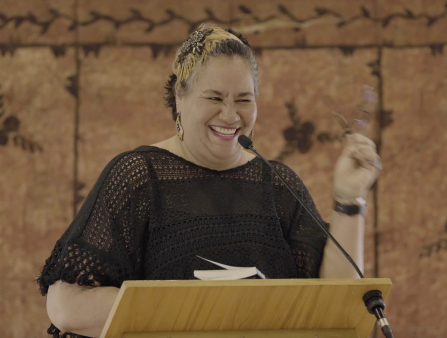
D: The trek across America could easily have been the sole focus of the doc, but it goes so much wider—and that’s not even getting to the shocking revelation at the end. I’m curious about how you shaped the narrative as you spent more time with your subject.
KB: We got some seed funding from Pacific Islanders in Communications to help with [shooting] the walk across America. We ended up filming her at various points on the walk. I obviously wasn’t there 24/7 because I didn’t have the time or funding for it. When the walk finished, Sia and I believed we needed to continue filming. Four or five months after the walk, she called me and said, “Kim, if I’m going to be honest with you, I’ve really been struggling with these extreme emotions, and I want to go see professional help for the first time.” That’s when we started asking, “Well, would you be open to us filming that?” That’s the moment when it became more of a mental health journey. The walk was integral for her figuring out that the next step is to go get help with this.
D: There are so many narrative devices utilized throughout the film: animation, talking head interviews, phone call audio, text messages, family archives—even a Microsoft Word document. How did you juggle integrating all of these elements?
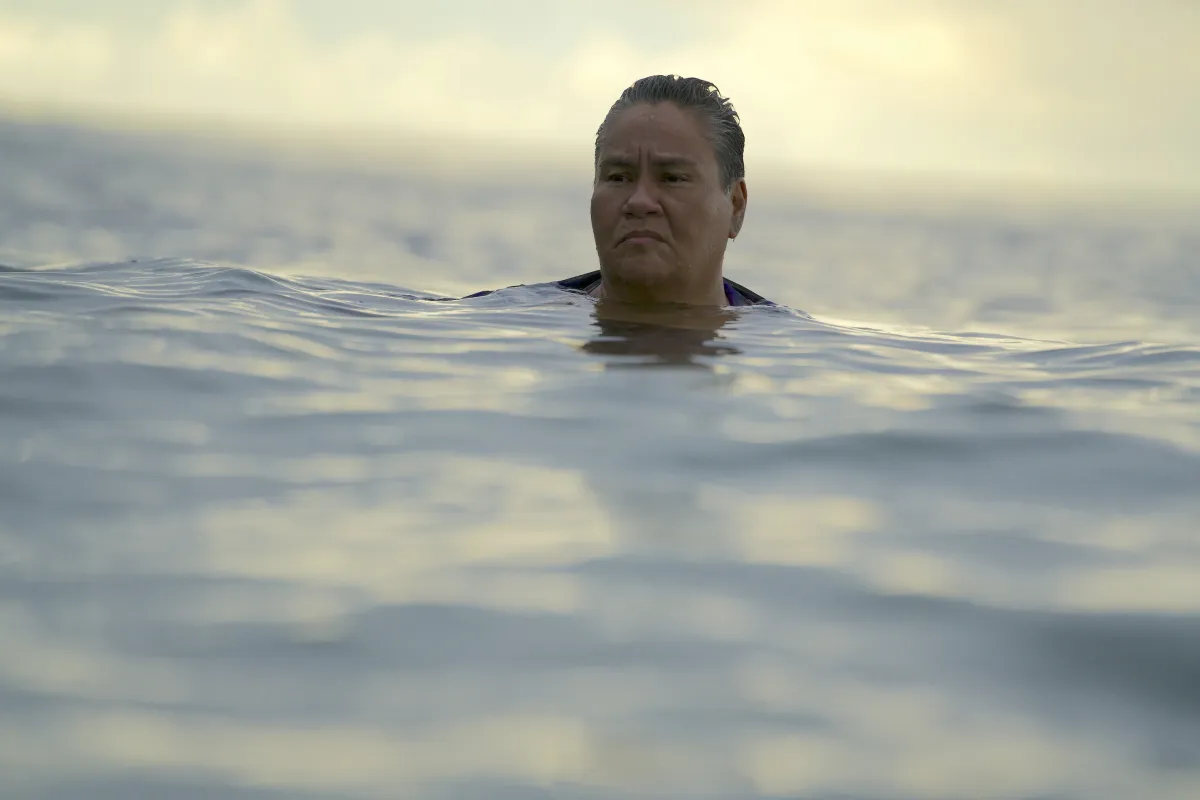
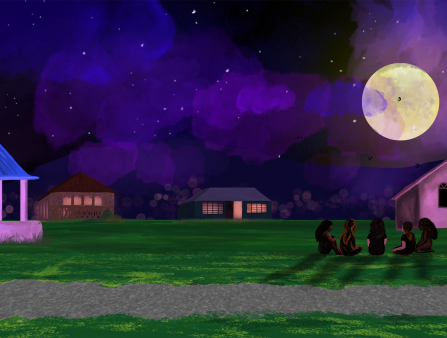
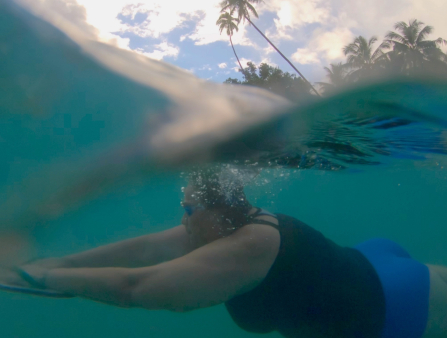
KB: It was pretty organic. I knew early on I wanted to do animation, so we brought on Mahima Tuladhar, an independent animator. We started collaborating before the pandemic. I wanted to use animation to depict the world of Sia’s writing. We ended up using the animation later on to show more of her inner world, too. The motif of water came about organically. Most Pacific Islanders have a special relationship with the ocean. Sia loves to swim, and she always said that is the one place where she doesn’t feel her weight. The decision to use the little girl [for poetic visuals] was something she and I talked about because a lot of the story was about her memories of what happened when she was a child. We wanted to evoke that. I don’t want to call them reenactments, but doing some stylistic filming with a young girl was something we wanted to do pretty early on.
The project was so long, and Sia never really stayed in one place for more than a year. She originally was in Seattle, then she was all over the continent: Utah, Hawaii, then Florida. I couldn’t always be with her, so a lot of our relationship was over the phone and through text. I don’t think she had much consistency with her family, so the film became one of the few constants in her life over those eight years.
D: What was your experience at the DocuClub work-in-progress screening you presented back in 2021? How did the feedback you received impact the project?
KB: That screening was really important. I can’t remember how much we shared—maybe the whole cut at the time?—but since then, I wanted to experiment more with structure. We were having a hard time trying to figure out how to meld all of these things—the walk across America and her diabetes, writing, mental health, and abuse. At that point we didn’t know what would happen in 2024. I was working with a different editor then, but within the next year, I started working with Jess [Lee Salas]. I thought she had the ability to think outside the box. I really wanted the film to be more lyrical, like Sia’s writing. [That previous cut] wasn’t meeting that level of her own writing. Jess and I immediately thought of structuring it more like a suifefiloi, which is a Samoan term for singing short, individual songs continuously until they become one long continuous melody. We did not end up doing that in the film, but we were experimenting. The film’s structure ended up being chronological. We were trying to be these creative filmmakers, but that turned out to be the best structure for it.
I was taught the traditional [method of] keeping a healthy distance from your subjects and not giving them any editorial control. This film project made me question all of that because when you’re telling someone’s life story, can you expect them to just give you 100% control?
—Kimberlee Bassford
D: Are you still in contact with Sia? Has she seen the film?
KB: Not currently [in November 2025]. We were last in contact in June [2025]. She was in prison, where she still is, and I told her we were premiering at the Doc Edge Film Festival. She wished us well. At the time, she was much more focused on her trial, which started in August.
She had seen cuts of the film up until the murder. I came from UC Berkeley’s Graduate School of Journalism, so I was taught the traditional [method of] keeping a healthy distance from your subjects and not giving them any editorial control. This film project made me question all of that because when you’re telling someone’s life story, can you expect them to just give you 100% control? Once [the film] became more about her mental health journey, we started to collaborate more. Part of that collaboration was letting her see cuts of the film. She was aware of the content of the film up until the murder. Then we talked on the phone about the murder, obviously. But no, she hasn’t seen the full film. That was not possible.
D: Something I find fascinating about the film is that you allow the production itself to peek through—you try to get in touch with Sia at several points, you see Sia ushering a cameraperson to get a closer look, and you initially end by asking her directly how it feels to be concluding the last interview of the project. What inspired the creative decision to let the facade of the film itself fall away a bit?
KB: The two tenets for this whole process were compassion and honesty. After Sia’s suicide attempt in Samoa, she comes to Hawaii. That phone conversation [between us] is in the film. She says she wants to come to Hawaii, so I bring her to Hawaii, and I’m the one who takes her to the hospital. In all honesty, after the hospital, she’s staying at my grandmother’s house. That was the moment for me when I knew I had crossed that traditional [filmmaker/subject] line. I don’t know if someone else would do something different. But I’m no longer just the filmmaker, right? Now I’m her confidant. I realized that I was part of this journey, so I needed to start filming myself. I was okay with my voice being in it just to show the audience that I’m trying to be honest, but once the murder happened—and especially when figuring out how to end the film—it took a while to [understand that] it needed to involve me.
We had a different ending last year that still had the murder in it. We did a more journalistic thing, ending with the same images and the family conducting its own internal forgiveness ceremony. People we shared that cut with felt it really wasn’t emotionally satisfying. I’m asking people to spend 90+ minutes with a woman, and then this huge thing happens, and there was almost no debriefing or anything.
Around the same time, I got a letter from Sia. I wasn’t really sure if I should reach out to her, if putting the film project in her mind would upset her while she’s in prison. That’s why we went with just presenting the murder and letting people decide for themselves. It became clear to all of us that I could be the proxy for the audience, because I’m also still processing it. I think it was Linda who suggested writing an unsent letter. So I shared it with Jess, and we decided to use parts of it for the ending. We were also consciously thinking, “Oh, she’s a writer. We can start the film with her writing and then us writing to her.”