

Rintu Thomas and Sushmit Ghosh, the duo behind Writing With Fire (2021), are reimagining the nonfiction filmmaking landscape in India, a country with scarce institutional fellowships or funding for documentary storytellers. In 2023, they launched the Himalayan Story Lab (an IDA Field-Building Fund grantee), a 12-month incubation program for 5 Indigenous directors from the Himalayan region working on their debut feature films. Conceived as a ten-year commitment, the Lab aims to nurture the storytelling gaze from within the region. Their vision is to create a self-sustaining ecosystem where director-producers can collaborate on each other’s work. “In the long term, we would be able to map impact [of the Lab] in terms of the number of independent producers that emerge from the region,” says Thomas.
Drawing on their experiences through international programs such as the Sundance Stories of Change Fellowship, Chicken & Egg Accelerator Lab, and IDFA Academy, Thomas and Ghosh designed the Himalayan Story Lab as a holistic space. Combining in-person labs, virtual mentorship, and access to global networks, the Lab aims to address critical gaps in storytelling craft, funding, and industry exposure. To that end, the Lab collaborates with the Dharamshala International Film Festival, offering many fellows their first festival experience and opening doors to films, conversations, and industry events.
After just two years, fellows have pitched their projects at increasingly global platforms, including Docedge Kolkata (India), Docs by the Sea (Indonesia), and Tokyo Docs (Japan). One of the Lab’s alumni, Manisha Halai, won the Australian International Documentary Conference (AIDC) Award and the Audience Award at Docs by the Sea for her debut documentary, Orange, Beetle, Mother and I.
For Documentary, Thomas and Ghosh reflect on the founding vision of the Himalayan Story Lab, the challenges of building an ethical ecosystem for nonfiction filmmaking in a resource-starved region, and broadening the Lab’s commitment to the region by expanding eligibility to Nepal and Bhutan. This interview has been edited.
DOCUMENTARY: Since 2016, you have been mentoring young people from the northeastern parts of India at the Green Hub, a residential film school started by environmental filmmaker Rita Banerji. How did you decide to pivot to the Himalayan Story Lab?
RINTU THOMAS: I think we exist in the extreme—between the opposing forces of scarcity and gatekeeping. To us, the question has always been: Is there a way to create radical abundance? Rita’s work is an example of that possibility. She realized that while many stories were being told about the region, few were told from within it. That’s what led her to start a film school in Assam. When Green Hub turned seven, it had already built this rich foundation of working with filmmakers from the region who were making compelling short documentaries, but rarely had the chance to develop feature docs.
Around that time, as we were wrapping up the six year journey for Writing With Fire, we were asking ourselves: How can we share what we’ve learned in a way that builds it as an ecosystem, rather than a one-off program? That’s when we pitched the idea of the Lab to Rita. Green Hub became the physical home for the Lab in the state of Assam, which is really the gateway to the northeastern Himalayan region. We were also fortunate that Writing With Fire had won a bunch of awards all over the world, and we decided to invest that prize money into creating the Lab.
SUSHMIT GHOSH: A year-long fellowship for documentary filmmakers is unusual anywhere, and almost unheard of in South Asia. What’s been powerful about the collaboration with Green Hub is that it gave the Lab a physical home—an old Assam bungalow with dedicated rooms, a projector, a sound system, edit bay—so something that started as an idea on paper could take real shape. For me, physical space matters. It reminded me that where we work shapes how we think. Stories from this region have long been filtered through outside eyes; the Lab lets filmmakers from here turn the camera inward, grounded in their own worlds and ways of seeing.
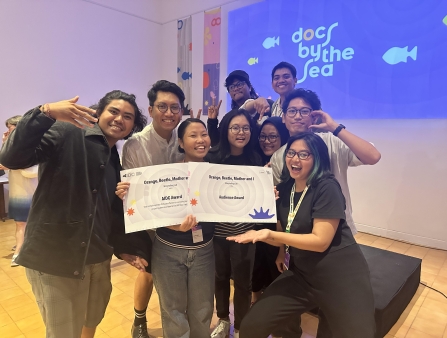
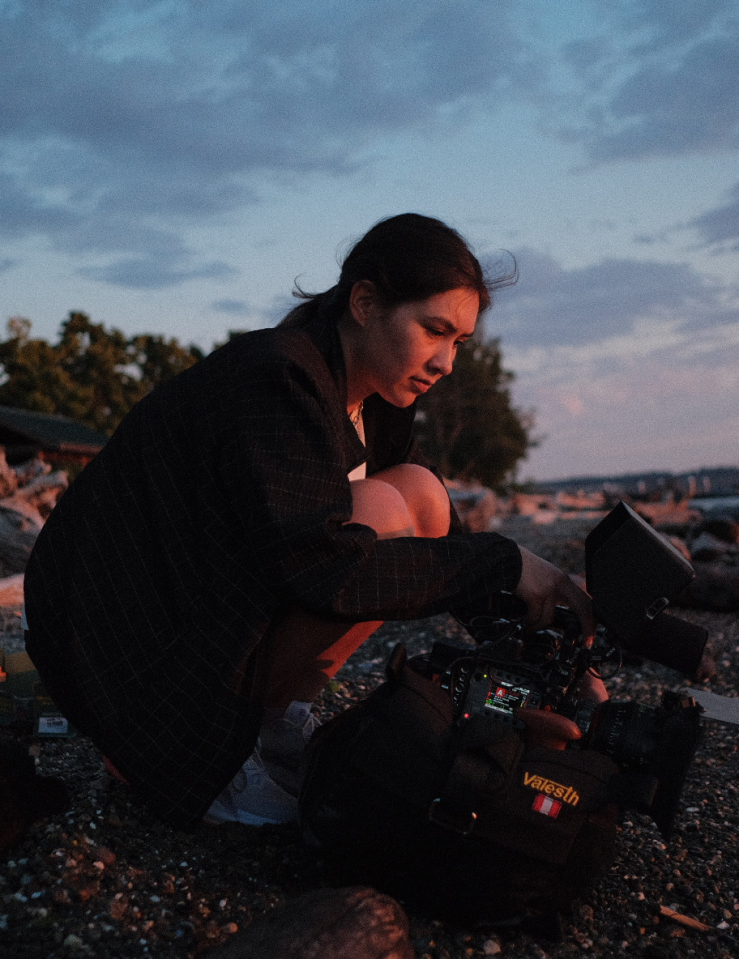
Manisha Halai winning two awards at the Docs by the Sea Pitch Forum.
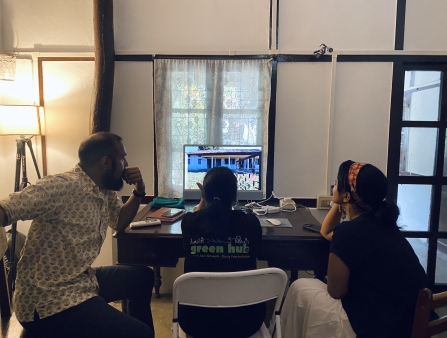
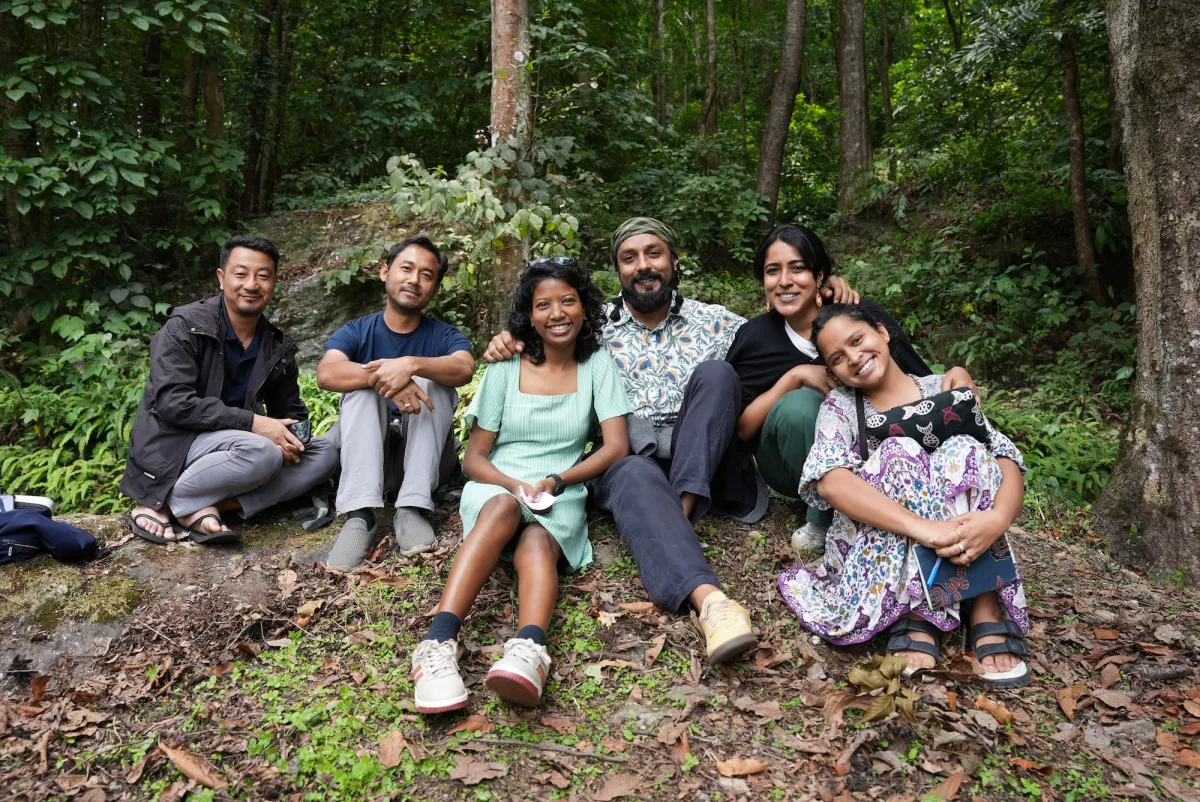
Manisha Halai (C) with Thomas (R) and Ghosh (L) during a lab.
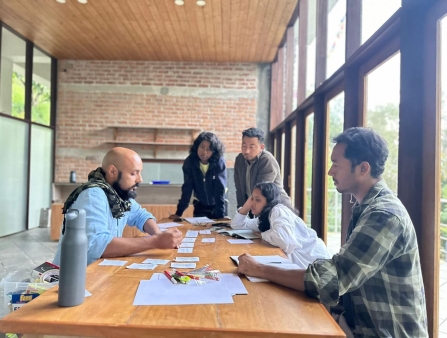
A Cohort II session.
D: By the end of the fellowship, how well are fellows equipped, financially and conceptually?
RT: The Lab stays alongside a project through its undergrowth, from early to late development. It is structured as three labs spread across a year. The Fellowship takes an expansive definition of “emerging,” supporting filmmakers from their mid-20s through their 40s. Filmmakers come with a wide range of stories and narrative styles, from personal docs to experimental narrative essays, all rooted in indigenous knowledge and memory. The early sessions are about turning inward: What’s the story of your life? Why does my heart feel that this is my story to tell? It isn’t about story arcs or timelines. The first lab is really about listening for your voice and the form that feels most honest to your subject.
SG: The second lab is more of an editing retreat. Last year, we held it in a Buddhist monastery, which lent itself beautifully to reflection and focus. We’ve learnt that the second lab is where the most chaos emerges, when filmmakers start playing with uncertainty and the film begins to reveal what it really wants to be. That’s the value of an incubation space: it makes room for vulnerability, for what feels like failure, and for the belief that something truer will emerge.
By the time we reach the third lab, we are all focused on creating a short development trailer and writing about the film. In Labs 2 and 3, we also spend time producing, looking closely at budgeting, contracting, and learning from best practices in the field. We invite peers, fellow practicing filmmakers, and creative producers (Indian and international) to lead masterclasses. It’s about keeping knowledge open and accessible, while also strengthening their imagination to all the aspects of independent filmmaking, and having fun through it all. Joy is the marrow of this fellowship.
The Lab also supports each filmmaker with a grant of INR100,000 (US$1,200), a small but meaningful investment they can use toward travel, research, filming, or sustenance. In the first year, we collaborated with the Dharamshala International Film Festival (DIFF), giving fellows access to its screenings and community. For many, it was their first time being at a major festival space and feeling welcomed there. It was such a meaningful experience that we’ll be continuing our collaboration with DIFF for the second cohort, this November. At this point, the Fellowship feels less like a program and more like a long, iterative conversation.
D: You had a recent success with Manisha Halai. Can you talk about that, and also the financial, infrastructural, and ethical challenges you’ve faced in the first two years?
RT: Manisha has been remarkable in how she’s found her voice. She came in wanting to make a climate change film about the vanishing oranges in her village. She’s from the Miju Mishmi tribe. Through the course of the Lab, she began to see that this wasn’t an issue-based film. It was actually the story of her family: her mother’s story. She delivered a memorable pitch at Docs by the Sea, won two awards there, and has since returned with more opportunities for creative collaborations.
I think the “success” of a fellowship like this needs to be understood for what it is and what it is not. It is validation of what we’re trying to do, yes. But success for this Fellowship cannot be measured in fellowships or forums. It’s also about how success speaks back to the communities the filmmakers belong to. When others from the region see that recognition, they think, If she can do it, maybe I can too. That’s where the real success lies, in what it sets in motion.
SG: We’re working with first-generation, emerging filmmakers, and that comes with its own responsibility. The danger is that the scaffolding you build can also become a cage. The ethical task is to keep asking: Are we simply amplifying their gaze, or also confronting how our presence shapes their creative process? The work is to know when to guide and when to step aside to let the filmmaker discover their own way. What we do insist on is that each lab becomes a collective reflection on what it means to look at your own people and landscape through the prism of cinema.
There’s also the challenge of ambition. For us, the Himalayan Storylab is a ten-year experiment. Fifty filmmakers in ten years, a chorus of Himalayan voices. The danger of ambition is that it can begin to resemble extraction if you’re not careful, if it asks people to move faster than their own rhythm. The real work is to let each of the filmmakers grow like moss, a kind of persistence that holds things together patiently, slowly changing how a region sees itself. That’s what the Lab is really working toward.
The ethical task is to keep asking: Are we simply amplifying their gaze, or also confronting how our presence shapes their creative process?
Sushmit Ghosh
D: The third edition of the Lab is expanding to Nepal and Bhutan.
SG: Yes, we opened the call for applications across the Himalayan region, and honestly, I didn’t expect such an overwhelming response. Nepal has a small filmmaking community, and Bhutan has a handful of documentary filmmakers. The idea is to keep widening the circle because it’s about building a sense of community across borders that share language, landscape, and questions. The Himalayas aren’t a single country; they’re a connected ecology, and the Lab is slowly beginning to reflect that.
D: With this international expansion, it feels more like a deepening than a scaling-up. Would you like to connect to other labs and festivals to help strengthen this ecosystem?
SG: We started in 2023, not knowing what shape it would take. And now, within two years, two more labs have launched: the Kathmandu Doc Lab (Nepal) and Doc Producing South (India) [Ed. note: a previous form of the Kathmandu International Mountain Film Festival’s Doc Lab was first launched in 2014]. Both are created by practicing filmmakers from the region coming together and saying, “Let’s rewire the system.” I see the Himalayan Story Lab, Doc Producing South, Docedge Kolkata, creating more points of access and dialogue in a landscape that long needed them.
RT: Philosophically and politically speaking, in the post-colonial building of power structures, collaboration is everything. We have to be in conversation with each other. And this generation of filmmakers totally gets that.
D: Rintu, in your beautiful essay for Documentary, “The Beautiful Mess of Seeing,” you mentioned that “the spectre of colonialism is never far” when it comes to international financing. How do you resist the impulse of making these stories more “digestible” for Western audiences?
RT: From day one, that’s been the conversation. Even the language we use—words like “fellow” or “mentor”—carries a certain hierarchy. The idea is to take the air out of that right from the start. The first question we ask, of them and of ourselves, is: Why are we here? What has brought us here? It’s certainly not because we’re here to polish a group of “rookie” filmmakers for an international slate. As practicing filmmakers ourselves, our role is to protect their authorship, not reinterpret it. At the same time, understanding the industry is as important as protecting the space where your voice can take shape. This isn’t filmmaking for sale. The Himalayan Storylab is an attempt to reclaim authorship, to say that filmmakers can stay rooted in their own voice and still be part of the global conversation.
D: There is often an expectation with indigenous filmmaking to preserve or fossilize their culture. Is that something you think about when reviewing applications?
SG: That’s a great question. For me, the real provocation is how to build a space that keeps the power to unsettle what we think “documentary” is. What does it mean to arrive with an indigenous voice and lens? Is there over-romanticizing of resilience that needs interrogation? Let me give you an example. Manisha comes from the Miju Mishmi tribe, which has about 80,000 people living between the Indo-China-Myanmar border. The Miju Mishmi language is slowly disappearing. She’s been talking about the significance of the film for her and her community, because it’s going to be in Miju Mishmi. Her younger siblings and nieces don’t speak the language anymore. So, in a way, the film becomes an act of preservation.
But yes, there’s always a danger of exoticizing both the filmmakers and their stories, simply because most of them are tribal, indigenous, living in remote regions. Even when the gaze shifts, the work can still fall into the same traps. The real work is to stay in such contradictions and ask what happens when filmmakers stop performing identity and start shaping their own cinematic language.
Editor’s Note, November 12: Rintu Thomas’s answer about the origins of the Himalayan Story Lab was updated.