

Earlier this fall, the Criterion Collection added Pamfir (2022) by Dmytro Sukholytkyy-Sobchuk to its catalogue, making it the only contemporary Ukrainian title in its archive. A Cannes Directors’ Fortnight premiere, the film unfolds as a gangster-like family drama about a father who turns to smuggling, putting his beloved family at risk. Visually striking and emotionally charged, Pamfir foregrounds the landscape of Western Ukraine, rendered with a deep affection for its folklore and cultural texture—the very fabric from which the director himself emerged.
Although Sukholytkyy-Sobchuk is internationally recognized as a promising fiction filmmaker, his work has always been intertwined with documentary practice—Pamfir, for instance, grew out of his short documentary Red Malanka (2013). His debut feature-length documentary, Silent Flood (2025), serves both as a culmination of his long engagement with Ukraine’s socio-ethnographic landscape and a crucial milestone in his artistic trajectory, as the film had been in development long before he became a filmmaker.
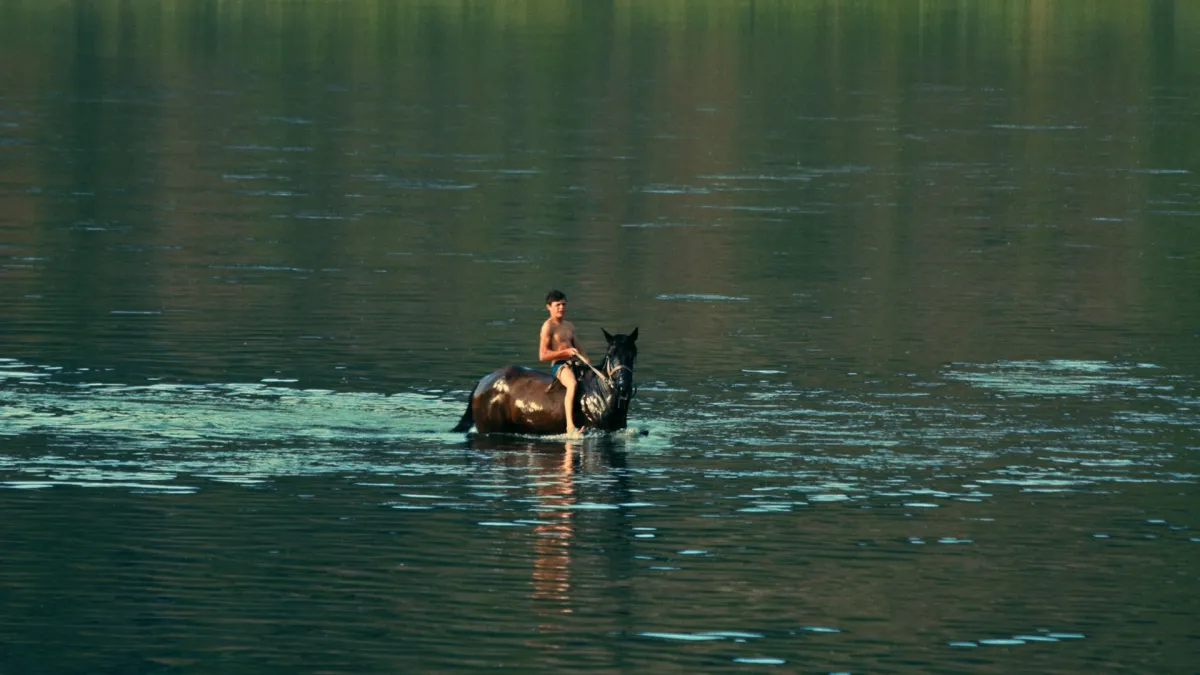
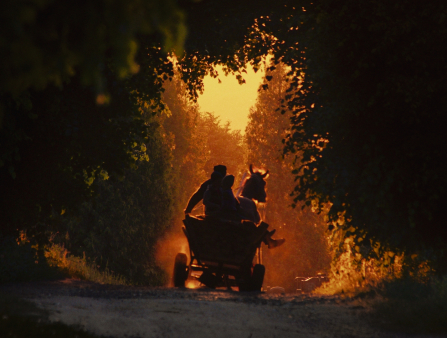
Silent Flood observes a pacifist, traditional religious community that, for decades, remained deliberately isolated from the modern world and its technological advancements. They live by the picturesque Dniester River, whose banks are continually haunted by wars and floods. Sukholytkyy-Sobchuk, who first met the community over two decades ago, approaches them with respectful distance, embracing the charm of their environment by capturing playful children, regional rituals, and the breathtaking landscape they inhabit.
Yet, such idyllic isolation is ruptured by the full-scale invasion, which compels them to break the rules and engage with the outside world. Suddenly, the geography within the film shifts. Sukholytkyy-Sobchuk transports us to the opposite part of Ukraine, carrying the village’s atmosphere of warmth and beauty to a soldier’s Christmas dinner. It’s against this backdrop that Silent Flood captures a discussion about this distinctive community, which eventually deepens into a meditation on the meaning of pacifism itself.
Silent Flood, remarkable for its intimacy and candor, stands as a poetic love letter to Ukraine’s multicultural fabric—one that reveals many forms of resistance as an urgent necessity in defending the beloved home. Documentary spoke to Sukholytkyy-Sobchuk prior to his film’s world premiere in IDFA’s International Competition. This interview has been edited and translated from Ukrainian.
DOCUMENTARY: How did you manage to get so close to such an isolated community?
DMYTRO SUKHOLYTKYY-SOBCHUK: It started a long time ago. My first encounter was back in 2003, when I was into rafting and our coach, Kuzmych, suggested organizing a swim down the Dniester River. At that time, I was the head of my class at the Faculty of Philosophy, and a few of my classmates joined. I took a camera and one roll of film. I remember that route vividly. During the trip, Kuzmych told us about the area, the traces of past wars, and a certain community he referred to as “Old Believers,” saying they lived in isolation and without electricity. That fascinated me, and as we were rafting past their village, I took a photograph. Those landscapes were stunning—it looked like Bosch’s The Garden of Earthly Delights. That moment left a deep impression on me, and I wanted to come back.
A few years later, I suggested organizing that rafting trip again. By then, I was already studying directing at Karpenko-Kary University, so I rented a camera and invited experienced friends to join. The community firmly rejected filming, as we were, after all, just students with rather unconvincing arguments. To be honest, I didn’t have a clear idea of what I wanted to capture or what the concept could be; I had only an impulse to film something. Only the children were open to contact. They expressed this playful curiosity. But as soon as we took out the video camera, they’d scatter. So we set up camp near the village, and one night something very beautiful happened. We were sitting by the fire when a swarm of mayflies gathered around us—white insects drawn to light, and then they committed a kind of collective suicide in our fire. Apparently, we were the only source of light in the area, and we had attracted this procession of thousands of them. I filmed that moment, and it became a part of my student short as a gentle memory through which I fulfilled my urge to capture something in that place, and then I let it go.
D: When did you start this project in earnest and earn their trust?
DSS: In 2020, after Pamfir, I was thinking about what to film next, and my thoughts kept returning to that place, so Tabor Production and I decided to make another attempt. When I went there again, the atmosphere was still rather reserved. Even though I was now far more experienced in such conversations, I realized I still might not get permission to film. The landscapes were as breathtaking as ever. But the story—the protagonist—was still missing. Then the full-scale invasion began. At the very beginning of the war, I was filming The Liturgy of Anti-Tank Obstacles (2023) across different parts of the country. At one point, I decided to visit that community again—to see how they were living through the war. That’s when the first genuine moment of trust happened, because the war had changed everyone. It helped that I showed them a few photos from 2007, pictures of children who, by then, had grown up and had started their own families. Maybe it also worked in my favor that I could occasionally quote the Bible. Finally, my knowledge of theology from a philosophy degree came in handy.
D: As you said, during your earlier attempts, you were struggling to find a clear idea of the film’s protagonist or concept. How did floods and wartime memory eventually become the central themes?
DSS: The initial concept was more focused on the floods, on the relationship between nature and people who remain detached from broader social connections. As we often say, if you’re not interested in politics, politics will eventually take an interest in you. They weren’t concerned with global warming. Yet, it reached them. I recalled my first visit there and the stories I’d heard about how many battles from both World Wars had taken place in that region, and began to notice how often people referred to those wars through the memories of their great-grandparents, how this land had been hell. For them, the passage of time is measured by floods and wars.
Then came the new war—far greater than the floods, though the floods still returned to the village. In that way, the focus on nature became a quiet leitmotif, while the war drew all the attention. Thus, the concept shifted from an ecological story to a wartime one. From then on, we continued documenting everything through that lens.
D: It’s interesting that both the stories of war and of the floods are told only through the off-screen voices of the older generation, while the camera mostly focuses on the children.
DSS: It is simply about generations: an older one that remembers past wars, and the younger one that knows only the current one. It’s also about memory, especially that of the elders, who carry World War I recollections passed down from their parents, and who themselves lived through World War II as children. The children we filmed are their reflection. Fifty years from now, they may become those same voices, retelling the stories once heard at the beginning.
D: I really appreciate how you depicted the beginning of the invasion, on such a sudden and quiet note, steering clear of the clichés of Ukrainian war documentaries. How did you arrive at this approach?
DSS: We need to talk about the war differently. Because the cinematic language through which the world perceives Ukraine, that pulse, needs to be felt in other places, not repeated through the same editing phrases over and over.
There’s also something deeply interesting in how these people actually learned about the war. It wasn’t through the internet, but spread from mouth to mouth. It was something distant and, at the same time, terrifying, the kind of thing our great-grandparents used to warn us about so that there would never again be hunger or war. Yet, it happened. It changed them. They used to remain detached from all social and cultural processes. Now, they’ve become part of it.
D: From the moment the invasion begins, the film ceases to be neutral—just like the community, which starts gathering humanitarian aid that eventually takes us to the front line. Can you tell me about that turning point?
DSS: At some point, we learned that the community collaborates with the local council, sending humanitarian aid to the front lines through volunteers. They contribute supplies, food, and money, but they insist their support only goes toward defensive needs: they’ll donate to a reconnaissance drone, but not an FPV—and that’s a pure act of faith. We wanted to capture one of these moments of aid transfer, which became the motif of bread.
The challenge was that we specifically wanted to film soldiers from the same villages where the community lives, so that when they spoke about “home,” it referred to a very real place we had already filmed, with all its calm, tenderness, and warmth. These men are defending our collective home, and at the same time, simply longing for their genuine home. Volunteers helped us find them. Then we began negotiating with battalion commanders to allow filming near their [combat] positions, finding the right moment and opportunity. It took several attempts to record those conversations. We were, for instance, offered to film artillery fire, because the soldiers felt it was unusual that we wanted to shoot something unrelated to combat.
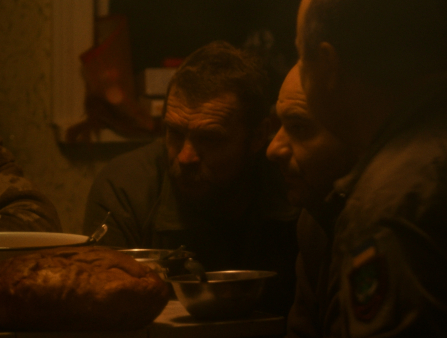
Eventually, we recorded the conversation on Christmas, full of emotional memories of home and peace. Even though they had just returned from their positions, especially the medics who shared unspeakable horrors, there was still a sense of warmth among them. One of them, Andrii Porubii, is a military medic with extensive field experience who has saved many lives. He had also worked as a doctor in that same village for a long time. In that scene, it’s he who tells the soldiers about this community. His reflections are very clear and simple. They reveal the essence of what this community gives to others.
D: It’s a tense and super intimate scene, as the soldiers eventually reflect on pacifism through Andrii’s stories about the community. Given today’s context, I imagine that the word “pacifism” in the film’s synopsis will immediately draw attention as something anti-militaristic. However, in your film, the reflections on pacifism emerge within the military context, taking on a distinct meaning. Can you reflect on that?
DSS: The word “pacifist” has a constant quality to it when it comes to this community: they were pacifists even before the full-scale war. Take this village, that isn’t made up solely of members of that faith. Some are simply Christians, and others don’t belong to any religion. But they are all citizens of Ukraine, regardless of whether they are serving in the army or not. That’s why the film contains these two perspectives, two opposing views that exist within our society. These are our shared challenges, and this community learns to coexist with them, finding its own balance.
You know, Professor [Robert] Sapolsky once gave a lecture about shrews, hardworking creatures that constantly dig tunnels. In their colony, everyone works, except for one individual, who is still fed by the rest. Scientists couldn’t understand why that shrew had no hierarchical role. But then its role becomes crucial: during a flood, the colony places that one shrew at the tunnel’s entrance, and it blocks the passage to prevent the entire labyrinth from flooding. In other words, everyone has their role and significance. Even the simplest organisms have come to understand that we are all necessary; it’s just that at certain moments, some appear to be needed more than others.