
Tamara Kotevska grew up and fell in love with the Macedonian story of Silyan. The local fairytale tells of an angered farmer that curses his son for wanting to travel abroad. Transformed into a white stork, Silyan is condemned to a state of permanent inbetweenness: unable to fully integrate in the animal kingdom, while eternally banished from human society.
This sublimation of the human condition on the realm of animals has become an organizing principle in Kotevska’s most celebrated documentary work. Her feature debut Honeyland (2019, co-dir. Ljubomir Stefanov) uses the inner workings of a bee community as a metaphor to depict how a Macedonian beekeeper’s traditional livelihood is imperilled by the ills of modern society. Deftly borrowing stylistic flourishes from fictional films, Honeyland is imbued with strikingly rich cinematography, particularly in the ways the splendid hues of gold tickle the senses.
The audience-friendly narrative metaphor and gorgeous imagery surely helped Honeyland to secure two Oscar nominations, alongside numerous festival accolades.
With The Tale of Silyan, Kotevska uses the eponymous fairytale as an effective metaphor for the startling ecological and economic conditions that plague North Macedonia. What was once a fertile country with a robust agricultural sector currently has a decimated economy. Instead of the bountiful harvests from crop-rich farms, the country is now littered with quickly proliferating landfills, where unsold produce rots amongst heaping piles of trash. Unexpectedly, these are now the dire places where flocks of great white storks scour for their food, which Kotevska initially set out to capture.
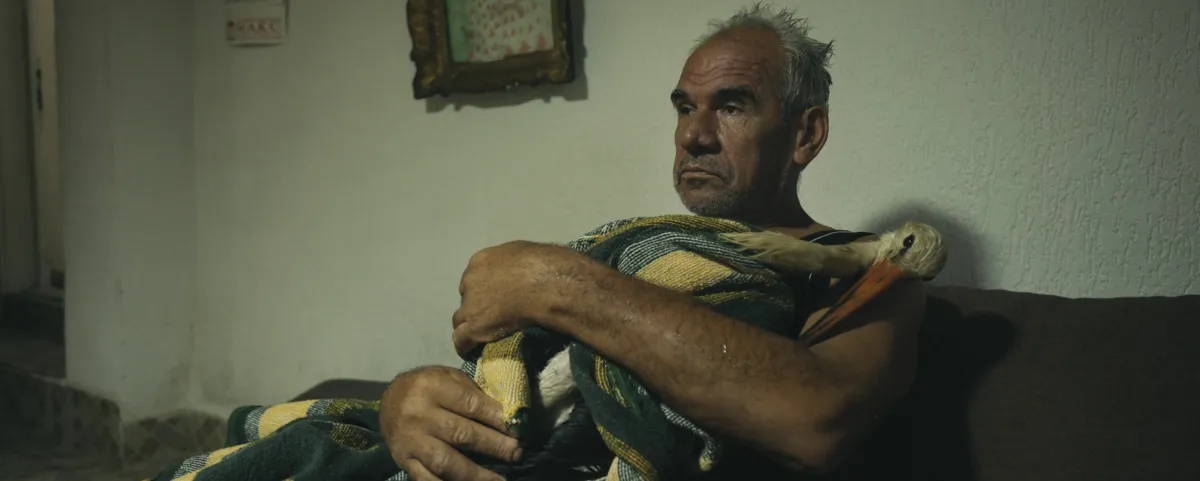
Once there, she witnessed Nikola, a stocky farmer who is forced by the economic downturn to work as a landfill attendant, rescue a wounded stork, bring it to his home, and nurse it back to health. The unlikely bond between human and avian mirrors Silyan’s fable in productive ways, allowing Kotevska to once again craft a fairytale-like narrative out of her documentary footage. The sense of witnessing a fictionalized fairytale on screen is supported by Nikola’s voiceover narration recounting Silyan’s tale, over snappily edited expressive imagery of storks captured against the luminous backdrop of a full moon.
Gradually, this stylistically embellished narration makes way for an urgent portrait of a desperate farmer, who channels his mounting frustrations into the care of a bird. This delicate friendship offers a shimmer of hope to what is otherwise a grim story of economic and ecological collapse, which earned The Tale of Silyan nominations for Best Cinematography and Best Feature Documentary at the 2025 IDA Awards. Documentary spoke to Kotevska after The Tale of Silyan’s world premiere at Venice. This interview has been edited.
DOCUMENTARY: The Tale of Silyan incorporates a Macedonian fairytale within a documentary framework. Did this synthesis between fable and nonfiction arise organically during shooting?
TAMARA KOTEVSKA: Silyan’s tale existed for a long time in Macedonia and was my favorite childhood tale. However, I didn’t immediately think of this fable when we set out to make the film. Initially, we were simply following the white storks, as we were interested in how the birds were eating from landfills and chose to not migrate. About that point, I spent another six months brainstorming how to put the story together. That’s when we found Nikola working at one of the landfills. After we witnessed how he took one of the storks home, we realized we hit a deeper nerve. The idea of incorporating Silyan’s fable within the narrative immediately started to flesh out, as the locals started making fun of him, saying that this duo resembled the story of Silyan.
I’ve always been interested in stories that show human psychology through animalistic metaphors. Undoubtedly, my familiarity with Silyan’s story since childhood has informed that interest, as it’s part of my subconscious. After that, you observe animals in a different manner. I’m using that same kind of symbolism in all of my films, so I guess it’s some kind of childhood inspiration that kept growing into my form of cinematic expression. For instance, the narrative of Honeyland is entirely based around the psychology of bees, with protagonist Hatidže as the human equivalent of a working bee. She is tasked with bringing food to her mother, who doubles in this story as the queen bee. I just love to remind people that we cannot run away or outsmart our animalistic nature.
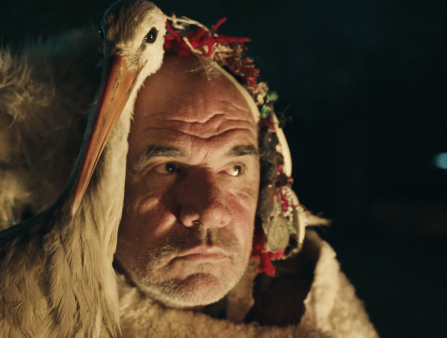
Nikola and Silyan by the fire as Nikola and his friends perform a traditional Macedonian ritual.
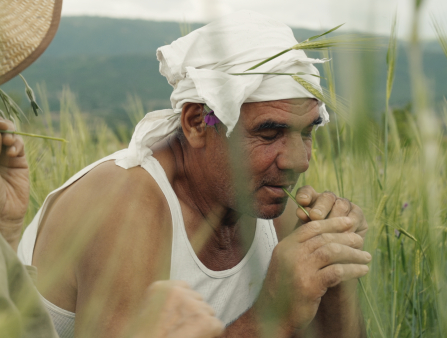
Nikola and Jana sitting in a wheat field discussing their life and love.
D: It allows for a more embellished approach to documentary filmmaking, as the fairytale provides a more fantastical contrast to the stark realism. How did you strike this balance?
TK: Just as with Honeyland and The Walk, I love breaking the known forms of documentary storytelling. I co-directed Honeyland with Ljubomir Stefanov and we came from quite different backgrounds and generations. The initial idea of Honeyland was to do it with talking heads, but I insisted on making it into something else, to try to immerse it into more of a feature-like structure. Hailing from a generation that’s more familiar with social media, I saw how my peers were losing interest in the standard forms of filmmaking and the type of documentaries we’re all too familiar with, like films that rely heavily on talking head interviews. Films like Exit Through the Gift Shop (2010) and the works of Werner Herzog helped me to reimagine what documentaries can even be.
D: Considering you found such proximity to both the humans and birds, it raises the question of how you approached the filming itself. How did you establish that level of emotional closeness to all of your characters?
TK: We spent about two years shooting this film, always with the aim to be as close to our subjects—both emotionally and physically—as possible. In terms of cinematography, we opted for a wider lens and to film up close, creating the kind of intimacy that was integral for the visual language of the film. In documentaries, this is not an easy feat; it requires a deep trust between filmmakers and their subjects. In that sense, filming the storks has been particularly challenging, as you can't negotiate with wild animals. You simply need to be patient and wait for them to stop perceiving you as a threat. To establish that trust with the storks, we worked closely with the environmental organization of Macedonia, who we simply called “the stork people.” They gave us a map of nests in the country and taught us how we could approach the birds properly. Storks are known to return to the same nest every subsequent year, which worked greatly to our advantage. We also came back to the same nests on a yearly basis and formed a level of familiarity with the returning storks.
D: Did you notice this in how they got used to your cameras?
TK: We literally witnessed the birth of a new generation of storks that grew up besides us and our camera equipment, including a lot of drones. Drones in themselves are quite intrusive pieces of equipment, since they fly in such unnatural ways and generate a lot of noise. Fortunately, this younger generation of storks was completely familiar with the drone and accepted it as part of their lives. It resulted in uniquely intimate footage of storks, in which they weren’t distracted at all by us filming them.
D: You could say that this familiarity of the birds with your presence is also reflected in the level of domesticity Nikola achieves with Silyan. What was it like to witness this gradual bonding between animal and human?
TK: After we saw how Nikola rescued one of the wounded birds, he told us that he had already captured a hurt stork once before. Now, he did it in front of our camera, and from that moment onwards, we managed to capture their developing bond. With the help of Nikola, Silyan not only becomes domesticated—it also seems like he becomes more human. At the beginning you see a lost animal at the vet, while at the end of the film, you can look into Silyan’s expressive eyes and think “Oh, that’s his son for sure!” We achieved this character development in tandem with Nikola. The closer Nikola was able to get to the bird, the more access we were allowed to Silyan with our cameras.
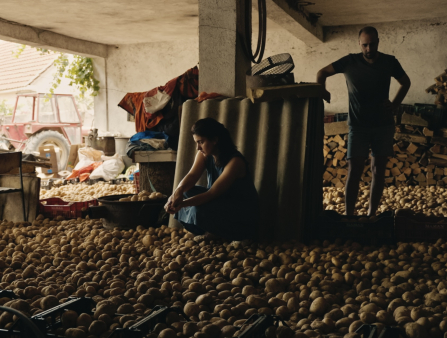
Jana, Ana, and Ana's husband standing on the hundreds of potatoes they weren't able to sell at the market.
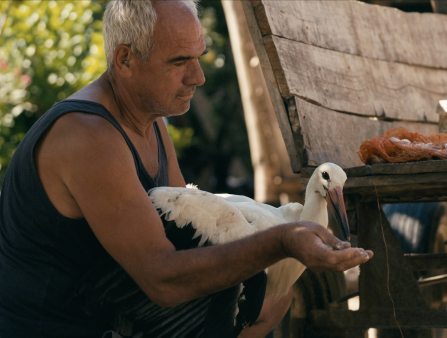
Nikola feeds Silyan fish in his palm as he tries to nurse him back to health.
D: While you’re taking a distant, observational approach to filming, your intervention rather comes at the stage of editing—for example, you often employ jump cuts.
TK: Even though it’s an observational documentary, Honeyland is also quite fast-paced. I guess I cut like that, because I don’t like to waste the audience’s time. While shooting, I opt for a more traditional manner of pure observation; accumulating as much material as I can, which can support the dramaturgy of the story. In terms of structure, I knew I wanted to expand on my approach for Honeyland with a clear-cut three-act structure. That’s something I use in all of my films. When we set out to do the film, we don’t even know what those three acts are going to become, but we develop it along the way over the course of shooting.
D: Did this more audience-friendly approach also inform the decision to end the somewhat bleak story on a relatively hopeful note?
TK: As an author, I feel somewhat obliged to make films that somehow provoke a wave of positive change. What am I contributing as a filmmaker, when I’m only criticizing and don’t offer any hope? If we want to establish change, we need to hand the audience tools through which they can make better choices. For instance, I want to raise awareness about the value of returning to the countryside and living from the land—picking up on a tradition we carry with us through our ancestors. It was my intention to instill this feeling of beauty in the audience, to cherish this connection with nature.
D: Since you based The Tale of Silyan on canonical Macedonian folklore, and your film deals with the myriad economic, political, and ecological problems that Macedonia is currently facing, it feels like you carry the burden of cinematically representing your country. How do you deal with that responsibility as a filmmaker?
TK: I still feel obliged to speak about Macedonia as an author. Although I do shoot abroad and work on other types of films, I think I will be on this mission forever. I believe the wounded countries generate the most relevant art, because they really have something to speak about. Art heals them and, in that sense, I’ll always carry the responsibility to bring some kind of cure to my country. I understand Macedonia from the heart, meaning I can speak the loudest about it.