

Making a Production is Documentary’s strand of in-depth profiles featuring production companies that make critically-acclaimed nonfiction film and media in innovative ways. These pieces probe the creative decisions, financial structures, and talent development that sustain their work—revealing both infrastructural challenges and industry opportunities that exist for documentarians.
In Los Angeles, where most post houses cater to television, commercials, or studio features, and where the postproduction process is most often divided among multiple different specialty houses, Sugar Studios has carved out an unusual niche: supporting the middle class of independent cinema—feature films too polished to be called low-budget, yet too lean to carry studio resources, and therefore more likely to find a home on streaming platforms than in wide theatrical release.
Sugar’s welcoming, collaborative spirit has made it a destination for filmmakers navigating the precarious final stretch of production, where independent documentaries often falter. In a time when, as founder Jijo Reed puts it, “the rise of streaming platforms like Netflix, Hulu, and Apple TV has created an insatiable demand for independent films,” Sugar centralizes the different aspects of postproduction, which in Los Angeles are often a patchwork—color in one facility, sound in another, effects somewhere else—allowing projects to get across the finish line more easily. “That surge lined up perfectly with our business model,” continues Reed. “We’ve been fortunate to stay busy, even through the pandemic.”
Paul Buhl, Sugar’s head editor, explains the business proposition: “When you get to post, you’ve got a million, two million on the line. If that post process doesn’t come together, it’s very stressful … Sugar created a full-service, full atmosphere, where people immediately feel taken care of.”
True to Buhl’s pitch, Sugar’s bread-and-butter work comes from experienced directors and producers looking for a reliable home for their films, though on occasion, Reed will give a young filmmaker storage space and an edit bay for free. Narrative projects keep the lights on (Sugar’s slate is about 70% fiction, 30% doc), while documentary clients often negotiate discounts, trade executive producer credits, or rely on Reed’s willingness to make a deal if he likes the project.
While Sugar occasionally hosts full editorial projects, most of its work is concentrated on finishing, including color correction, sound mixing, visual effects, graphics, and deliverables. Directors typically bring their own editors, with Sugar stepping in to unify and polish the final stages. Though editors like Paul Buhl and Nico Alba give the studio a strong creative presence, the majority of Sugar’s staff is similarly devoted to finishing, ensuring projects can be completed to industry standards without ballooning costs.
To this end, Sugar tries to split the difference between investing in projects they believe in and turning a profit, a challenging task given the current economic outlook of the film industry. Buhl explains that Sugar has to be careful not to lose money on projects, and in this sense, they don’t consider themselves investors. But projects like Blink of an Eye (2019) were finished for around the mid-five figures, an amount Buhl described as “dirt cheap” for full edit, color, graphics, and audio. That level of flexibility means Sugar often entertains filmmakers who would otherwise be turned away by Company 3 or Formosa, two of the big post houses in Los Angeles, where even an “indie package” can run well into six figures.
Whereas scripted indies tend to arrive with standardized workflows, documentaries are less predictable and often more fragile. At Sugar, most documentary budgets fall between US$500,000 and $2 million—figures that require professional post but rarely cover the extended timelines documentaries demand. This budget window defines Sugar’s niche: big enough to need polish, but small enough to require flexibility.
Working on documentaries is important to Reed, despite their greater financial pressures. “With documentaries, the amount of commitment that’s required, and the passion that is necessary, is rooted in the fact that it’s a story we feel should be told,” he says. “When we’re able to contribute to the telling of a story, that is so much more gratifying to us.” The hearty business from the Sugar’s fiction operation gives them the flexibility to take on nonfiction projects that larger post houses might turn away.
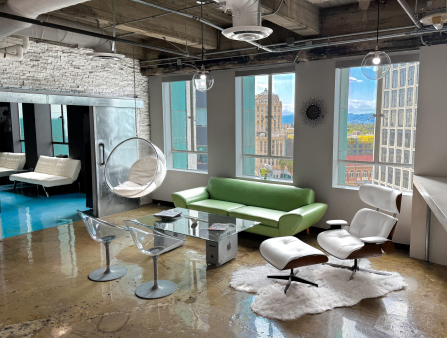
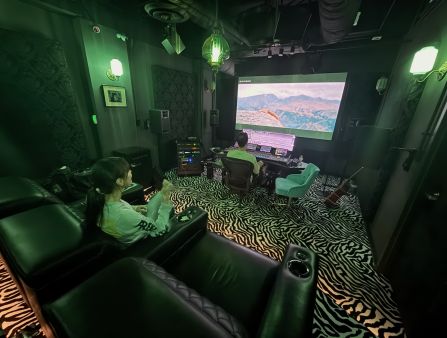
Sugar Studios’ ninth-floor lounge.
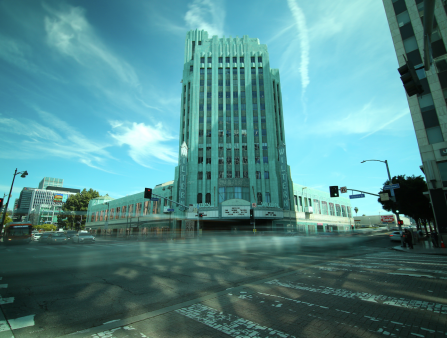
The Wiltern Tower.
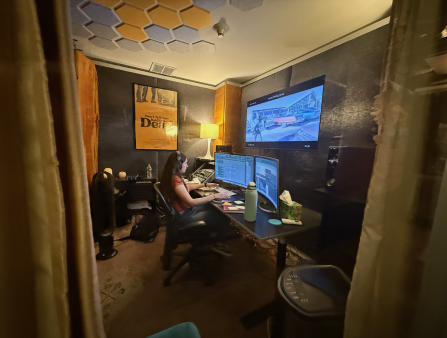
ADR supervisor Erica Smith.
Starting Small, Staying Smart
Jijo Reed’s trajectory began far from Sugar’s boutique office on Wilshire Boulevard. An L.A. native, he comes from a Hollywood family. His grandfather, Alan Reed Sr., was an actor and the voice of Fred Flintstone, and his uncle, Hermes Pan, was Fred Astaire’s choreographer. Reed is the youngest of six siblings, all of whom live in L.A. and work in the arts. One brother, Chuck, worked at Interscope Records for 30 years. Another brother, Jimmy, is a musician, and Jijo’s twin sister is a chef. He cites them as integral to getting his business off the ground, thanks to their connections to the music and art world.
Reed spent years cutting trailers, commercial spots, and sizzle reels—work that taught him both the technical precision and the marketing instincts of postproduction. Gradually, he began to take on independent features, building a reputation for steady and collaborative support. “It’s been 30 years of laying bricks,” Reed says. “I didn’t take shortcuts. One project at a time, one client at a time.” His decision to have Sugar focus entirely on feature films, eschewing shorts, branded content, or episodic TV, was as much philosophical as logistical. “A feature, whether fiction or documentary, is a complete thought,” he says. “That’s what I want to help bring into the world.”
Paul Buhl expands on the way Sugar has built its model over the years since its inception in 2012: “There were four or five years of real struggle for Jijo—sleepless nights, worrying about where he was going to get the money in two days to make payroll—but business kept coming in.”
Reed describes the model and format of his company as something that had to be built “brick by brick.” He started out small, investing profits from early projects back into equipment and wages. “We don’t have the debt that other companies of our size have because we built slowly and smartly. We didn’t expand too quickly. We stayed ahead of technology while being very smart and not wasting money on things that don’t directly benefit the projects and artists.”
‘A feature, whether fiction or documentary, is a complete thought,’ founder Jijo Reed says. ‘That’s what I want to help bring into the world.’
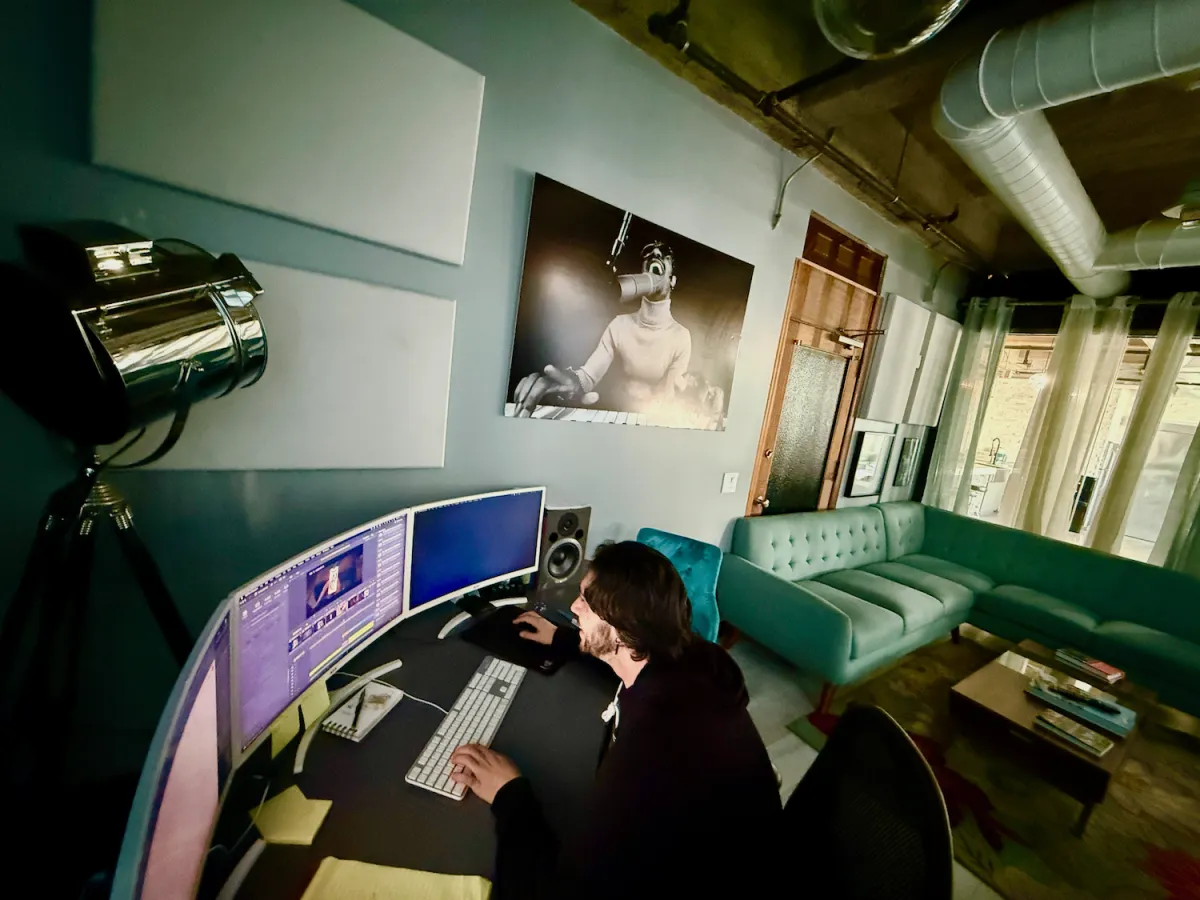
Reed also says that they got lucky with the timing when it came to securing their opulent penthouse location in the Wiltern Tower in Los Angeles’s Koreatown, getting into business with the landlords back when the neighborhood was much cheaper, and having a long-term lease that further helped keep overhead low. The resulting studios resemble a boutique creative space rather than a postproduction facility. Spread across three floors, its professional atmosphere is leavened by an art-deco playfulness: pale blue walls and mid-century modern decor give way to edit suites decorated with zebra rugs and splashes of hot pink. In the penthouse, a patio opens to look out over the city. On a clear day, you can see the Hollywood sign over the haze.
Sugar’s recent documentary slate is impressively varied. Eddie Huang’s Vice Is Broke (2024) is a playful, unconventional retelling of the many twists and turns of Vice Media, narrated and emceed by the director. The film includes talking-head interviews but also uses archival footage, music, and re-creations in the style of performance art–type skits. As is often the case, Sugar helped do finishing work on the film, even offering their facilities for some last-minute interviews and ADR, but wasn’t involved in the editing.
Conversely, The Life and Death of Westerly Windina (2024) was a passion project nurtured within Sugar, with Buhl serving as one of its primary creative voices. It traces the journey of Westerly Windina, a transgender Australian surfing icon from the ’70s. Directed by Alan White and Jamie Brisick, the film was sparked by Brisick’s long-form profile of Windina in Huck. Though Buhl isn’t a full-time staff member, his deep involvement with the studio and his freelance status (maintained in part through his guild membership) enable him to both anchor Sugar’s editorial presence and continue cutting projects beyond the company.
One defining feature of Sugar’s nonfiction slate is that it includes a lot of music documentaries. If These Walls Could Rock (dirs. Tyler Measom and Craig A. Williams, 2025) is a celebratory ode to the Sunset Marquis Hotel, weaving together stories of the 60-year span when it was a secret haven for beloved rock stars. Interviews with figures like Ozzy Osbourne and Billy Bob Thornton are enlivened by bursts of animation, which inject color, humor, and a sense of playful irreverence into the otherwise classic talking-head form. Other music documentaries that have passed through Sugar’s suites include I Was a Teenage Sex Pistol (2025), Machine Gun Kelly’s Life in Pink (2022), and KISS 2020 Goodbye (2020).
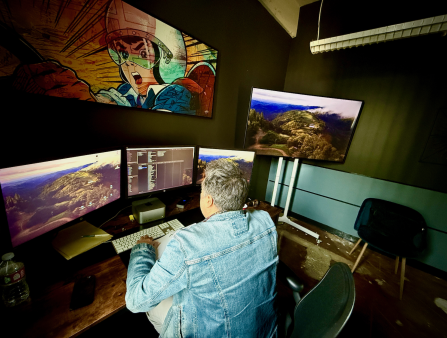
Editor Nico Alba.
Sugar COO Nicole Wainstein (L) and mixer Troy Ambroff (R).
Making It Run
Sugar faces the same challenges as the industry at large. Budgets for independent documentaries remain tight, even as technical expectations climb. Archival costs have risen sharply; festival selections are more competitive than ever. Meanwhile, the line between theatrical and streaming has blurred, leaving filmmakers uncertain where their projects will ultimately land. That’s what makes it worth looking closer at how Sugar operates day-to-day, and how its setup directly addresses the new realities of independent filmmaking.
First, the studio’s physical structure mirrors its philosophy of cohesion. Every edit suite connects to a 2,500-terabyte central server, enabling staff and clients to access live working files from anywhere in the building. The effect is less about flash than about reliability: no lost drives, no endless versioning across platforms.
The staff is intentionally small, but growing steadily. A full-time staff of about 20, including colorists, sound engineers, and finishing producers, is supplemented by a circle of “permalancers” such as Buhl. Two years ago, Sugar opened a UK office, led by Nick Dixon, which services European clients as well as American ones and specializes in sound design and mixing. The environment also reflects Reed’s belief in keeping creative energy in-house. During the pandemic, when remote workflows became standard across the industry, he quickly adapted but insisted on returning to an in-person model as soon as it was safe. “The shorthand you get when you’re in the same room—you can’t replace that,” he says.
The in-person work also affords other advantages. Clement Mattox, one of Sugar’s lead sound mixers, points to their work on Vice Is Broke as an example of how the workers adapt to each filmmaker’s sensibility. “One of the first things I did was record Eddie Huang’s voiceovers,” he recalls. “He wanted it raw—one or two takes on every line, no overthinking, no polish.” When they needed some extra interview material, they filmed it in Sugar’s penthouse. The final mix was done in a single week, an unusually fast turnaround for a feature, but it matched Huang’s desire to recapture the unfiltered, DIY energy of early-2000s Vice while reframing it for 2024. For Mattox, the experience underscored Sugar’s dexterity: the studio can lean into a quick, stripped-down workflow.
We try to be the steady part of the process. There’s always a crisis. Our job is to solve it without letting it derail the film.
— Sugar’s head editor, Paul Buhl
To mitigate these creative difficulties, Sugar insists that if they are to take on a documentary feature, directors bring in story editors early, sometimes before post officially begins, to clarify the spine of the film. That patience extends to the post process itself. Buhl describes weeks spent balancing archival gaps, music clearance issues, and festival timelines—all while keeping filmmakers calm. “We try to be the steady part of the process,” he says. “There’s always a crisis. Our job is to solve it without letting it derail the film.”
Much of the studio’s dexterity comes from its daily rhythm. Sitting in on one staff Zoom call, the team bounced between UK-based sound supervisors, L.A. mixers, and dialogue editors—clearing archival audio for If These Walls Could Rock, scheduling ADR sessions for Stranglehold, and debating how best to fold a director’s homemade sound design into Coyote. The mood was light, full of inside jokes and medieval quips about “squires,” but the work was serious: weighing legal restrictions, triaging halved schedules, and juggling the demands of multiple directors at once. What might feel chaotic in another setting read here as practiced coordination.
There’s a spirit of camaraderie and eagerness to keep sharpening the work. UK head Dixon notes that one of his team members, who is about to turn 24, will have nearly as many films under her belt as years in her life. Several members of the staff have been brought through from a junior level and are still part of the team. Says Dixon about the company culture, “We’re not a family—everyone comes to work to get paid—but we do create an atmosphere of respect, flexibility, and companionship.”
Even more unusually, “We don’t want people working ridiculous hours. That was one of our objectives from the start—scaling in volume while taking pressure off staff.” Sugar’s workplace model stands out. Jijo stresses that the company offers what most postproduction freelancers can only dream of: regular 9-to-5 hours and vacation time. In a creative field defined by gig work, it feels almost utopian.
Sugar’s pivots across genres and continents aren’t improvisations so much as the product of a cultivated flexibility—an infrastructure and culture built to absorb complexity without losing momentum.
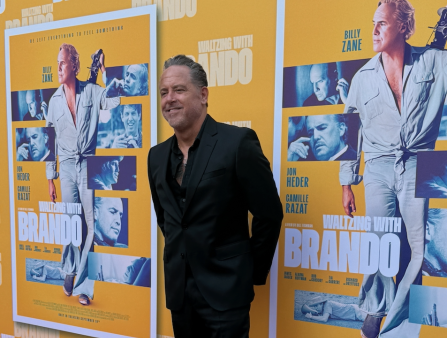
Founder Jijo Reed.
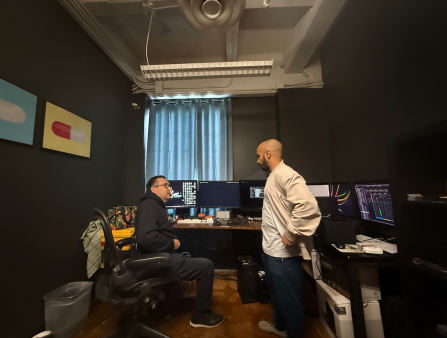
Senior post producer Jacobo Vizcarra (L) with Nassim El Bouhtouri (R).
The Balance to Strike
Over the years, Sugar has worked on a wide range of projects, from music documentaries to sports biographies, vérité investigations, and hybrid experiments. Some projects arrive polished; others are sprawling and chaotic. Reed recalls a film where a tattoo glimpsed on-screen triggered a legal clearance issue—a reminder of how small details can become major obstacles. In another case, the team shepherded a large-scale music documentary through complex licensing negotiations.
“We’ve seen it all,” Reed says. “The ones that succeed are the ones where there’s trust—where the filmmaker lets us be part of the process instead of just a vendor.” The staff members are there to protect a filmmaker’s vision rather than impose their own.
Sugar Studios complicates easy binaries about access. On the one hand, they have built a business model that genuinely expands the options available to independent filmmakers with lower costs compared to the big post houses, sometimes floating edit bays or credits in exchange for creative partnership, and cultivating a collaborative culture that makes post feel less transactional, more flexible, with more camaraderie. On the other hand, their floor remains relatively high—filmmakers still need substantial resources to bring projects through Sugar’s doors, and the projects that benefit most are often the ones with commercial hooks: biographical portraits, true-crime stories, or music docs that can travel across streamers.
For Sugar, the goal is less about expansion than about deepening its niche. “We’re not trying to be everything,” Reed says. “We’re striving to be the right partner for a certain kind of filmmaker.”
Sugar thrives because it can balance supporting scrappy, serious filmmakers on the edge of viability while also capitalizing on the kinds of documentaries that fit neatly into the current distribution economy. That duality—hopeful yet selective—is the space where Sugar operates, and where the future of feature documentaries may well be decided.
This piece was first published in Documentary’s Winter 2026 issue.