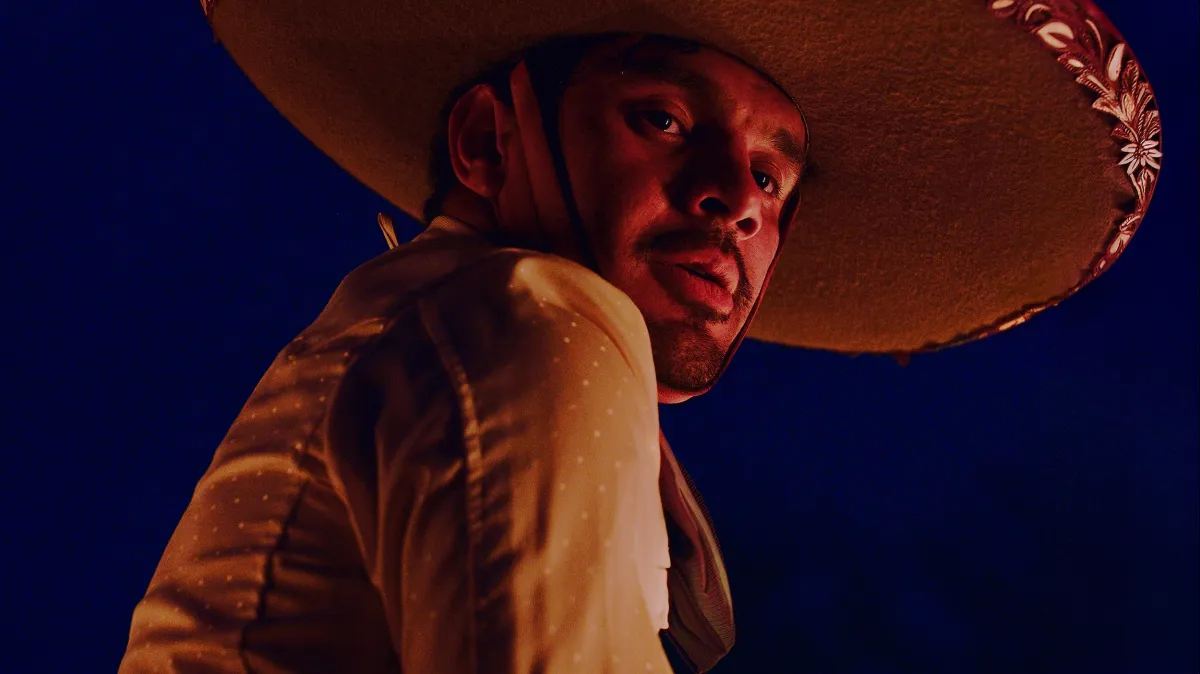


Efraín Mojica and Rebecca Zweig’s Jaripeo opens with scenes of a figure in a cowboy hat surveying a local Mexican rodeo in Penjamillo as they discuss their first memories of attending these kinds of jaripeos. Throughout, we watch them capture scenes of men and horses around them with a Super 8 camera. Immediately, we’re inside and outside the frame, called to dream up those memories of a young kid dazzled by rodeos and men in Wranglers, and attending to what they're witnessing, instead, here in the present.
The figure is Mojica, and soon enough, what they’re shooting takes over the screen. Grainy footage not only shows us men riding bulls but offers us close-ups of hats and belts; of beards and boots. They guide us to look at hands on hips, and notice glances and smiles askew. A conceptual artist who was born in Michoacán, Mojica’s words and images structure a stylized hybrid doc most interested in exploring the friction between masculinity and queerness in this Mexican tradition.
Through Mojica, we meet two other protagonists: Noé, a muscled, butch, bearded cowboy who finds masculinity utterly beguiling, and Joseph, a make-up-wearing stylist who wears his flamboyance like a badge of pride. Mixing vérité footage at these jaripeos, candid talks with its subjects, and a series of poetic interludes that double as heady art installations about bull-riders, Jaripeo is a fruitful collaboration between Mojica (an artist) and Zweig (a poet).
Ahead of the premiere of Jaripeo in the NEXT section at Sundance, Documentary caught up with the pair of friends and collaborators to discuss the allure of these Mexican rodeos, how they found the doc’s shape in the edit, and how their disparate backgrounds inform the process of making this documentary. This interview has been edited.
DOCUMENTARY: Rebecca, I read that this project began with written stories of your experiences visiting Penjamillo with Efraín. What did those look like, and how did they evolve into Jaripeo?
REBECCA ZWEIG: I spent my 20s as a poet and a teacher, and I was moonlighting as a journalist; Efraín and I have been friends for over a decade. They invited me to Penjamillo in 2018, and I was just really struck by the place and by this specific sort of masculine performance that seemed to be happening there. What was interesting to me was how this idea of a man, or a Mexican cowboy, was amplified for the diaspora community. It was like a lesson on a specific type of masculinity. But then, when you talk to people, everyone is far more interesting and complex than that archetype. I spent many years talking to people and writing down stories. I didn’t quite know where it was all going. I thought maybe it might be a magazine piece.
And then when I was talking to Sarah [Strunin], our producer, who’s also an old friend of mine—we actually all met in Seattle as baby punks—she was just like, “This sounds extremely cinematic. Have you ever thought of it as a documentary?” And I said, “No, but we can think about it as a documentary.” And very soon after that, because Efraín is such an amazing visual artist, it was clear it was a collaboration. When I started, I said I was really interested in this rodeo and these themes of masculinity. And Efraín said, “Oh, I really want to tell queer stories.” And that was the point where everything came together.
D: In that moment when you start thinking about queerness framing this story, and it begins to be filtered through these very stylized pieces, and you start structuring it as a documentary, how does that also evolve into you, Efraín, serving as our guide to what is a rather personal piece about your own approach to gender and sexuality?
EFRAÍN MOJICA: It took some time for me to realize what was actually going on. Because I knew these queer characters just from growing up in this town. And so I know all of these stories—meeting up in the corn fields, escaping from your parents’ house. My original idea was to portray them through these characters; just have them tell their stories. But it’s quite a sensitive topic, because a lot of these men are not openly gay. Or, don’t even identify as a gay man—even though they’re getting married to a man. So it was about sharing vulnerability with them, not just to extract their information or expose them, but to have a conversation and put some of my personal life in front of them so they would feel comfortable sharing. All of the voiceover of the film is a conversation that Rebecca and I had throughout the four years that we filmed. It really was in the editing room that we decided on my presence as a guide.
It was about sharing vulnerability with them, not just to extract their information or expose them, but to have a conversation and put some of my personal life in front of them so they would feel comfortable sharing.
— Efraín Mojica
D: Speaking practically, does that mean there were interviews with Noé and Joseph where you weren’t going to be in the frame, where you would have been edited out?
RZ: This film was conceived extremely organically, very step by step. We never wanted to do straight-on interviews. We wanted to do more observational vérité. But it seemed like they opened up so much more when they were speaking with Efraín, so showing that relationship on screen was extremely important.
EM: It was so much easier to have a casual hangout with them as opposed to showing up with a camera and being like, “Okay. Tell me why you are gay,” you know?
D: The film is punctuated by these dreamy interludes; we see Noé in the corn fields illuminated by a bright red light; we see dreamy shots of a quinceañera party featuring Joseph; and even a smoke-filled light show of a man riding a mechanical bull in the middle of a field. How did you conceive of these scenes?
EM: A lot of them are memories. They just came to my head. I’m a conceptual, experimental artist. It’s just the way I think and visualize stuff. For me, it was a more interesting way to portray these anecdotes. Because it’s a collective queer subconscious; everyone in the same situation has these same anecdotes. We worked with our protagonists to find these scenes.
RZ: The scene in the milpa, in the cornfield, with Efraín and Noé, was the first of the abstracted scenes we filmed. And that was very much Efraín having this drive, I need to film this scene in the cornfield. It was just so important for them. From there, the abstracted scenes became, What else can we explore like this?
EM: And with Joseph, he actually had this quinceañera party. And their friends call it a stepping stone for the queer community in town. Before, everyone was closeted. And once this quinceañera happened, Joseph started wearing makeup and skirts out in the street. He broke this stigma, and others followed through.
This film was conceived extremely organically, very step by step. We never wanted to do straight-on interviews. We wanted to do more observational vérité. But it seemed like they opened up so much more when they were speaking with Efraín, so showing that relationship on screen was extremely important.
— Rebecca Zweig
D: Speaking to that collaborative spirit, I wondered about finding and winnowing down your protagonists to Joseph and Noé.
EM: It was all just very organic. I met Noé shortly after we started talking about making the film. We became close friends from the beginning. He’s just this bodybuilder, a very, very Instagrammable person. So when I asked him if he wanted to be in the documentary, he’s like, “Of course. Make me famous.” Joseph, we approached. You see him from two miles away, because he’s always covered in bling bling. But he’s such a busy person. He’s the president of the Church of his village. He choreographs folkloric dance.
RZ: He’s a makeup artist and a stylist. He’s a trainer at the gym.
EM: He’s always doing something. So that first year, we couldn’t actually film with him. But I knew he was an important piece to this, like a foil to Noé and his hyper-masculine side of queerness. We did talk to other people here and there, but once they knew it was like a documentary, they took a step back. It’s difficult to put your life in front of the camera.
D: To that end, can you walk me through the principles that guided what it was you were capturing with the Super 8 camera?
EM: From the beginning, the Super 8 was conceived of as the “queer eye,” if that makes sense. Our thought was seeing the wide shots with the digital camera as the traditional rodeo. And so the Super 8 is like a magnifying glass that pays attention to the subtleties of the queerness that has always existed in these places. You just gotta know where to look. That is what I was doing with the camera: pointing out these subtleties with the delicacy of not outing anyone, not pointing the camera at anyone’s face, while also just portraying the sexiness of it all.
RZ: It was very important to us that that camera specifically be Efraín’s eye. Then, in the edit, it became more collaborative, building these montages, these ideas of what the desirous eye is in different parts of the film. Because you see it go from these hot bodies to these more ethereal images of horses running–a desire for self-realization. So much of this was having both the sort of outsider and insider perspective on the place, respecting both of those but not necessarily needing to always merge them into a single image either.
The Super 8 is like a magnifying glass that pays attention to the subtleties of the queerness that has always existed in these places. You just gotta know where to look. That is what I was doing with the camera: pointing out these subtleties with the delicacy of not outing anyone, not pointing the camera at anyone’s face, while also just portraying the sexiness of it all.
— Efraín Mojica
D: One scene that really struck me finds Efraín talking with Noé about masculinity and femininity. You’re trying to impress on him how rigid he’s being when he’s conceptualizing the two, especially when it comes to what is (or what he finds) sexy. It feels so much like the film’s thesis distilled, allowing these ideas to come through without condemning how Noé himself feels. Since you’d known Noé for a while, I wondered, was that kind of conversation staged?
RZ: It was not staged. Noé actually left the film for a little while. He had told us at one point that he didn’t want to film anymore, and then came back to us a little bit later, “Actually, I’ve decided that I do want to do this.” So we conceived of that scene as a let’s hash some of this out, let’s have some sort of reconciliation. And it ended up being an incredible conversation—and so much of it is not in the film.
EM: We had had that conversation before. Because he always likes to tease me about me being “nontraditional,” if you will. So it did feel easy to come back to this topic, because he did at some point give me shit, because I had my toenails painted. And he’s like, “Why do you do this?” I was like, “Because it looks cool, you know?” He’s like, “No, but why?” And it was like, “You want me to tell you because I’m gay? Like, is that what you want to hear?” He’s like, “You’re a man.” And it’s like, “Oh god, you’re gay too, you know?” “But that doesn’t mean that you paint your toes.” That’s just the ping pong type of relationship we have. That conversation scene in particular was a very long one. We struggled to cut a lot of it. But it turned out the way it did because it wraps up the entire thought of what we wanted to say with this film.