

What do you do when you accidentally discover a treasure trove of personal archives about a life in and of transition? Filmmaker Nicole Costa faced such a question while working on her first feature documentary, The Journey of Monalisa (2019). Máxima, a trans sex worker who provided tapes for that portrait of trans sex worker Iván Monalisa, proved to be a compelling subject herself.
Máxima had been filming her daily life for decades, not just the 25 years she’s been living in New York City, but also her early adulthood in Buenos Aires, Argentina, and her years of total freedom amongst a vibrant community of trans performers and sex workers in Miami. Costa knew the person at the center of all these images deserved to be seen by the world.
Today, the culmination of this accidental discovery is Costa’s second feature, No Money No Honey, which had its World Premiere at this year’s Camden International Film Festival. The film is made up almost entirely of Máxima’s deep archive of diaristic, first-person video footage; she was a master vlogger long before the word ever entered the lexicon. Máxima’s life is one of joyous performance and deep, hidden pain. Over the course of No Money No Honey, Costa harnesses Máxima’s personal narration and a variety of experimental editing techniques to bring the viewer into her conflicted inner world, acquaint us with her secrets, merge the past and present, and compassionately shepherd both Máxima and the viewer through to the other side. At a time when queer and trans people are rightly questioning how they’re portrayed in the media, Costa’s warts-and-all portrait of contemporary trans life poses a hopeful, if still searching, challenge to embrace Máxima’s traumas, mistakes, and triumphs: from childhood sexual abuse and addiction, to embracing new forms of community participation.
In the lead-up to No Money No Honey’s World Premiere, Documentary caught up with Costa to talk about layering the past over the present, building trust, and balancing relationships as friend and filmmaker. This interview has been edited for length and clarity.
DOCUMENTARY: Tell me about when you first met Máxima and how your relationship on the film began.
NICOLE COSTA: I met Máxima in the process of my previous documentary film, The Journey of Monalisa. Máxima provides some of her tapes where Monalisa, the protagonist of the film, appears. In that process, we had to check the whole [collection of] tapes, and we realized that there was a lot of incredible and very interesting footage. Jokingly, the editor, Melissa Miranda, said, “Wow, this could be another documentary.” Melissa is very sensitive. She’s also an editor on No Money, No Honey, and she was right, of course. So when the pandemic hit New York, we all had a lot of time, and I went back to that footage. I started reviewing it very carefully. I asked Máxima to share the other tapes she had, and I was so overwhelmed. Watching this incredible journey was like watching a whole trans diaspora. I believed these tapes couldn’t be just kept in a closet. This had to be a film. There is also something very interesting in the way that Máxima records herself, because she’s constantly talking to the camera as if there were someone on the other side. So I believe that unconsciously, Máxima wanted to be seen, wanted to share her life with audiences—even fantasizing that she was making a documentary. I believe this story deserves to be told.
D: What were some images or moments from Máxima’s full archive that really stuck out to you when you first saw them?
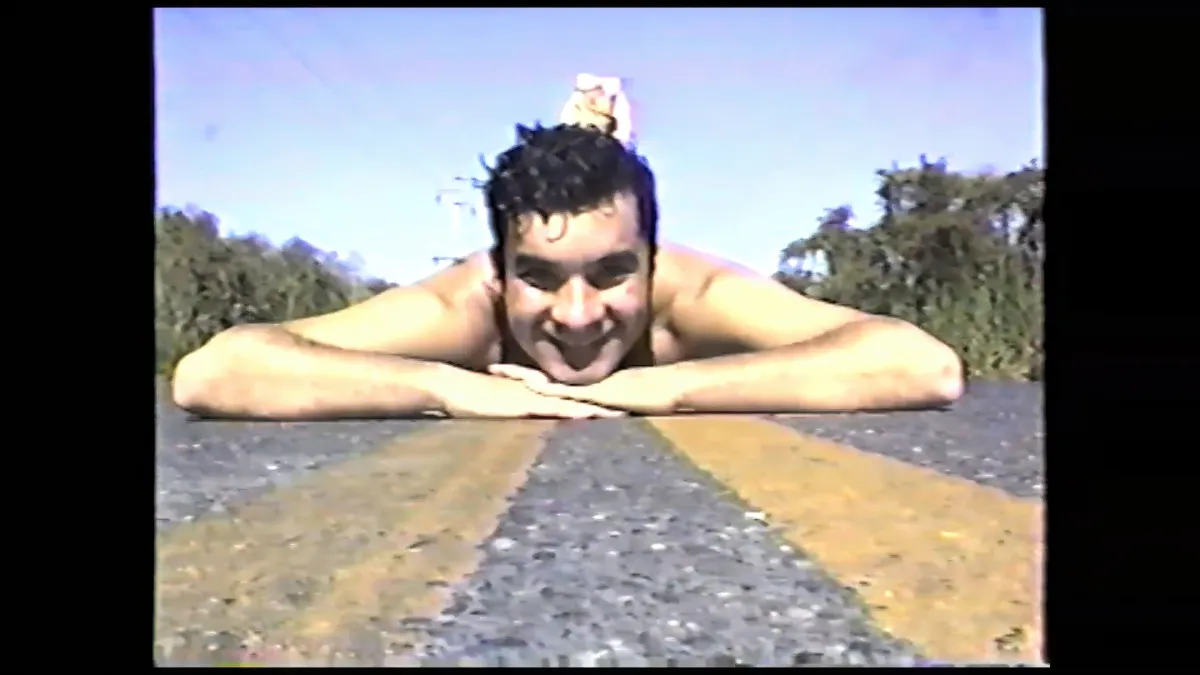
NC: First of all, the way that she records was very clever. She’s sometimes putting the camera on the floor, making her own frames.
D: She’s ahead of her time.
NC: Exactly. So that was very interesting aesthetically. But I really got more deeply into this as a story when we started to explore Máxima’s inner world through her archive. And that impressed me because it was a very personal, very intimate moment, [conducting] interviews and recording her testimony. It was very impactful for me. We were conscious that the trans experience would be very important, because it’s part of herself. But what really moved me was the human side of how she confronted the past, and also how she understands herself to move forward.
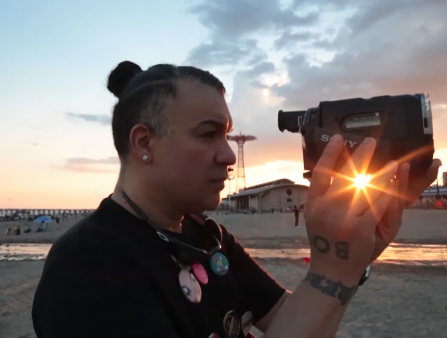
No Money No Honey. Photo credit: Nicole Costa. Courtesy of Nicole Costa
D: It’s interesting to hear this backstory from you because it seems like the idea for this film came accidentally. Maybe Máxima wasn’t really prepared for a deep dive into her own past. Can you talk about how you both arrived at that point where she was ready to talk about some of those really traumatic events?
NC: I think it was the pace at which we started this film. I never like to rush the process because I feel the process is the most important thing, sometimes even more than completing the film. It was a very slow process to build trust. But we’ve become very good friends because we’ve shared so many moments. Máxima is very open, but I knew that there were very sensitive moments, and when she was able to be open and willing to talk about them, we did it. But something that is very important to say is that Máxima is not just the subject of this documentary. She is also an active collaborator. From the very beginning of this project, she was working with us. We really wanted to treat this footage with respect, so we were able to listen to her, and she was able to share what parts of the material she didn’t feel comfortable showing and what parts she really wanted to share. So it was very one-on-one, working with her.
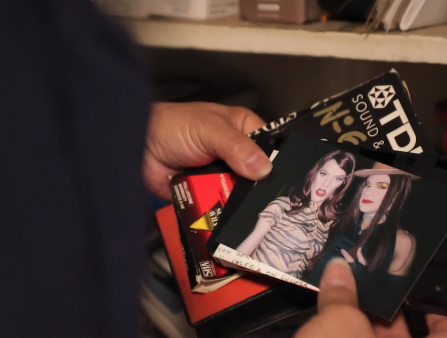
D: Because the majority of the film is based on Máxima’s personal film diaries, the perspective is often first-person. But there are key moments in the film, like when we see her discover the old tapes from her past, that the perspective shifts outside of herself. I’m curious what motivated you to bring a third-person perspective into the film in those moments.
NC: Identifying the point of view of this story was actually the hardest part of the process, because there are a lot of tones that are in the film: there’s the performance part and the confessional part. So we needed to see which one would be the most “accurate.” At the end of this process, we started to realize that we had to prioritize her perspective. I had done a lot of filming during this process, but we picked only what was really necessary to use; of course, there are some recreations to fill the gaps of the full story.
D: In the process of getting to know and becoming close friends with Máxima, did you ever learn the motivations behind filming her life? You said there’s this subconscious desire, but I wonder if, through this process, she was able to vocalize the actual motivations behind it.
NC: I believe that she always wanted to leave a trace, to feel that she was visible. Those tapes are the proof of her life, of her adventures, of her pain, the darkness, and the lightness of her life. I also think it was a strategy to create this space to confess and play—the play is so important, the sketches, the performance are all connected. I believe that aspect of her life was very important to show and to keep.
I believe that she always wanted to leave a trace, to feel that she was visible. Those tapes are the proof of her life, of her adventures, of her pain, the darkness, and the lightness of her life.
—Nicole Costa
D: There is some very specific footage that anchors the film that I hope you can talk about a little bit more. It depicts a small body of water and children jumping in and out of it. It’s very important to the film, and it’s interesting that we don’t quite know when or where that footage was taken. What was your reaction to those images when you first saw them, and how did they speak to you?
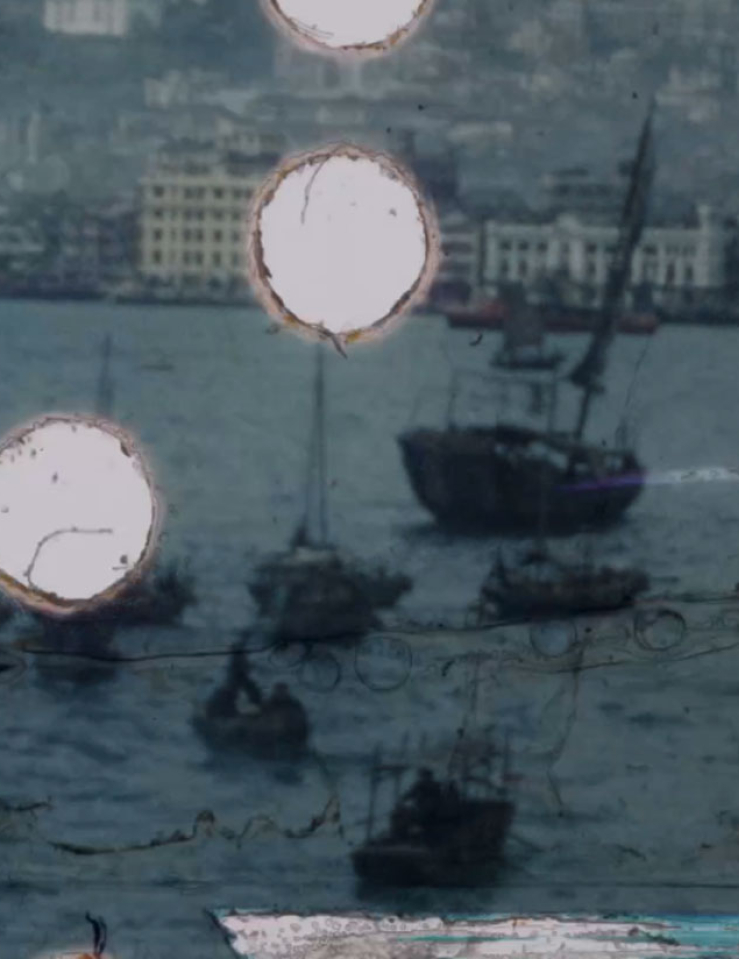
NC: There were a lot of very eloquent and suggestive images in the footage of Máxima because she was recording herself, and you can see the desire and sometimes even the confusion in her. We wanted to create this feeling of being in a dream because those are her memories. So we really wanted to project this as if we were diving into Máxima’s mind. Those images were very powerful because they don’t belong to the narrative or her daily life; it’s more like they are coming directly from her inner world.
D: In a film made up of diaristic footage, instead of treating it logically or chronologically, you overlap time. Not just narratively, you quite literally place images of the past underneath images of the present, so we can see time overlap. Can you talk about finding your way to that approach and the aesthetic tone that creates?
NC: This way of narration started to develop in the editing process. My editor and I did something like that in our previous film, and I think it makes sense here, too, to have these flashbacks of time and going to the past because this is a journey about how to confront that past by revisiting it. That past is going to accompany you your whole life. [Máxima] is constantly revisiting those experiences. It was very important to show how Máxima faced this past but also embraced it. She doesn’t deny it, and she obviously recognized that there is a lot of pain and harm, but she can still separate the love, for example, that she gives to her mother, who is also a very complex character in the film. I feel very inspired by the radical tenderness that Máxima applies in her life. Even with all the people that she knows and feeling those harmful moments in her life, she still can move forward and take them with her as part of her story. She can’t erase them, so she learned how to walk with them.
D: How did you navigate your role as both a filmmaker and Máxima’s friend when moving through these traumatic memories? Is there something that either stops you or encourages you to intervene as a friend when you also know that you’re making a film about her?
NC: My goal in making this film wasn’t to give Máxima a voice, because she already had it, but to create this space of trust where she feels comfortable talking and sharing her feelings. It was an incredible exercise to review these scenes together, because she realized that she didn’t want them to be seen when she was struggling with addiction, for example. But the power of the images is incredible because they allow you to look at yourself from the outside. I think it was very important for her to reconnect with her community, with her friends, with her chosen family, and have a purpose in her life, because she was very isolated in the beginning. Seeing that there were fights that were larger than her own struggle was very important for her to improve her life. She overcame addiction through the process of the film, and she became an activist. She’s a very important voice now for the organizations that we see in her community in New York. So it was an incredible transformation, and I think cinema can be an incredible space to transform ourselves. I am not the same person that I was at the start of the film. We all learned through the process.
The power of the images is incredible because they allow you to look at yourself from the outside.
—Nicole Costa
D: I was so taken by all of the superimpositions and the water motif throughout the film. Do you have any films or filmmakers whose styles inspired how you manipulated this archival footage?
NC: I don’t remember if I had references about that, but it was just the projection of how we imagined the images in Máxima’s mind looked, because she experienced a lot of confusion about very sensitive subjects like sex and how to awaken that sexuality and desire. There are a lot of things that cross and bend, so that was the choice behind creating that style. But it was made along with my editor, who also has her own style and is very good at using archival material, so she really understood how to create this sense of traveling into the past and going to the future and creating this dialogue with the present.
D: Queer and trans people are asking themselves right now, I think with a lot of urgency, what kinds of images should be representing them in the media. The amazing thing about this film is that all of the images are Máxima’s, so they’re all motivated by her own choices and her own mistakes. Could you speak from a personal standpoint about the importance of seeing not just a positive or perfect representation of trans people, but one that encompasses everything?
NC: We never wanted to create a manifesto with this film, but the political is actually in other aspects of the film, like the intimacy. A remarkable scene for me is the one where Máxima talks with her friend Mila, who is of a different generation and has a different perspective on being trans. You can see that Máxima considers herself a “travesti,” which I know in the U.S., the translation is kind of offensive, but it’s not in South America. We’ve vindicated that word into something very political, as resistance, because it’s from a totally different context. I believe Máxima was also learning how to define herself through different communities, and she tried to teach her friend what she learned. That is what was so interesting to me because, obviously, the trans community is a huge community and it’s very diverse. I believe it’s okay to have intergenerational conversations about these topics, and all the contexts we come from deserve to be respected because they are made of experiences.
D: You mentioned this before, but an important aspect of this film was seeing Máxima open up after the pandemic and re-entering the world in lots of different contexts, whether it was being more politically active, finding love, or reconnecting with old friends. How is Máxima doing now? Is her world still as wide and expanding as we saw in the film?
NC: She’s amazing. She’s incredibly confident, and I am so proud of her. It’s so incredible how she presents herself to the world right now. When we started, she was very shy. Even as a character in my previous film, The Journey of Monalisa, she was very hard to interview. She was sweating and super nervous, but now you see her with a microphone, talking to a big audience in her community, and being so influential among her peers. It’s incredible that she was able to transform herself, not just through the film, but in all aspects of her life.