
Over two decades, Millennium Docs Against Gravity (MDAG) has evolved from a bold experiment into one of Europe’s most dynamic documentary platforms. Founded in 2004 with a focus on audience development rather than industry deal-making, the Polish festival has steadily expanded its reach—geographically, structurally, and strategically—into a multi-city event that now draws over 180,000 attendees annually and is increasingly positioning itself as a pan-European hub for non-fiction cinema. From the start, that meant treating documentaries not as niche festival fare, but as works that could circulate through regular cinemas, media debate, and civic partnerships—an approach reinforced by MDAG’s parallel role as a distributor.
Today, MDAG combines a large public-facing festival with theatrical distribution, education, online access, and a growing industry strand. Its latest edition is set to unspool from May 8-17 across Warsaw and six other Polish cities—Wrocław, Gdynia, Poznań, Katowice, Bydgoszcz, and Łódź—before continuing online from May 19-June 1. The program includes a broad range of competitions, thematic sections, masterclasses, pitching sessions, and professional meetings. This year also sees the introduction of a FIPRESCI award in the Main Competition, further underscoring the festival’s international profile.
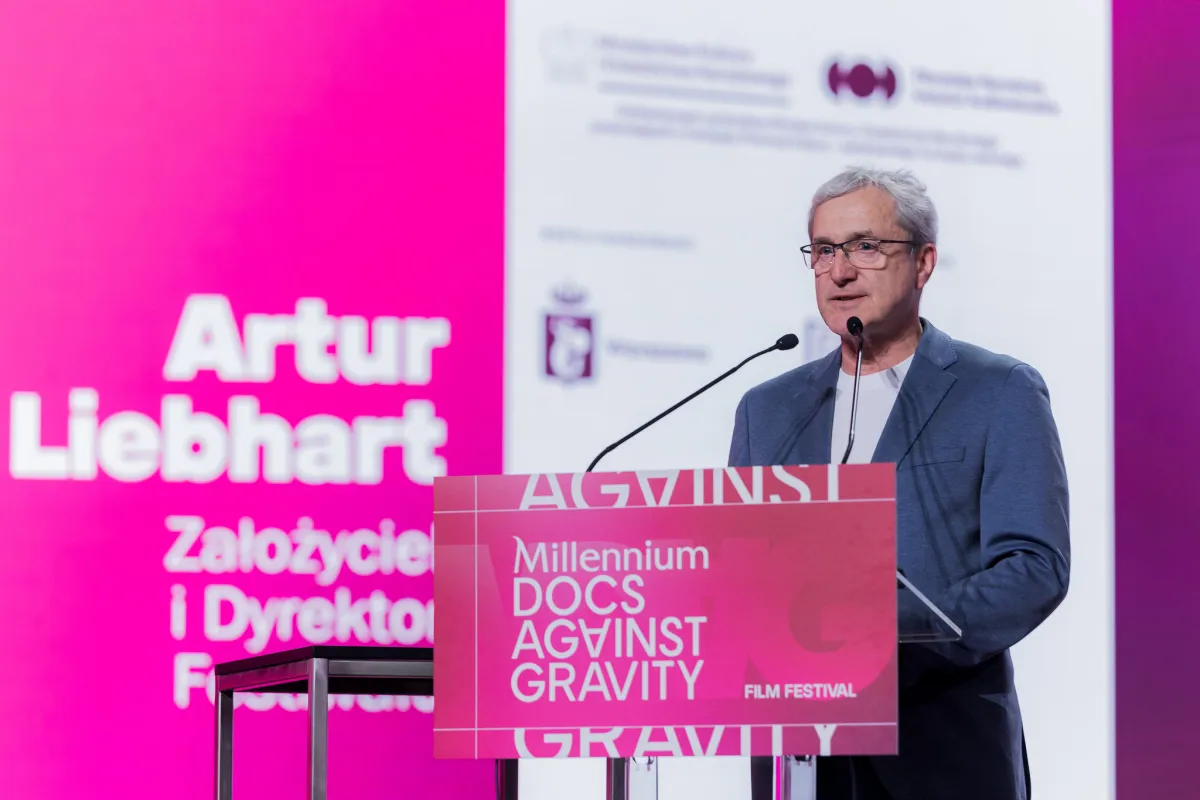
In this conversation, festival head Artur Liebhart reflects on MDAG’s unconventional origins, its hybrid audience–industry model, and how decentralization, editorial programming, and year-round initiatives are shaping its next phase. The following conversation has been edited for length and clarity.
DOCUMENTARY: Let’s start from the beginning. How did MDAG come into being, and how did it evolve into what it is today?
ARTUR LIEBHART: The starting point was quite simple, but also quite radical at the time. I wanted to build an audience for documentary films. Back then, most festivals were primarily focused on industry—markets, pitching forums, financing opportunities. They were like dots on a map that professionals would travel between. I chose a completely different angle. My main goal was to create a space where audiences would actually go to cinemas to watch feature-length documentaries. That’s why we launched the festival in 2004 alongside a distribution company. The idea was that between festival editions, we would function as a regular distributor and keep documentaries alive in theatres.
At that time, there were essentially no documentaries screening in Polish cinemas—neither in arthouse venues nor multiplexes. People thought we were crazy. But as strong international films began emerging, we slowly built momentum. We began releasing five to seven films annually and gained trust from major world sales companies. Eventually, we were also selling dozens of titles to Polish television.
Another key element was how we approached the media. Instead of going to cultural desks, we went straight to political and social affairs editors. We invited journalists to actively participate—moderating Q&As, curating panels, engaging with themes. That helped position the festival as a place where public discourse happens.
We also wanted it to be more than a film event. We involved NGOs, activists, and cultural organizations, and created additional activities around screenings—workshops, discussions, even performances. It became a kind of cultural ecosystem.
D: One of MDAG’s defining features is its multi-city structure. How did that model emerge?
AL: We became a kind of nomadic festival. Warsaw is our central hub, but we gradually expanded to other cities, starting with Wrocław in 2008.
The idea was not to grow randomly, but to build on a unique feature of Poland: many major cities have publicly owned arthouse cinemas. These venues became our partners. Once we demonstrated strong audience numbers and media impact, local operators and authorities began to trust the model. Today, we operate in seven cities. In most of them, we also run competition sections with local juries and awards. Filmmakers travel across the country to meet audiences, which creates a very direct connection. It’s a complex operation—around 1,400 screenings in total—but so far, we’ve managed it without cancellations. That requires a lot of coordination and experience.
The starting point was quite simple, but also quite radical at the time. I wanted to build an audience for documentary films.
—Artur Liebhart
D: How does this decentralized model shape the audience experience?
AL: Each city has its own identity within the festival. While some core films—especially from the main competition—screen everywhere, there are also local competitions and initiatives.
We wanted each location to feel like a festival in its own right. At the same time, there’s a shared structure, including a nationwide audience award, which creates a sense of unity across all cities.
D: Let’s talk about programming. What defines the editorial vision of MDAG today?
AL: Our primary goal is still to reach a broad audience. That means being open to different themes, forms, and styles. If you look at our competitions, you’ll see that diversity reflected clearly. The main competition focuses on the best international documentaries of the past year—films with strong storytelling, high cinematic quality, and emotional impact.
But we also have thematic competitions. For example, we collaborate with Amnesty International on films about human rights and activism. We have the Chopin’s Nose Award for films about music and the arts. There’s a section dedicated to psychology curated with a weekly magazine, another for debuts, whose jurors are film school students alongside seniors. These strands allow us to engage different communities and interests, expanding the audience without diluting quality.
D: On the industry side, what kind of professionals are you attracting, and how does MDAG position itself among other major European festivals?
AL: We attract producers, filmmakers, sales agents, and festival programmers. Our industry program is still growing, but we already have a clear profile. We run three pitching sessions: one for Polish and coproduced projects, one for films aimed at young audiences—which is quite unique in Europe, closer to what you would find in the Berlinale Generation sections—and one for short documentaries in collaboration with Prague’s Institute of Documentary Film.
We also organize masterclasses. This year, for instance, we’re hosting a session on director-editor collaboration with Erik Gandini and his long-time editor Johan Söderberg, as well as a masterclass by Alan Berliner on essay filmmaking. In addition, we will host a conversation around A Fox Under a Pink Moon, bringing together Mehrdad Oskouei and Soraya Akhalaghi to discuss the creative and practical challenges of making a film remotely—working across distance between director and protagonist, and navigating both emotional and production constraints in that process. In terms of positioning, we don’t try to replicate what festivals like IDFA or CPH:DOX are doing. Instead, we focus on our strengths—audience engagement, education, and a strong connection between films and public discourse.
D: I know that the COVID years have significantly reshaped MDAG. How did the festival navigate that period?
AL: We reacted very quickly. We built a VOD platform and moved the festival to autumn 2020, when there was a small window of relative safety. We combined a limited in-person edition with an online one, and it turned out to be a huge success.
We even received a major cultural award in Poland for how we adapted to the situation. That moment confirmed that we had built something resilient. Interestingly, it was right after COVID that we launched our industry component. Until then, we had focused almost entirely on audiences. But at that point, I realized we were ready to support the industry as well. When we introduced industry activities, the response was immediate—from Europe, the U.S., Canada. Very quickly, we became a relevant stop on the international circuit. Today, we host programmers from major festivals like Sundance, and we’ve joined the group of Oscar-qualifying festivals. Starting this year, we will also host a FIPRESCI award for documentaries, which is something we have worked towards for a long time.
In terms of positioning, we don’t try to replicate what festivals like IDFA or CPH:DOX are doing. Instead, we focus on our strengths—audience engagement, education, and a strong connection between films and public discourse.
—Artur Liebhart
D: Did that emergency solution permanently change the festival’s thinking about access?
AL: Yes, the online component is very important for us. Because we also operate as a distributor, we can negotiate broader online access than many festivals. Of the roughly 180 films in the program, about 120 are available online. We use our own platform, which we also operate year-round as part of our Documentary Academy. This educational dimension is crucial. We work with high schools and universities, using documentaries as tools for civic education. It’s about building future audiences, but also informed citizens.
D: Looking ahead, what are the next steps for MDAG?
AL: We are focusing on expanding our VOD platform and securing investment to strengthen that side of our operations. We’re also planning to develop a year-round tutoring program for documentary projects—both Polish and international. Many filmmakers are struggling to access funding, and we believe we can support them with our network and expertise.
D: Finally, can you share some key figures that illustrate the scale of the festival today?
AL: Last year, we reached around 181,000 attendees, which places us just behind IDFA in Europe. We aim to grow to around 220,000 in the coming years. On the industry side, we host about 200 accredited professionals, with total participation in industry events ranging from 500 to 1,000. In terms of funding, we have a balanced model—roughly 50% public and 50% private. That includes major partners like Bank Millennium and Visa, which shows that the private sector also sees value in what we do.
D: Sounds like a rare balance.
AL: Yes, trust is key—both from public institutions and private partners. Without that, none of this would be possible.