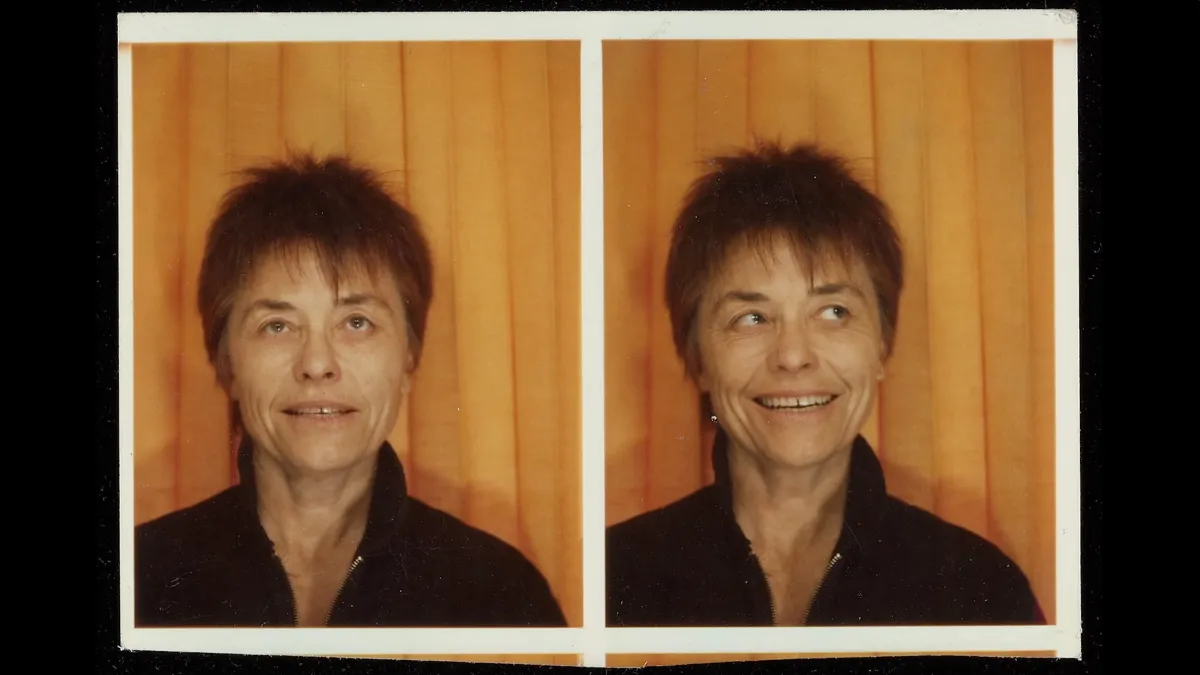
Barbara Hammer is one of the most important experimental filmmakers of all time. Through nearly 90 films made from the 1960s until just before her death in 2019, she honed a practice which avowed that a queer film should be queer in form in addition to its content. Her work was radically sensual, featuring prolific and uninhibited nudity and sexuality in its explorations of bodies, physicality, love, and their respective (and overlapping) political and personal valences. Hammer continually toyed with different editing techniques in works ranging from the 1974 short Dyketactics a freewheeling, joyful depiction of queer women cavorting in a meadow, to her 1992 feature Nitrate Kisses, an essay musing on love and relationships in the shadow of AIDS, with tender narration overlaying intimate physical gestures that range from soft touches to explicit sex.
Archivist and filmmaker Brydie O’Connor feels indebted to Hammer, and has expressed this admiration in multiple tributes. Her IDA Award–nominated 2022 short Love, Barbara sits with Hammer’s longtime partner Florrie Burke as she reflects on their life together. Now her full-length film Barbara Forever pulls from Hammer’s voluminous personal materials, her many films, and Burke’s recollections to draw together a biography. Starting with Hammer’s coming out in the 1970s, the film draws from disparate audio recordings to have her relate much of her life in voiceover—how she developed her cinematic philosophy, her various relationships (particularly with Burke, who also reminisces to O’Connor’s camera), and eventually how she faced her own mortality.
The many clips from Hammer’s work and her everyday videos often closely resemble each other, emphasizing how personal her work was. It’s an excellent introduction to her work for those unfamiliar, and a look at her life that will resonate with aficionados.
Ahead of Barbara Forever’s premiere at Sundance today, we sat down with O’Connor over Zoom to discuss how she got to know both Hammer and Burke, her lengthy editing process, and more. This conversation has been edited and condensed for time and clarity.
DOCUMENTARY: How did you meet Barbara Hammer?
BRYDIE O’CONNOR: I was writing my thesis in college on her early filmography, and I had to reach out to her directly to buy her DVDs to see her work. And when I moved to New York, I would see her around. I ran into her at Metrograph in 2017, when she had a show at Leslie Lohman, and we stayed in touch. She asked me to send her my thesis for her archive. We were in touch just about a month and a half before she passed. I was making my first short and reached out to her for advice. She told me that she was at the end of her life and wished me back best of luck with everything.
D: Did you know Florrie Burke through Hammer, or in a different way?
BO: I didn’t know Florrie before. I found her email address and sent her my condolences a few months after Barbara’s death. I asked if she would meet for coffee, since I was interested in doing a short documentary on Barbara’s work and legacy. I had been going up to Yale to continue my research and look through her archive there. I started going over to Florrie and Barbara’s home in the West Village, spending about a day each week chatting with her and digitizing a portion of Barbara’s archive that didn’t go to Yale.
The film ended up being about Barbara’s legacy through the lens and love of Florrie, through the context of their relationship. Florrie was never in any of Barbara’s films, and so many lovers and significant women in Barbara’s life are her topics and subjects. I was quite interested in what worked so well in their relationship.
I think Barbara saved everything. It was important to her to collect her life not only in her artwork, but in everything she filmed and wrote and made.
— Brydie O’Connor
D: What got Florrie to get past that reticence and appear on camera for you, both in that short and in this feature?
BO: She was open from the beginning that she doesn’t love being on camera. I think she specifically didn’t want to be nude and have her personal life out in the world in Barbara’s films. She had a career of her own, and she wanted to maintain a sense of privacy. Our collaborations have a different air, there’s a sense of Florrie doing it for Barbara. She says in Barbara Forever that her participation connects her to Barbara. It also took a lot of time. It was two years after Barbara’s death before we started filming together [for Love, Barbara]. We spent that time getting to know each other while I did my research. It took a lot of trust building and relationship building for her to feel comfortable on camera.
D: Do you think Barbara’s death recontextualized some things for her, that now she sees value in recording some of her thoughts and feelings and memories for posterity?
BO: Absolutely. Barbara specifically asked Florrie if she would be the shepherd of her work. That was not always the plan; it was just a couple of years before she died that they agreed Florrie would take that on. She told Florrie, “You know my work and the intentions behind it better than anyone.” I think that now that she’s passed, Florrie feels a certain responsibility to share what Barbara envisioned. I certainly think participating in these two iterations of my documentary project is first and foremost an act of love from Florrie. But it’s also part of what she agreed to as the executor of the Barbara Hammer estate.
D: Speaking of the estate, what’s its current status—both in terms of where Hammer’s materials are housed and the digitization efforts?
BO: All of Barbara’s films are at the Academy Film Archive, and all of her paper materials and outtakes and everything else are at Yale’s Beinecke Library. She was very specific about this; she started touring archives and building relationships with archivists in the years prior to her death, after her cancer diagnosis. I’ve worked closely with both of these institutions, with Mark Toscano at the Academy. Her digital files are at Electronic Arts Intermix. They’re incredible and provided early access to screeners when I started this project.
Besides these formal archives, there were so many artworks and personal materials that Barbara left behind in her home and her studio at Westbeth. Florrie had to clean out her studio after her death, and she moved from New York back to California. I helped her parse everything Barbara had left. Part of the gift of Barbara’s archive is that it continues to proliferate even after all of these years of working so closely with it. I hear all the time from people who were close with her or had interactions with her, and they’ll share photographs she took, letters she wrote, collages she made—things like that. I think Barbara saved everything. It was important to her to collect her life not only in her artwork, but in everything she filmed and wrote and made.
Barbara says in the film, ‘I was born when I became a lesbian.’ For many years, she felt like she was in what she called her ‘dyke adolescence,’ before she came out at 30.
— Brydie O’Connor
D: Hammer’s narration is pretty extensive and consistent throughout the film, and it seems to come from a variety of times and sources, yet together they form a fairly coherent timeline. What parts of these materials did this audio come from?
BO: One of the treasures in her archive is that we can hear Barbara talk about nearly everything in her life. There’s a wide variety of contexts for her audio recordings. Some are just MP3 files of her recording her reflections. Sometimes she would talk directly to a camera, just her looking in a mirror speaking about different topics. We were so lucky to access the audio archive of a scholar, Sarah Keller, who has written extensively on Barbara and her work. She conducted nearly 15 hours of interviews with Barbara, and Sarah generously shared everything she had recorded. We also referenced interviews and oral histories Barbara had done with the Academy and the Smithsonian. A couple of lines come from her 2018 performance at the Whitney, The Art of Dying. So some of these spoken words were more private than others. But in Barbara Forever, there’s no differentiation; it’s all a part of this larger archive and the voice of Barbara Hammer.
D: The arc of the voiceover feels very seamless. How did you approach editing this, finding the right audio in the materials? How much material overall did you have to work with?
BO: We had over 400 hours of archival footage and audio, and there was her entire filmography as well. I work as an archival producer professionally, so I have a background in organizing this volume of material. Still, it took so much time to create a story and structure for it. One thing that helped was that I did a queer filmmaking residency in Provincetown in the winter. It was freezing but really lovely. I’d go for a short walk each day, and I spent so much time listening to everything, Barbara’s recordings and interviews.
I had everything transcribed in Trint, and my producers [Claire Edelman and Elijah Stevens] and editor [Matt Hixon] and I created an outline of her life that was very chronological, birth to death, with a couple of thematic buckets. I created a radio edit of the film from the recordings that I felt best described certain moments of her life. That was the main document I referenced throughout the edit.
I was also cognizant of how her voice sounds very different across these recordings, which you hear in the film. In some clips, she’s healthy and strong, while in others, she’s much older and sick. I wanted clips of her speaking about as many topics as possible in both voices so we could weave them together. Something interesting revealed itself in this process. When Barbara was younger, she had this public persona and stories she stuck to. She tells some of them over and over. But as she gets older, she reflects in different ways.
D: You’re your own filmmaker, but in using so much of Barbara’s material, did you find that her sensibility would bleed into yours?
BO: I think that in terms of my approach to chronology, I felt very connected to this idea as a lesbian filmmaker, like my experience of being in the world opened up when I had a greater understanding of myself. I wanted to reflect that sense of the world opening when you have confidence in who you are. I think this idea is shared by many queer people, that life feels like it could begin in a new way when you feel most like yourself. Barbara says in the film, “I was born when I became a lesbian.” For many years, she felt like she was in what she called her “dyke adolescence,” before she came out at 30.
I was fascinated by this idea of a life lived on one’s own terms. In terms of form and her experimental sensibilities, I wanted the audience to get a close feel for her work, even though we’re not showing her full films. I want them to feel her sensibility for pacing and her eye, as well as the thematic notes that drive the arc of the story. Her work goes hand in hand with a nontraditional form and structure, and our structure was driven by this idea of self-discovery and self-reinvention.