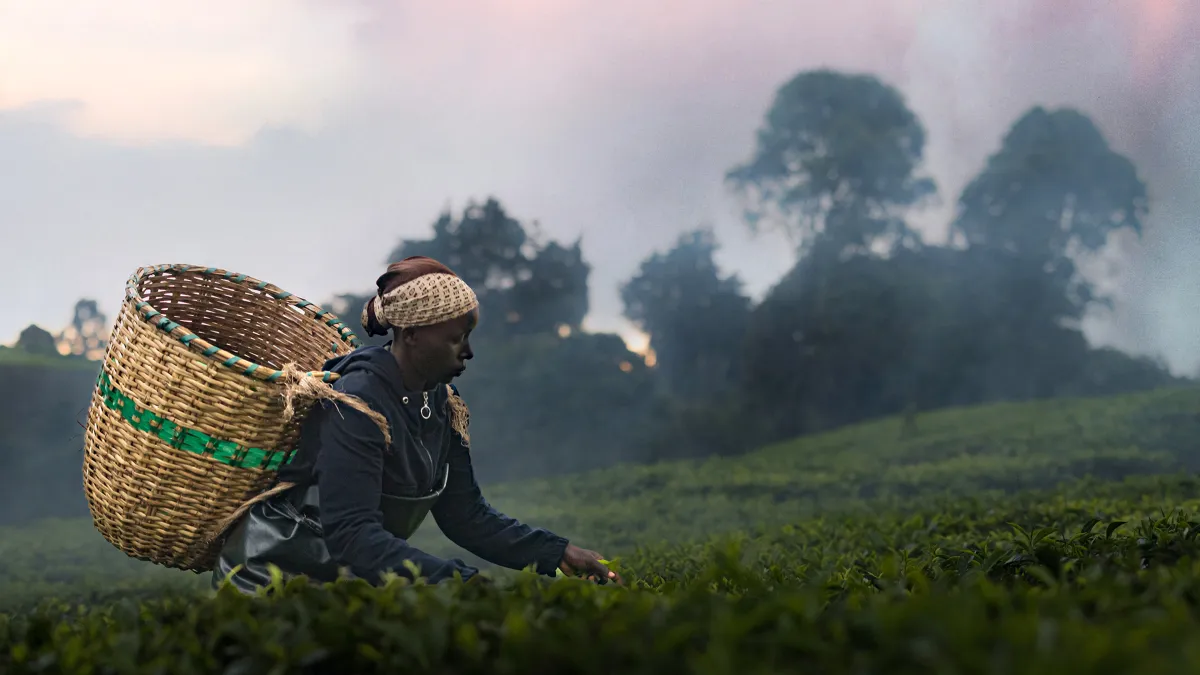


In May 2025, while touring a “resort” in Tigoni, Kenya surrounded by endless tea fields and gorgeous rolling hills, it became clear once the haze of beauty settled into a calm sobriety that we were actually on a plantation—one owned by the descendents of white colonizers and run by Kenyan staff. The experience was full of dissonant resonance as the land expressed itself in deep, easy dreaminess, yet this colonial reverie was punctuated by startlingly present echoes of plantation power dynamics, especially familiar to those of us descended from ancestors enslaved on the west side of the Atlantic and survivors of colonial violence worldwide. The perpetuity of colonial legacies of extraction, displacement, and accumulation clarified under the drifting clouds above Tigoni.
In Kikuyu Land, we follow resolute journalist and co-director Bea Wangondu in her search for truth and justice—for the Kikuyu peoples and in her own family. British colonial forces took ancestral Kikuyu land, leaving countless families displaced from what generations had called home. Starting with archival footage, co-directors Andrew H. Brown (Between the Rains) and Wangondu bring us through a documented history of British colonial wrongs before transiting us to the present in poetic, rousing cinematography of the lands and peoples between Nairobi and Mount Kenya, where families still cannot access lands stolen from them, now held by faceless corporations extracting tea from these hills to send worldwide.
“Shamba yetu ni nzuri, lakini imelaaniwa”—“The soil is fertile, but the land is cursed,” an undisclosed tea worker tells us as we traverse deeper into difficult histories. On a familial investigative journey that reveals hard truths about her ancestors, Wangondu’s energy and determination—a resolve that never slips even on the slipperiest slopes of capitalistic self-interest and self-preservation—guides us through the resonant struggles for true reparations. Between the scarred historical contours of Kikuyu land and into Nairobi streets where the anti-colonial struggle continues in the protests and movements toward a truly free Kenya, one finally able to rid itself of colonialism’s vestiges and find a way toward healing and repair, that can give the people back to its rightful land and a land back to its people.
Documentary spoke to Brown and Wangondu before Kikuyu Land’s premiere at Sundance. This interview has been edited.
DOCUMENTARY: I was in Nairobi when Ngũgĩ wa Thiong'o passed away in May 2025, and started learning a lot more about his work and how hard he went for Kikuyu culture, the importance of being able to be connected to the Kikuyu language and to the land. Your film also made me think of conversations with friends about how complicated that could be, when Kikuyu communities and elites are in a dominant position of power in current Kenyan society. How do you navigate and think about that as you’re making this film called Kikuyu Land?
BEA WANGONDU: We approach the film from the origin of the problem, which is loss of land and how that came about and where people who lost land are now. Since [I was] young, my dad created a space where you could ask questions. Being African, we didn’t talk about everything, so when you had the window, you did. Being a history teacher, he always had books around with pictures of history, but there wasn’t much for Kenya. What we learned was what the British left as our education system.
Coming from “ask me all the questions” to “some colonialist discovered Mount Kenya”—it was confusing. I kept asking my dad, “How come? Where were our grandparents?” Because the exam says Dr. Krapf discovered Mount Kenya. That’s how I grew up. Same with this documentary: In an environment on my mom’s side with such poverty, how come our grandfather had so much land? I never got answers and being dismissed drove me to ask more questions.
ANDREW H. BROWN: When Bea and I met on assignment at National Geographic for another documentary, I was reading [Thiong'o’s 1964 novel] Weep Not, Child, which is obviously about loss of land and colonial systems. I thought the novel was compelling in how it didn’t focus on the system but the household—how systems of oppression strip a family’s pride, dignity, and agency, and what that does for generational trauma and poverty when you strip land and culture.
When Bea and I met, that novel was a major touchstone. A lot of our early conversations asked whether this was true in her family. One side of her family was loyalist to the crown, one side freedom fighters. In production downtime we’d talk: “How do you think that shaped your identity? Your curiosity?” I saw bravery that she was willing to take those questions to her own community and hold the mirror up in her own home.
At that time, she wasn’t planning on being in front of the camera. We were just going to interview elders. But it became clear her family story was an important thread tying the story together. It grew from there, following her and allowing her curiosity to lead. She always responded—her curiosity was met with bravery to follow wherever the conversation took her, even uncomfortable conversations.
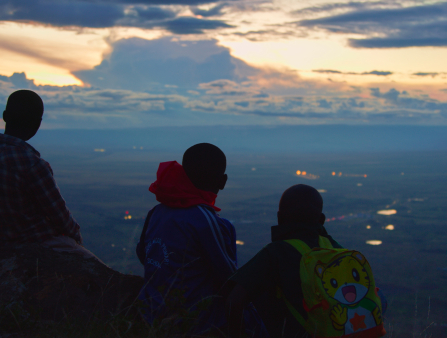
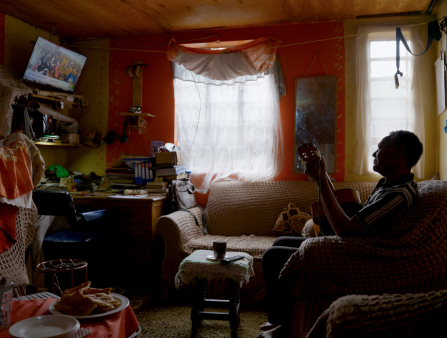
Nganga Mungai appears in Kikuyu Land.
D: For me, having Black family on my father’s side and trying to explore ancestral history or family stories—it can be tough. People got attitudes, but there’s also trauma there: “We don’t talk about that.” Pain they suffered through, but also pain they inflicted or were complicit in.
Bea, being a journalist, an artist, a writer, filmmaker provides good cover to ask these questions when otherwise people won’t talk about it. What was your thought process going into that? Did you have trepidations? How are you feeling now since it’s brought up things within your family?
BW: The part that threw me off was fear of being blacklisted from the family, waking this almost dead giant back up and having the insecurities of our family—I come from a very big family, my grandfather had five wives, so my cousins and I are spread everywhere.
When we were filming, for a long time I couldn’t call home, couldn’t talk to my aunties or to people close to me. I’d become mostly persona non grata. That was scary.
Andrew was supportive during that time. Naivety has you walking into something thinking we’re just going to have a conversation, then you realize it’s not just conversation—you’re trying to get the bones to come back alive. When they do, they come with vengeance that’s poisonous. This is what I felt was being fed to me during that time.
Now that the film will be launching in Kenya, I’m just going to let them decide when they want to see it. I know they’ll know it’s out. I let them walk their pace. That’s not easy because the conversation will start because this film is screening in different cities across Kenya. Our family’s big and spread—somebody will see it in May, then July. It might be an endless conversation that’s not pretty.
D: Through this process, you got isolated. You’re asking worthwhile questions, doing familial work of healing and repair—not just for your family but ancestrally with the land, other families in the area—very important work. Simultaneously, you’re coming under increasing threat of violence from government forces and others who potentially don’t want this story out. How are you able to handle that? When you speak to the lawyer in the film, she talks about putting the story in the press as powerful protection. Do you still live in Nairobi?
BW: Yeah. By God’s grace, we have a lawyer on standby working with all of us in Kenya—those we see in the film and those we don’t—to make sure should anything happen, we can be bailed out, shipped out of town, or kept safe legally. Kenya is very litigious, so it’s not all lost, but it’s not safe.
It’s very risky considering what happened the last couple years with abductions. Goonyism is a lucrative job in Kenya now. You don’t know who’s known about this or who’s been paid to get the job done. I will not water it down—it’s not rosy. Within Nairobi, you’re going into a year of campaign then election. That compounds for loads of money. Money is corrosive. This is what we’re up against launching this film this year.
AB: From the beginning, we knew that the system in place and the powers that be, not just in Kenya but in America, those with money and resources pull the strings and decide what is talked about, what is challenged. They will do what is needed to keep their resources and power unchallenged. It’s a tactic to get silence: “You understand how dangerous that is?”
We tried to make sure people understood the risk. We’ll do what we can—hire attorneys to protect participants and team members—but we can’t promise safety. We took precautions. There’s ways to change names, hide identities. We’ve moved people and helped them relocate where they feel safer. We can do these steps, but we can’t guarantee. We’re not more powerful than the system in place.
Many people said no. We respected that. But some said yes. That’s what this film is—brave people willing to share their truth and talk about things often told with a whisper.
Allow time. Show up, create space. Technically, we don’t use artificial lighting. Strip everything away, go in with minimal gear, two or three lenses to make sure there’s not barriers between what’s in front of the camera and behind it.
— Bea Wangondu on building trust with those they were filming
D: I’m curious how you all were able to create environments or atmospheres for the people that you were filming, for them to feel safe, or that they could be open and free and intimate in the stories that they were telling and what they shared with you? As filmmakers, what were you doing with the cameras? How did you make people feel comfortable? What strategies did you employ?
AB: Being honest about the risk and what we are able to do before capturing someone’s story is step one. But, consent is ongoing. It has to be true collaboration and participation. We wanted audiences to feel it was intimate, but for participants, it’s not intimate—it’s invasive. You’re coming in their home, invading their space.
It’s an ongoing conversation about intent to use their voice, how we’d shape their story, to what degree. Once agreed and everybody’s on board, it’s about time and space. Not rushing, showing up time and again, understanding what they said yesterday they might feel different today. They can rewrite their story, sleep on it, say, “Actually, I don’t feel that way. Can we talk about this again? There’s more I want to say.”
Allow time. Show up, create space. Technically, we don’t use artificial lighting. Strip everything away, go in with minimal gear, two or three lenses to make sure there’s not barriers between what’s in front of the camera and behind it.
D: I really loved what Ngũgĩ wa Thiong'o says about Kikuyu language—the need to speak in your own language and native tongue as a way to form closer, more intimate understanding. Bea, you say in the film: “The story doesn’t matter, the only thing that matters is the storyteller and how loud their voice is” and “the loudest story is the one often told with a whisper.”
What were you thinking about how you wanted to tell this story? And in what language? Whether that's literal: Is it in Kiswahili? Is it in Kikuyu? Is it in English? Also cinematically, what is your language? What was your approach or ethic or philosophy that you were thinking about while forming your cinematic language?
BW: Growing up as a Kikuyu girl, information that couldn’t be said blatantly was told in stories. Coming into this film, one of the most important things was being authentic about who am I, where am I coming from.
When my grandmother told that story around that fire in that small hut, that’s where my mind went. When you talk about Kikuyu land being a Garden of Eden, that’s where my mind goes—that purity of being told this lovely story. My small seven-, eight-year-old mind understood what that story meant. We had to start from that point of authenticity.
If I was going to talk about Mount Kenya, which is sacred to our people, how we came up and lost land, it had to be very honest.
AB: My father’s side is Scottish, my mother’s side is Huron-Wendat First Nations. What’s interesting is no matter where you go in the world, it’s the same playbook when Indigenous people are colonized, when their land is taken, whether Indian Removal Act or Kikuyu Land Unit. Very first thing they do is take away the story, then return it saying, “We are going to tell your story.”
This was never just a Kikuyu story or Kenyan story. Early on I said, “Do we tell this in Kikuyu, in Swahili?” Bea said, “No, I want the majority in English. We know our story. This is for the western world. We’re going to tell it in their language so they can understand and we’re going to retell—recapture ours.”
At the same time, there’s pieces Bea would say are just for us. Moments in the score—Nyokabi Kariũki, the composer, is Kikuyu. She recorded women’s voices singing. There’s times we’re not translating that. That’s for us. That’s our hymnal. We’re not giving that to the world. That was the ongoing conversation: What do we want to share with a global audience and what is just for us?
Nyokabi Kariũki, the composer, is Kikuyu. She recorded women’s voices singing. There’s times we’re not translating that. That’s for us. That’s our hymnal. We’re not giving that to the world. That was the ongoing conversation: What do we want to share with a global audience and what is just for us?
— Andrew H. Brown
BW: I love that we did those components in our culture. If you read Ngũgĩ’s books, there’s things you have to research more to understand. It was important we retain those for ourselves.
My position with this whole thing is about being able to amplify voices from a very honest perspective and declaring out loud what we think we deserve. The vision was always to create a story that the world would watch and understand where we are coming from. For me, with my own voice for the first time saying, “Yes, this was fed to us, but really - this is who we are.” And being able to develop (the story), put it in a position for people to see it simply and respectfully and delicately in a way that they can understand.
AB: And I would say the style was Ngũgĩ, quite a bit. As I said, his work was such a touchstone and we had a lot of conversations about how are stories told around the campfire. It wasn’t factual based, “This happened A to B to C.” There was poetry and beauty and they would allow lines and moments to breathe. It was a dance that they were willing to figure out as they go.
We’d create scenarios where we wanted it beautiful, because Kikuyu, like many indigenous stories, are graceful, poetic. They capture the landscape, culture, and nuance. They’re stories you receive differently each time. We tried to say, “How does this look within documentary form? How do we give language to the land, let it speak for itself so people recognize its beauty but also see it’s carrying trauma and decades of abuse and plundering, that skeletons are buried within?” It is cursed land, as fertile as it might be.
It was collecting those textures and threads, then allowing each person to tell their story the way they wanted with what tone. Allowing Stephen, the boy—truly a prodigy. He is one of the most intelligent kids. We never tried to force answers. We just allowed him to ask questions. Whereas Mungai had all the answers and his story was holding on to answers—he was steward of that generational trauma, pain, suffering. He directed all his scenes. He’d tell us when we’re done filming, what he’s going to say, what he’s going to talk about, what his soundbites are.
D: How do you resolve perpetuating pain and hate that persists among neighbors when colonizers came and did fuck some shit up? How do you repair and heal amongst different peoples and groups in what is now a nation state of Kenya made up of so many different peoples? How do you bring Kenya together when there’s so much intracommunal violence, pain, deception, theft—people stealing from other people, taking advantage, acting as middlemen? That pain goes on for generations.
BW: One way Kenya is trying, in early stages of healing, is we have some of the best Internet connection within the region. That allows for information and tech is big in Kenya. As soon as whatever document is trying to get passed in Parliament, whatever is happening will be online shortly. That allows large numbers to be in the know.
The government is aware they’re going to be fought tooth and nail to listen to people. They can’t kill everybody. Some of us will be here to fight. That’s one way. But it’s not easy because losing one person is already too many. We’ve already lost so many. It’s painful. To me, it feels like you’re fighting for independence as they did in 1950s Kenya. It’s happening all over again, but it’s worth every minute. That much I know.
AB: One reason I encouraged Bea to be in this story in front of the camera is I saw her willingness to have difficult conversations and wrestle with hard truths. That’s also what I find inspiring about this story and something here in the States and in the West, I don’t think we do well.
We receive information, then decide how to internalize it based on party lines. We’ll bend truth and tell it as the deepest, darkest lie as long as it aligns with us winning the argument. That’s something I wrestle with every day that has broken many relationships here in the States. People, no matter who they voted for, cannot say, “I lied and it hurt you. I was lied to then lied to you. I believed that, then weaponized it against my own family, neighbors, community.”
We’re not foolish to think this one film will fix all that, but Bea starting in her own community—that’s what she can do, and that’s what I hope I can do in my own community.