

In his first Netflix release, veteran BBC presenter Louis Theroux enters the realm of Andrew Tate and his disciples with the stated aims of better understanding why and how these Men’s Rights Activists (MRA) types arrived at their regrettable concerns and what their true financial goals are.
To that end, Adrian Choa’s Louis Theroux: Inside the Manosphere seeks out figures united by virulent misogyny, putatively ambiguous anti-Semitism, and pitiless financial grifting—most of those profiled seek to redirect followers to dubious crypto-advice services or similarly under-regulated financial sinkholes.
Tate himself is absent, but the group includes Justin Waller, whose Southern drawl stands in contrast to the cultivated Brit-lad-matiness of HSTikkyTokky and his mini-me Ed Matthews, the Ben Shapiro-esque rapid-fire whining of Myron Gaines, and, finally, the ultimate heart of darkness: Sneako, currently distancing himself from a past stream of racist and misogynist invective by declaring himself a born-again Muslim.
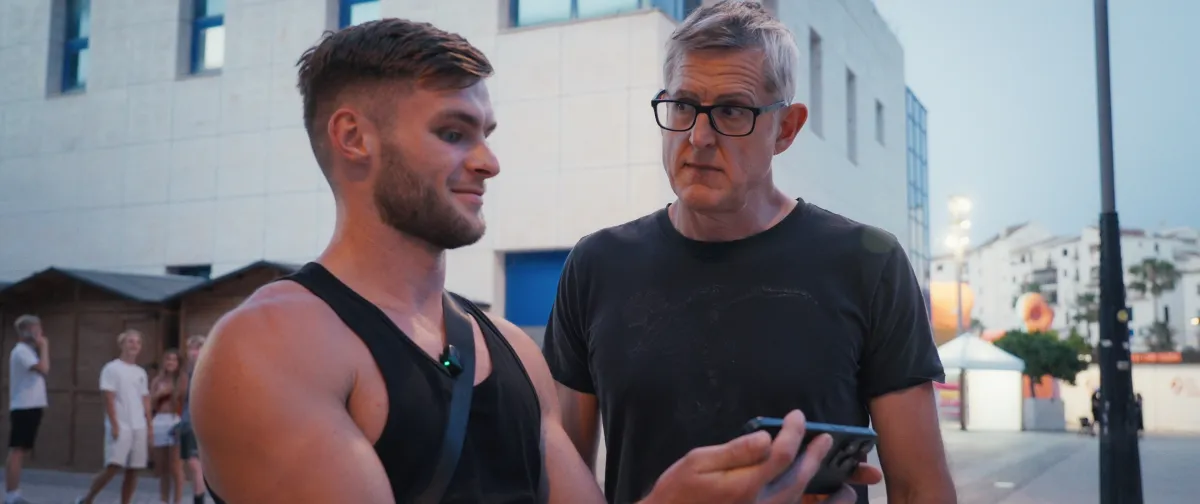
Finding a new, productive angle of inquiry on the manosphere is inherently difficult, especially when there’s not much mystery about what exactly is going on here: the conservative grievance industry is a bedrock of American society. Much like any part of the conspiratorial right-wing, the MRA prides itself on being excluded from untrustworthy “mainstream media”; their lack of slickness is presented to disciples as a feature rather than a bug. But unexpectedly, Theroux’s first point of attack on this MRA Greek chorus is formal. Arriving to meet his first interview subject, HSTikkyTokky (née Harrison Sullivan), Theroux’s documentary crew is greeted by HS’s associates, armed with iPhones that they’ll use to both create a for-the-record reverse shot to this film’s angle and live-stream some of the encounters. They marvel at the size of Theroux’s crew’s camera, and he responds that this is a proper documentary, not just online content. In this context, that categorical descriptor is presented not as admirable—as per, say, Netflix head Ted Sarandos’s title of “Chief Content Officer”—but pejoratively, signifying a degrading bait-for-monetary-switch. Theroux is making a movie, a distinction reinforced through shifting aspect ratios. The manosphere content is presented in its native vertical formats, while this streamer-funded documentary is in widescreen.
Presentational distinctions are put even more sharply into relief when Theroux tags along as HS goes to the gym. The influencer starts talking directly to Theroux’s camera, and the presenter asks who he’s talking to. HS explains that he’s used to talking directly to camera rather than with others. A presumably crucial distinction is thus drawn between what Theroux has to offer—bonhomous professionalism, a final product whose technical specifications are up to Netflix’s meticulously detailed standards, conversation rather than monologue—and his boorish subjects’ comparatively amateurish, unidirectional, literally lower-res rants. The illusion of conversation is more of a “give them enough rope” strategy , a standard tool in Theroux’s kit that sets the stage for subsequent interactions in which the presenter repeatedly models himself as trustworthy—calm, married, a vetted veteran—thereby placing his subjects in unflattering relief.
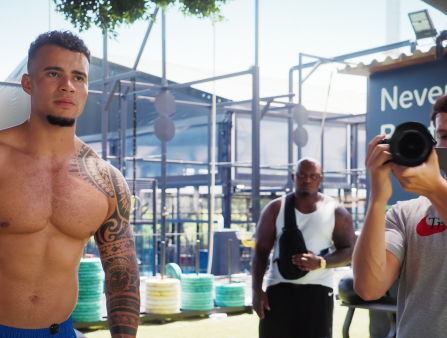
Harrison Sullivan (HS Tikky Tokky)

Ellie Nutall (L) and Harrison Sullivan (HS Tikky Tokky) (R)
These useless dialectics—professionalism vs. amateurism, calm vs. controversy—serve as a metaphor for the film’s broader argumentative failures. For every shot, there is a reverse shot—or, more precisely, unused footage of the same event from the subject’s angle. As Theroux told Deadline’s Max Goldbart, that was in part the plan:
I hoped we’d get this feedback loop where there was a meta-narrative that was then affecting my approach to the story. Sometimes it was kind of embarrassing. I’d arrive back from filming trips, and my kids would say, ‘Dad, what you were doing? You got owned.’ That’s a little bit painful, but actually makes for a stronger film.
Thus, the resulting mise-en-abyme, where Theroux films content creators who film/stream him back and are either warned by their chatbot disciples that they’ll get dismantled in the final product or egged on to aggress against him. Such feedback leads to waxing and waning levels of suspicion, but monomaniacs are by their very nature unstoppable, and the mildly varying degrees of hostility Theroux is treated with don’t fundamentally change the nature of his interactions. When you look into the abyss, and it looks back at you, absolutely nothing happens.
For Theroux’s subjects, the problem isn’t their worldview but simply how it’s abridged. Claiming that an unedited full picture vindicates them is in keeping with the way the rightwing has rhetorically taken on the press, from Senator Joseph McCarthy gaining rhetorical authority from an infamous list of known communist government infiltrators that he couldn’t share with the public for security reasons (and because it didn’t exist) to Donald Trump’s recent threat to sue CBS for editing his 78-minute 60 Minutes interview. To say that we’d understand the subjects better and more sympathetically if we heard more from them is a non-starter.
As LADBible’s Anish Vij wrote with probably inadvertent irony, “In response to Theroux’s documentary, [subject Myron] Gaines said during a seven-hour-long stream that it made ‘him look crazy.’” Gaines has released both an edited pushback counter-rant—“Exposing LIES Of The Netflix Documentary Inside the Manosphere (DAMNING Receipts!)”—as well as a 53-minute uncut version of one of the film’s central interviews. The former makes the point that the documentary cut out every time someone on the street said something good about him. The full interview, which includes his then-girlfriend Angie Camacho making an appearance, is supposed to similarly draw our attention to how all the nice things she had to say were omitted in Theroux’s deliberate distortion.
For Theroux’s subjects, the problem isn’t their worldview but simply how it’s abridged. Claiming that an unedited full picture vindicates them is in keeping with the way the rightwing has rhetorically taken on the press.
The couple has subsequently broken up, with Camacho saying in a since-deleted TikTok that “I need to thank Louis Theroux, because his questions made me question myself and the future of everything.” To be honest, I’m upset that I spent any time at all researching and “getting to the bottom of things.” There’s no moral universe in which Gaines could have any credibility, and even entertaining the possibility of fact-checking is an immediately inadmissible dead end. Where Theroux sees success, Gaines’s followers will continue to see exactly what they’ve seen before: a man who speaks for them standing up to a mainstream media bully.
Who is Manosphere for, and what is it trying to achieve? Speaking to WIRED’s David Gilbert, Theroux defined the target audience in broad terms:
This is for people who might see HSTikkyTokky on their feed, maybe some who even like a lot of that content, and then also for parents, also for anyone who’s curious about this weird landscape that we inhabit, people curious about the culture in general, the ways in which the people in power seem to be influenced by certain manosphere talking points. If you are curious or especially if you’re raising kids, or you are young yourself, and you’re consuming the content, then it’s helpful to know what’s happening.
“People curious about the culture in general” is casting the widest possible net, while the premise that undermining its subjects’ claims is going to deprogram any of their adult disciples is as credulous as the faux-naivety Theroux’s deployed to entrap subjects before; conspiracists are, by definition, unconvinceable. One initially proferred context for the show was as a follow-up to fellow Netflix property Adolescence. Theroux says he conceived the film before that series, but the suspicion lingers that the algorithm will smoothly drive you from one product to another, leveraging tragedy for second-screen captivity. Late in the film, Theroux returns for one more conversation with HS, this time with his mother in the house. “If you don’t agree with what Harrison’s doing, then why are you making money off it on a program by publicizing it?” she fumes. The point is both specious—being answerable comes with the territory—but still unnervingly valid within a film that offers no better answer.
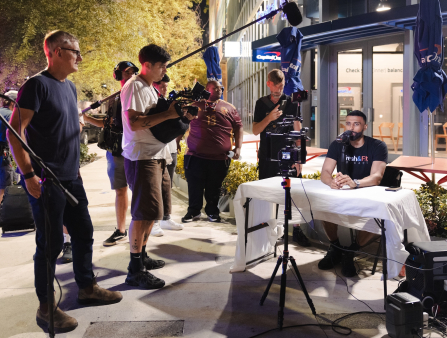
Louis Theroux (L) and his crew look on as Amro Fudl (Myron Gaines) (R) creates content.

Louis Theroux (L) interviews Harrison Sullivan (HS Tikky Tokky) (R).
Given a surplus of media coverage of the manosphere, what might a truly productive engagement look like? In the fictional realm, Radu Jude provided a credible answer with Do Not Expect Too Much From the End of the World (2023), in which his lead actress, Ilinca Manolache, unleashes bile while wearing the digital skin of an Andrew Tate-lookalike, a deepfake of a reality that shouldn’t exist. The film built upon Manaloche’s COVID-era conception of the character, for which her “idea was to recycle this type of toxic, hideous language that men use in order to dominate us and in order to humiliate us […] to empower myself somehow.”
For his part, the Romanian writer-director was interested in the subject because of his older kid, now 18, who “has a kind of liking for this very toxic, horrible guy. So this is why I started to follow him. And I got a bit worried, to be honest, because these kind of people attract a lot of gullible naïve young people and create these fake values.”Acknowledging the real-world measurability of Tate’s seductive appeal to young men who feel themselves to be disempowered, Manolache and Jude make their uneasy peace with the idea that this is a key avatar for expressing disposed rage in the present and appropriated him for their own devices.
In nonfiction, Julian Vogel and Johannes Büttner’s Soldiers of Light (2025) offers a different, more productive answer. Deploying the traditionally austere, putatively objective, and merciless fixed-camera gaze of fellow Teutonic social spelunkers Ulrich Seidl and Nikolaus Geyrhalter, Soldiers approaches self-help scams through a raw-food influencer whose sphere of association inevitably enfolds Holocaust denial, tax evasion, flat-earth truthers, and crypto pitchmen. The film observes not the top of the chain but its rapidly-expanding middle, where canny grifters with smaller-scale targets can still do immense damage.
To perpetually redirect attention to this terrain’s celebrities is to ignore all the infinitely vile worlds popping up in their wake. In a strange, inadvertent way, Manosphere both appeals to authority, interrogating those at the top of the chain, while seeking to denigrate it, staging a fight amongst intractable opponents for audiences who’ve already chosen their favorite relatively famous fighter.