
When MakeMake Entertainment began considering directors for what would become One Last Adventure: The Making of Stranger Things 5, producer Terry Leonard was the first to throw out Martina Radwan’s name. Radwan (Tomorrow, Tomorrow, Tomorrow, 2023), a cinematographer and filmmaker known for her vérité work, felt like a good fit precisely because she could bring an observational approach to what she describes as “the Duffers’ brainchild.” Ahead of shooting the ambitious final installments of their Netflix hit television show Stranger Things, showrunner duo Matt and Ross Duffer wanted someone around to chronicle what would be a grueling, year-long process.
Radwan began work in October 2023 in Atlanta, spending an entire year embedded in the Atlanta soundstages where Hawkins, the Upside Down, and various other iconic set-pieces of the show were brought to life by a committed crowd of collaborators. And she spent an additional year shaping the doc with editors Carol Martori and Alex Ricciardi, aiming to create a piece that didn’t just feel like a complement to the show but a documentary unto its own. As the final doc shows, Radwan was just as interested in the Duffer brothers’ creative process (and attendant anxieties over ending their decade-long passion project) as she was about the work of sculptors, make-up artists, set decorators, and camera operators who helped bring that much-anticipated final season to fruition.
Ahead of the doc’s release (available now on Netflix), Documentary caught up with Radwan to talk about how her previous work on films like Girls State (2024) prepared her for this years-long endeavor, why there was a steep learning curve in capturing this sprawling cast and crew, and how curiosity led her every move. This interview has been edited and condensed.
DOCUMENTARY: During discussions with the Duffer brothers and Netflix, was there any sense that anything would or could be off-limits?
MARTINA RADWAN: The Duffers wanted to have an on-the-ground doc. They didn’t want it to be reflective. They grew up on behind-the-scenes docs where you would actually learn something about filmmaking, and they wanted to pay that forward to their fans and budding filmmakers. And they really wanted the camera to be on the ground, participating, which is incredibly generous—and, of course, fearless, because who wants to have a camera pointing at them when they're working?
At the start, I bought zoom lenses for a shoot, and they didn’t arrive in time. So I was on prime lenses. I was literally in their faces at the very beginning. And they were like, “Can you back off a little bit?” Because I was so into it that I didn’t even realize [how close I was]. But I never heard “we can’t do this” or “we can’t do that.” They knew they had input on the edit. If there had been anything in the edit that they wouldn’t like, they would just tell me, which created that freedom. They knew they didn’t have to censor themselves on set.
D: You spent a year embedded in the production in Atlanta and even got to capture what was happening in the writers’ room in Los Angeles. Once you begin the edit with everything you’ve shot, how did you begin organizing it into a coherent piece that covers so much ground (the story of the Duffer brothers, the season-in-the-making, the artisanship behind the show)?
MR: It’s such a tightrope, because you obviously have to tell the story of ten years, right? You have to tell the story of a big show that has so many fans. It was a constant struggle in the edit of how to maintain that balance without making it a BTS show. We edited for a year, which I’ll probably never get to do again, but it also needed a year. It’s not so much about the quantity of the footage we had, but how do you pull out all these storylines and then weave them so that nothing gets lost for too long?

Production Designer Chris Trujillo.
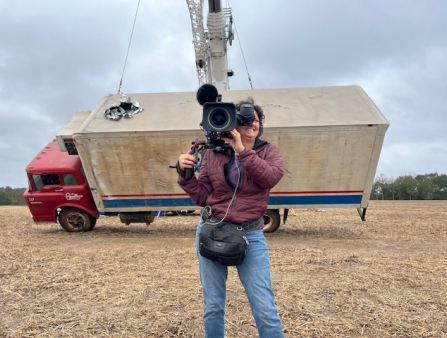
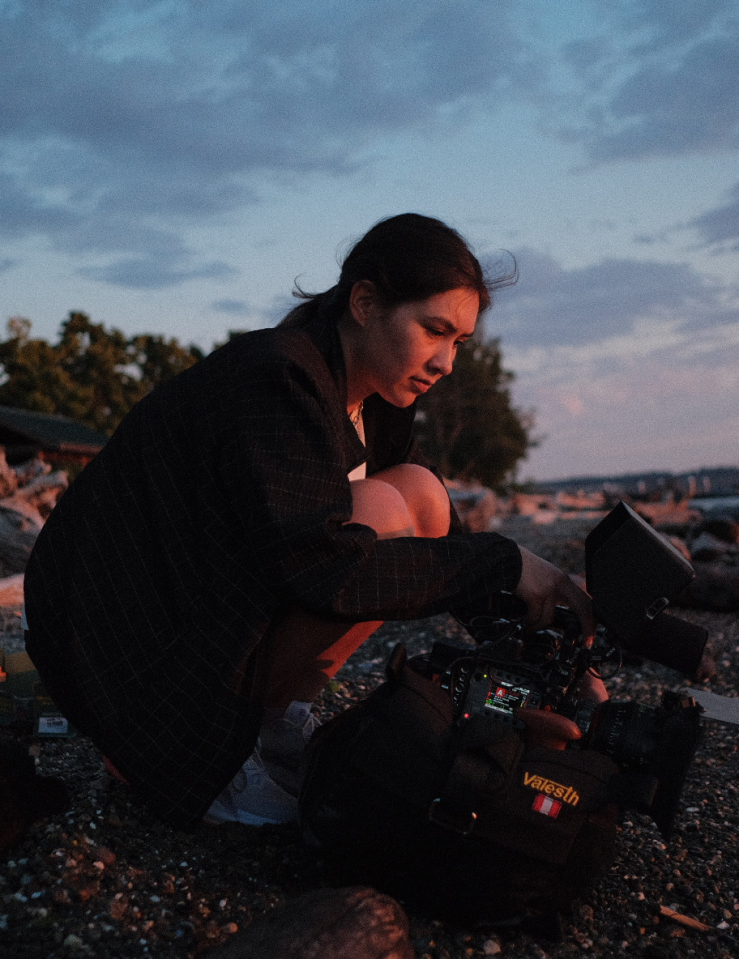
Martina Radwan shooting One Last Adventure: The Making of Stranger Things 5. Photo credit: Tudor Jones.

(L to R) Director/Writer/Producer Ross Duffer, Hope Hynes Love as Miss Harris, and Director/Writer/Producer Matt Duffer.
D: Also, because, in the face of it, this looks rather different than what you’ve shot before—not just your directorial feature, Tomorrow, Tomorrow, Tomorrow about your visits to Mongolia, but projects like Pasang: In the Shadow of Everest (2022), about a woman’s perilous journey up that mountain, and Inventing Tomorrow (2018), a doc that centers young innovators from around the world creating solutions for environmental issues.
MR: It is very different. But I like the process. I like to be challenged. We said, “Well, we kind of know what the film is about.” We didn’t know how we were going to tell the story, because how would we? I, as a documentarian, had an idea, but I dealt with a lot of people who are coming from fiction primarily. My goal was to make a standalone doc that the audience can watch without having seen the show.
D: To that end, did you have any touchpoints or documentaries that you saw as creative North Stars for what you were making?
MR: Well, it is Hearts of Darkness: A Filmmaker’s Apocalypse [Dirs. Fax Bahr, George Hickenlooper, 1991] without having the catastrophe, right? That inside look into somebody’s brain while they’re in it. That was my goal.
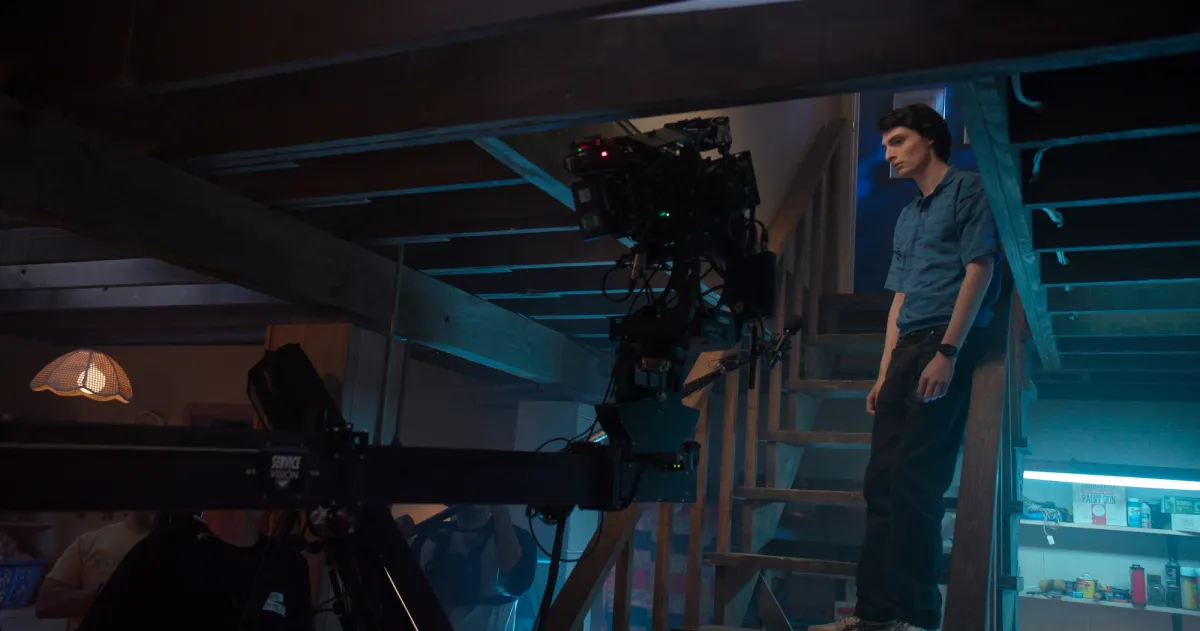
D: Your vérité work as a cinematographer on films like Girls State, for instance, really shines through. There’s a moment when you’re shooting Finn Wolfhard’s final scene, where you frame the shot around the way it affects the camera operator Nick Muller, who tears up. It struck me as in keeping with the intimacy you’re known for.
MR: As a cinematographer, you’re the first one to see it right? There’s such a direct connection between what’s happening and what you’re capturing. For me, in documentary, I do still shoot with an eyepiece, because I want to have that intimacy. In Nick’s case, he doesn’t have an eyepiece anymore. But he still has to follow every move in a specific way and having to understand the characters and anticipate their every move. We create such intimate relationships with the people we are filming, it goes beyond the script.
There’s so much intuition at this point for me in my work. I’m always scanning the room. There was a lot to look at on set, but 50% of the job was to stay out of the way, and yet still tell the story. Sometimes it’s not the obvious thing that tells the story. For that shot, there was a moment where I thought, “Finn’s going to be in the shot when he walks up.” But I also thought the [other] moment of him putting the book away was strong, so I was like, “Oh yes, there’s Nick saying goodbye in his own way.”
I don’t agree with calling vérité shooting being ‘a fly on the wall.’ You have to put yourself out there, and you have to give the people you’re filming a chance to get to know you.
— Martina Radwan
D: When it comes to balancing that embeddedness into the shooting of the show, while also, presumably, getting out of the way, how did you navigate that?
MR: There was a big learning curve for me because it’s such a large cast and such a large crew. But there was also a lot of trust-building, which you do in every documentary. I don’t agree with calling vérité shooting being “a fly on the wall.” You have to put yourself out there, and you have to give the people you’re filming a chance to get to know you. I put myself out there and showed everyone what I was doing and what I was hoping to do. I gained that trust, and within a couple of months, I could really be in the front line.
D: Another moment that really exemplifies your observational approach is the one where the Duffers are talking about their mom watching the dailies, which encapsulates so much of the story you end up telling about their creative journey. Was that a moment that, when you witnessed it, you thought, Oh yeah, this will make the final cut of the film?
MR: Yes. Absolutely. It’s what I loved about their story, that sense of the longevity of being an artist. They started when they were eight. Luckily, their former drama teacher [Hope Hynes Love], who was part of the cast, formulated it into the sentence that I had in my head to say: “This doesn’t happen overnight. It’s 40 years in the making.” So when Matt and Ross talked about their parents watching the dailies, I thought, “Of course they do.” It’s a family affair.
D: Your own curiosity about the creative process also runs through much of this doc—there’s so much talk of foam sculpting and set dressing. The piece feels driven by a curiosity, really, for how this mammoth-like endeavor was crafted by a group of dedicated artists and artisans.
MR: It was a fine line, because I did know there was going to be a lot of process, and I was interested in that. But how do you keep process alive? And you just do it with curiosity. I am a documentarian at heart. I love fiction. I grew up in fiction. But I love watching real people doing amazing stuff. Trying to understand how they got there was the biggest joy for me. I have hours and hours and hours of footage of people really explaining what they do. I wish I could use that, but that’s a different film. I was genuinely curious. As a documentarian, that’s what you do.