

“Marion is its own little world. The politics are extremely local, but Marion is a microscope of what is going on, not only here in America but all over the world.” That observation, offered by a Marion County resident, becomes the thesis of Emmy-winning documentarian Sharon Liese’s latest documentary feature, Seized—a film that profoundly understands how flyover country is often the canary in the coal mine.
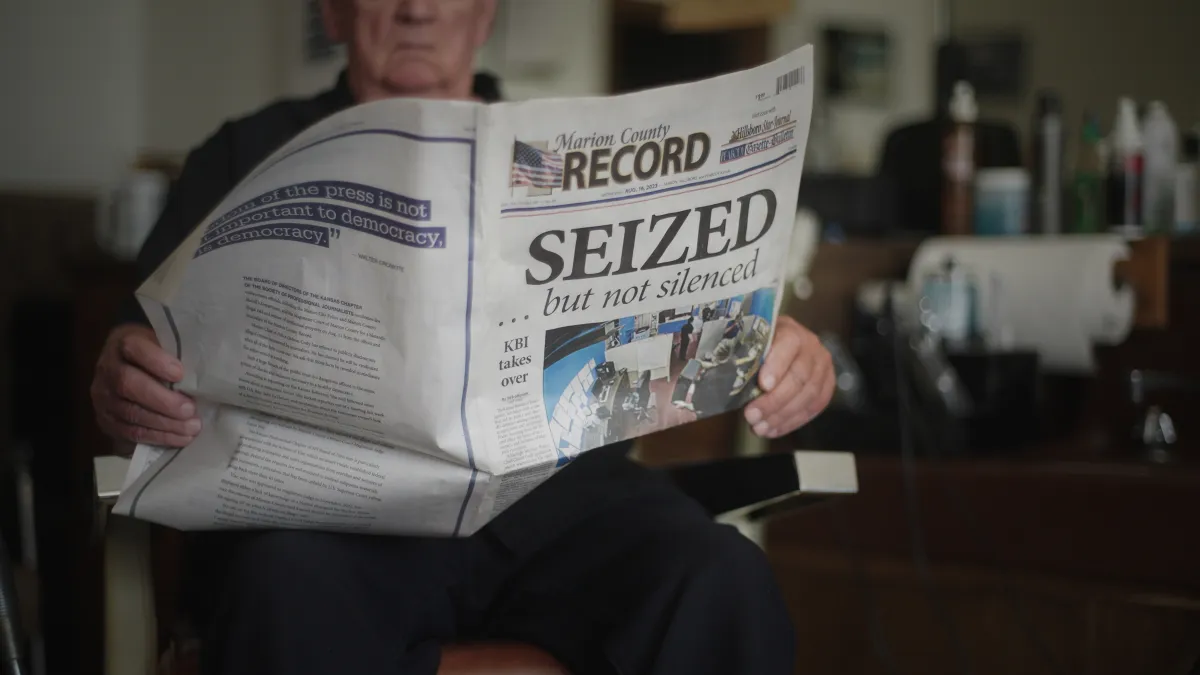
Marion, Kansas, is close-knit, yet deeply divided over the role of its local paper and the intention it holds. On August 11, 2023, police executed search warrants at the Marion County Record, a small but formidable weekly newspaper, and at the private homes of its publisher and reporters, seizing computers and phones in a raid that reverberated far beyond Kansas. The next day, the paper’s 98-year-old co-owner, Joan Meyer, died after officers illegally searched her home. Led publicly by her son Eric Meyer, the Record’s intimidating yet inspiring editor, her family has consistently linked her death to the shock and stress of the intrusion.
Taking its title from the paper’s defiant headline after the raid, “SEIZED… but not silenced,” Seized tracks the fallout in human terms: a community fractured by distrust, law enforcement in the crosshairs of litigation, and journalists forced to defend the basic conditions of their work. Liese keeps her frame tightly local while offering a stranger-than-fiction tale that gives way to our new normal, where the law can be bent toward whoever wields it. I spoke with Liese days ahead of the world premiere of Seized at the Sundance Film Festival about building trust in small-town America and the increasingly urgent stakes of press freedom. This interview has been edited.
DOCUMENTARY: When did you first hear about the Marion County Record raid and what made you realize you were dedicated to making this into a feature?
SHARON LIESE: I was in my car driving and I heard about the raid on NPR. I looked it up and saw that Marion was two hours away from where I lived. This town got thrust into the international spotlight overnight when their newspaper was raided by the police.
It’s not my typical story. I usually start out on a micro level and then branch out into broader themes going on in the country. For example, I did a feature doc on trans and non-binary kids and followed them for five years [Transhood (2020)]. I usually start small so I don’t have any competition with other people trying to access what I’m doing!
This story was big from the start. I thought every filmmaker from New York to California [was coming to Marion to cover it] and I’m nobody in my flyover state trying to get access to this story. But I kept reading more, and I thought, it’s right in my backyard and all of their electronic devices have been seized so filmmakers are probably having a hard time getting a hold of [the Record], so I’ll just drive there.
I waited my turn. There were a lot of journalists talking to Eric Meyer, the editor. I got in there and he said to me, in this very old school journalist fashion, “You’re the first filmmaker to get here, so you got the scoop!”
I had to earn my stripes with him. It took a while before we actually solidified an agreement that I would be able to be the documentary filmmaker of record, but he let me start filming right away. He trusted me and I trusted him.
D: This story involves people with opposing loyalties and deep suspicion of the media. How did you earn access, especially from people who didn’t trust the newspaper, or didn’t trust the camera?
SL: We were filming for at least a year before we were able to get any other voices into the film. We kept hearing there’s another side to the story, but they were afraid to tell us. One reason was this false belief that Eric Meyer hired a documentary crew to come in and tell his side of the story. Other people felt like if they spoke up against the newspaper, they would pay for it, that bad things about them would be written in the paper. It took them a long time to explain that we really were interested in telling a more panoramic view of what happened in Marion, Kansas.
One of my producers, Paul Matyasovsky, started talking to Mayor Michael Powers. They had several conversations on the phone, they emailed, and then he met in person without a camera. Powers decided that he would sit down and interview. He believed and understood that we really wanted to honor the voices of people who had different opinions than the newspaper because we really wanted to understand how this egregious attack on the First and Fourth Amendments could actually happen.
Once we had the mayor sit down and do a very long interview and get a lot off his chest, that resonated for a lot of people. Mayor Powers was able to talk to others about speaking to us. I can’t speak for him, but he seemed confident that we would honor everyone else’s story. Once that happened, more people and more stories started opening up.
It all had more to do with our consistent presence. We started knowing people, eating at the six restaurants in town, and going to the stores. The second we got into town, everyone knew it. When we were at the Marion County Record, I would hear over the police scanners, ‘Oh, documentary crew’s back.’
— Sharon Liese
D: The doc holds multiple perspectives without collapsing into both sides tell-all or even an endorsement-style portrait. Structurally, how did you build that balance in terms of sequencing what voices you wanted to lead with or withhold?
SL: Our team spent a lot of time on structure. The whole team had a commitment to honoring all the various facets of this story. We also knew the story is so layered and complex that we didn’t want to tell it in a linear fashion. We wanted to lead with the part that shocked the country and the world, then quickly go to a year later using Finn Harnett, the new young reporter who comes into town, as the vehicle. That pulls back the layers of tensions that existed between the newspaper and city council, the newspaper and some residents in Marion.
If you don’t have that context, the story becomes flat. The Record had something wrong done to it. While that’s true, there are also circumstances that led to that event, and those circumstances are reflected in how townspeople reacted to the media’s portrayal. We wanted people to understand the context. We had nine cameras with body cam and surveillance footage, so the story of the raids itself could be told in real time. Also the story of Finn getting into town a year later could also be told in real time, but we had to go back in time to contextualize how these raids came about and how people reacted afterwards.
D: How did the town’s relationship to you change as the story escalated? Did being a semi-local filmmaker help in terms of building trust?
SL: I’m not sure if living in Kansas had any impact on the people in Marion other than we enjoyed the same sports team. Being two hours away from a town of less than 2,000 that doesn’t even have a streetlight, I was still an outsider because I lived closer to a bigger city.
It all had more to do with our consistent presence. We started knowing people, eating at the six restaurants in town, and going to the stores. The second we got into town, everyone knew it. When we were at the Marion County Record, I would hear over the police scanners, “Oh, documentary crew’s back.”
There were also people who liked us at first because they were probably more supportive of the paper. We started going to city council meetings and hanging out with people, talking about things other than the First Amendment. That helped everyone to calm their nerves that we were not out to get them
D: I want to talk about a specific scene in the film that I found quite bold: that high-wire sit-down between Eric Meyer and Mayor Powers. Whose idea was it, and what did you do to make it possible, logistically and emotionally?
SL: We were hoping that it would just materialize because it seemed they were ready to have a conversation with each other. We asked them individually if they’d ever thought about having a conversation with the other. Both said yes but didn’t want to make the first move.
We thought, this is one of the reasons we filmmakers do documentaries. For people to see others perspectives and talk. We asked them to do this. We would be transparent with the viewer. We won’t put them in a cafe and say they just happened to meet up. We’ll just put it right on screen with a card and explain what we asked them to do and they agreed.
They both took about a week to decide. We had to find a neutral place and chose this school auditorium. While setting up we kept asking each other, “Should we put them right next to each other, how will they look at each other, is that too awkward?” We decided to put that one seat in between them and tell them to have a conversation, not a debate. It’s up to the audience to decide. We were glad that we could illustrate people who are at odds actually sitting down and trying to have a conversation.
It’s vital for us to acknowledge and be aware of all of these attacks on the freedom of the press. It’s also equally as important to be aware of how people in small towns are allowing this to happen.
— Sharon Liese
D: You’ve said, “Seized is a First Amendment story but also about the relationship between a community and its local newspaper, and the rising tensions between them.” What did this case reveal to you about the vulnerability of press freedom and where do you think we’re headed?
SL: Oh boy! When I first started working on this documentary, it felt like a canary in a coal mine story. The raids happened on the heels of the Biden administration but what happened before with the other administration, there was such an erosion done to the reputation of the press, emboldened actions and negative comments toward the press. It laid the groundwork for this type of thing so it felt like a canary in a coal mine. It’s been two and a half years later [since the raids on Marion County Record], and it isn’t a warning anymore. This is what’s happening and it’s happening everywhere.
Look what just happened with the Washington Post reporter. [Editor’s Note: In January 2026, FBI agents raided the Virginia home of Post reporter Hannah Natanson, seizing her electronics as part of a federal investigation into the leak of classified information from a Pentagon contractor.]
What is happening in this small town is a microcosm of what is happening in the rest of the country. Did we only hear about this story because Eric’s mom died? Could it be going on and on and [we haven’t heard about it]? It’s vital for us to acknowledge and be aware of all of these attacks on the freedom of the press. It’s also equally as important to be aware of how people in small towns are allowing this to happen. In Marion, Kansas, a lot of people were happy that it happened and were hoping Eric Meyer had done something criminal because [they thought] he deserved it.
D: I wanna talk about this genre of docu-journalism or cinematic journalism. I’m so curious from your end about making this film so closely with reporters, did it push you to work more like a journalist? Did anything in your process or practice evolve during the making of Seized?
SL: I’ve always been very clear that I am not a journalist and I am not held to the principles and standards that journalists are. But doing this documentary, the lines got a little blurry.
I felt like I was asking myself if I was being fair to the people involved, if I was honoring people’s stories more often than I may have in the past. I don’t think I changed my style of filming or editing or storytelling that much, other than just an awareness in my own mind comparing journalism to documentary storytelling.
I like to tell stories as authentic as possible and to honor the spirit of what people are trying to convey. I want to take from that scene something that two or three people would feel is the essence of what actually happened, even though it’s a couple of minutes in the film and might’ve been a two-hour-long scene we shot. That’s similar to what journalists want to do. We as documentary filmmakers are allowed to have a little bit more perspective and share more than journalists standards would suggest.
D: Seized ends on this gorgeous drone shot of Eric alone at his desk, then widens into a sweeping shot of Marion from above, offering a glimpse into what’s to come. What’s your great hope for the audience? What does meaningful activation look like after a film like this?
SL: My part in telling this story is to open people’s eyes to what is actually going on. There are so many different themes in the film. I learned more about the Constitution making this film than I previously knew, and that is something that would help all of us, to ask ourselves questions about freedom of speech and freedom of the press. What does that mean to us and why does it seem we are so divided and have different interpretations of what it means to have a free press?
We all have various blind spots in terms of how we define a free press and those blind spots have to do with who we’re talking about and what the situation is. We seem to shift our support for what we believe free speech is based on what is being said. This film opens up the conversation about that.
Another conversation is policing. The film brings up what safeguards and guardrails are in place so that people are not doing stupid things. People should know what the Constitution allows for and what it doesn’t. People in charge of executing orders should be aware of when they’re doing something right or wrong.
In the film, you can see clearly that the police are not aware of the First Amendment! In the beginning when you hear Eric tell a cop during the raid, “I would like to object on the grounds of Kansas Shield Law,” I would like to hear that cop repeat what the Shield Law is. We need to talk about what we want law enforcement to be trained on.
The biggest hope is that people can watch this film and pose questions to themselves about what their own role is in a community, what their role is in supporting free speech, and what they really believe freedom of the press really looks like. And can that belief stay consistent in different situations and with different people?