
Each January, as the Trieste Film Festival Alpe Adria brings audiences to the Italian border city overlooking the Adriatic, a parallel ecosystem takes shape just a few steps away from the cinemas. Producers, filmmakers, funders, distributors and curators gather for When East Meets West (WEMW), an industry platform that has quietly become one of the most significant meeting points for creative documentaries emerging from Italy and the wider Central and Eastern European region—from the Baltics to the Balkans, and increasingly beyond.
For its 16th edition, held January 18–20, 2026, WEMW unfolded against a backdrop of mounting uncertainty for the global documentary industry. In late 2025, Sunny Side of the Doc had announced the cancellation of its 2026 edition, a decision that reverberated well beyond France before being partially walked back following a clarification issued on January 29. While the market ultimately confirmed its intention to continue, the episode crystallized concerns that had already been circulating across the nonfiction sector: what role do documentary markets and coproduction forums play today, at a moment when broadcasters are under pressure, commissioning editors are overstretched, and traditional financing structures are increasingly fragile? In Trieste, the answer was not framed in terms of scale or prestige, but of precision.
Italy and Central-Eastern Europe as a Creative Axis
WEMW has always defined itself geographically and culturally. Rooted in Italy but oriented toward Central and Eastern Europe, the market reflects a region where documentary filmmaking often develops at the intersection of strong authorial vision and precarious funding realities. It is a context in which international collaboration is not an option but a necessity.
This year’s documentary selection reaffirmed that stance. According to Lena Pasanen, head of the documentary selection committee, one of the most visible tendencies was a renewed return to inward-facing storytelling, albeit with a clear outward gaze.
“Filmmakers are returning to personal stories, but with elements that allow the audience to identify and connect,” Pasanen notes. “Although rooted in personal experience, these stories shed light on broader developments or trends within our communities.”
That balance between intimacy and universality has long characterized nonfiction from the region, but at WEMW it is increasingly paired with formal experimentation. Hybrids blending documentary with fiction, animation, and essayistic approaches were not exceptions but part of the mainstream selection.
“There is a strong mix of genres and formats, where boundaries are no longer very clear,” says Alessandro Gropplero, head of WEMW. “We have many personal stories, but they aim to speak to a general audience.”
Among the projects discussed in Trieste were Beyond the Blue Mountains is the Sea by Albanian filmmaker Eneos Çarka, a hybrid docufiction shot on 16mm about a deep sea diver who emerges from an oxygen decompression therapy and finds himself connecting with a doppelganger on the other side of the world; and Rainy Dreams by Iranian director Alireza Ghashemi, an entirely animated documentary by a filmmaker previously known for fiction features that turns the dreams of displaced children at the edge of Europe into hand-drawn animated sequences. Such projects illustrate how creative documentary is increasingly finding support in these spaces.
“These are not television documentaries,” Gropplero stresses. “They are designed primarily for festivals and theatrical circulation.”
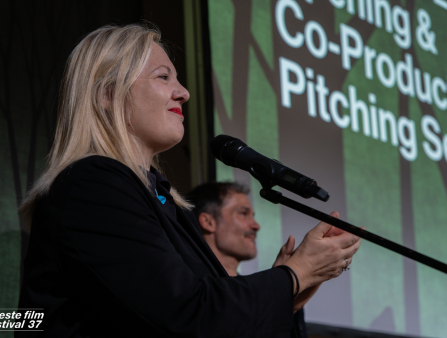
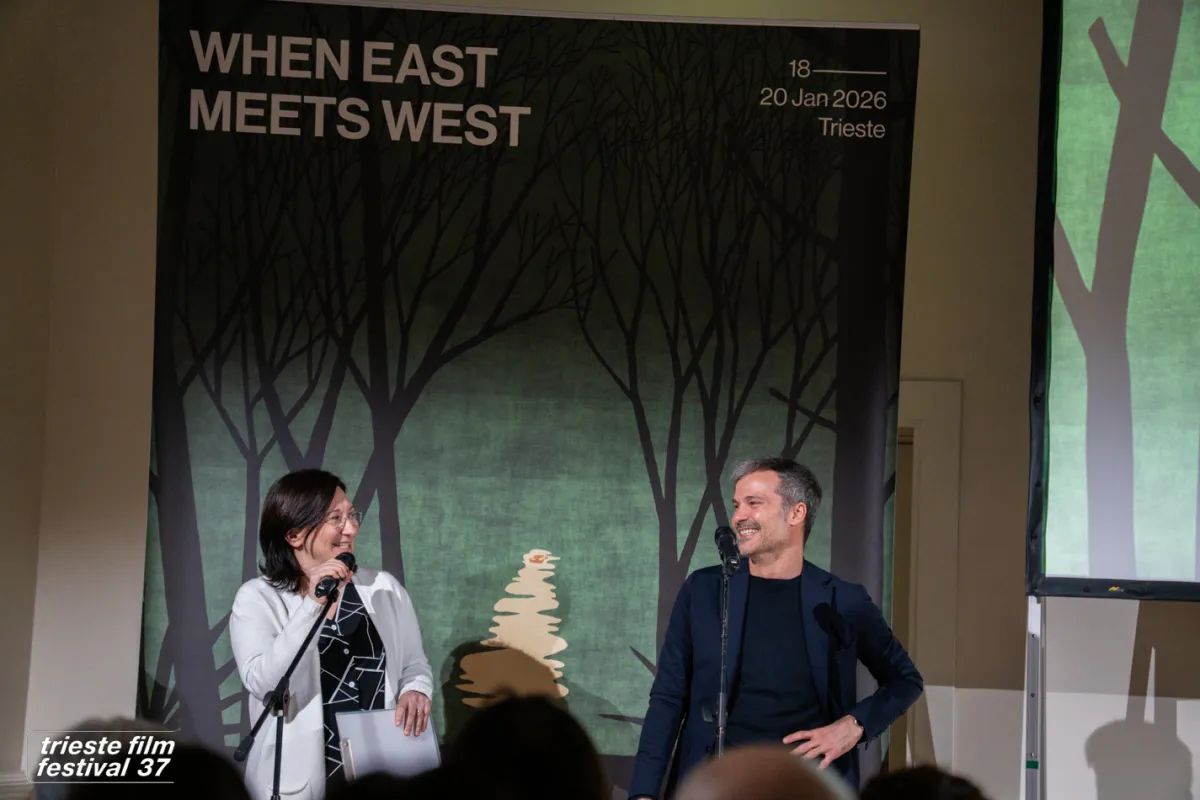
Trieste Film Festival director Nicoletta Romeo. Photo credit: Antonio Ciotola.
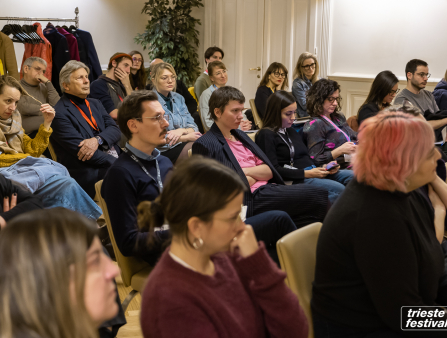
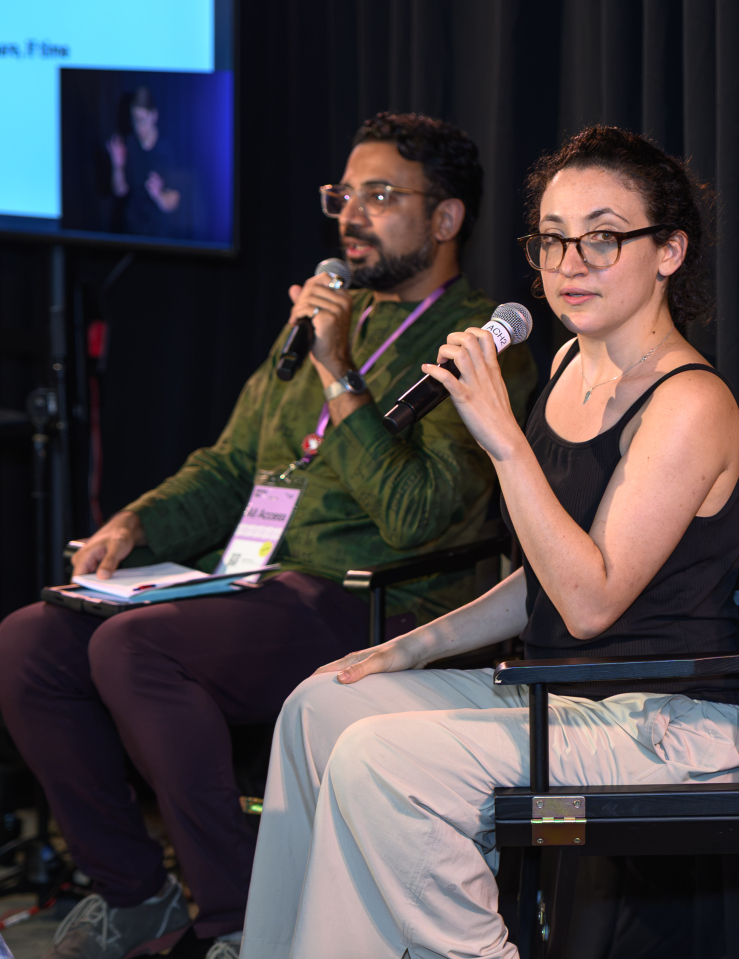
When East Meets West attendees. Photo credit: Andrea Bonazza.
A Market Built Around Development, Not Volume
That theatrical orientation has direct consequences for how WEMW functions. Unlike markets structured around buyers and commissioning editors, WEMW focuses on projects that are already relatively advanced and seeking concrete partnerships: coproducers, financiers, festivals, and creative collaborators.
“We try to facilitate real cooperation in development,” Gropplero explains. “We don’t concentrate heavily on buyers or commissioners, because their availability has become increasingly limited over the years.”
Instead, WEMW positions itself as a space where producers experienced in both fiction and documentary can meet regional and international funds, foundations, and institutions that support nonfiction filmmaking. This includes organizations operating outside Europe, particularly in the United States, as well as funders interested in specific territories where access to resources remains uneven.
The documentary work-in-progress section, Last Stop Trieste, exemplifies a slow, deliberate attention to the projects it showcases. Focused on feature-length documentaries from Central and Eastern Europe, the WEMW section privileges depth over speed, offering extended excerpts, hosting long feedback sessions, and organizing carefully curated one-to-one meetings.
Kateryna Ptashka had the opportunity to present a 20-30-minute cut of her Ukrainian project, Hide Me in the Light, at Last Stop Trieste. The experience, which included valuable discussions and one-on-one meetings, was, she said, an important step before a film’s release. Moreover, she said she was impressed by the overall programming and mood.
“The market is not very large, but it is highly concentrated, focused, and relaxed,” she adds. “Everything takes place in one location, which makes it easy to meet the people you want to talk to and to use your time efficiently. Another strong aspect is the program itself: the keynotes are insightful and reflect current trends in the documentary market.
For Latvian producer Dārta Vijgrieze, attached to Armands Začs’ Going Underground, another defining aspect was the sense that meetings were genuinely prepared.
“Almost everyone had seen our public pitch,” she notes. “That’s not always the case at larger markets. Here, it really felt like a match between people and projects.”
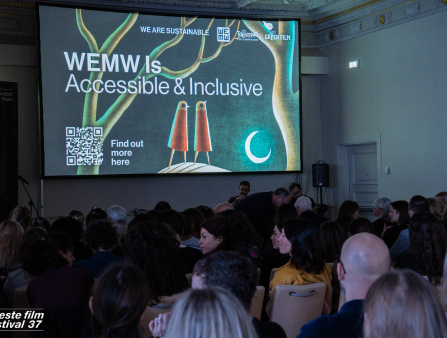
Photo credit: Andrea Bonazza.
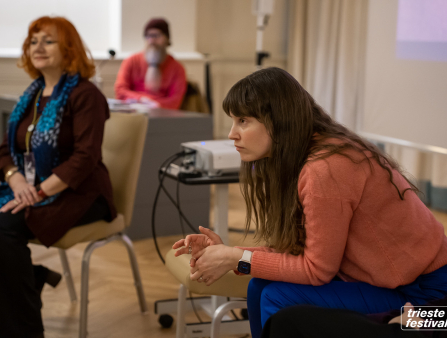
Photo credit: Andrea Bonazza.
Creative Documentary as a Strategic Focus
Several participants highlighted WEMW’s consistent attention to creative documentary as a key differentiating factor. Albanian producer Blerina Hankollari, producing the aforementioned Beyond the Blue Mountains is the Sea, described the market as one of the few places where nonfiction projects are clearly positioned as cinematic works destined for theatrical release, major festivals, and alternative distribution platforms.
“This is evident both in the selection and in the professionals invited,” she says. “Creative documentaries are treated as films, built on strong artistic and production approaches.”
That approach also informs the market’s curatorial logic. When finalizing the Last Stop Trieste line-up, the selection team actively seeks diversity in artistic ambition and market potential.
“We ask ourselves which project might be a ‘masterpiece’—extremely strong artistically, with perhaps limited distribution prospects,” Gropplero says. “At the same time, we identify films with stronger market potential because of their themes or language.”
The results are visible in WEMW’s track record. Projects such as Brotherhood by Francesco Montagner, which moved from coproduction forum to work-in-progress before premiering and winning Locarno’s Cineasti del Presente, demonstrate the market’s long-term accompaniment model. Other alumni have gone on to premiere at Sundance, IDFA, Tallinn, and beyond, often after securing Eurimages support.
WEMW’s freshest success is Biljana Tutorov and Petar Glomazic’s To Hold a Mountain, which has just scooped the World Cinema Documentary Grand Jury Prize at Sundance. The project took part in the co-production forum in 2019.
Impact, Cross-Media, and Expanding the Toolkit
While film remains central, WEMW has increasingly expanded its scope through Inspirational Labs and cross-sector initiatives. Two labs organized with ESODoc focus on impact strategies and documentary seriality, targeting producers who are new to these approaches.
One lab introduces participants to the fundamentals of impact campaigns, while another, led by industry veteran Mark Edwards, explores nonfiction series development, reflecting a growing awareness that documentaries now circulate across multiple formats and platforms.
This year also marked the launch of a Film x Games Connection Hub, designed to foster dialogue between film producers and video game studios around IP development and impact tools.
“This is about diversification,” Gropplero says. “We want to help creators understand where film, documentary, games, and other media intersect.”
The market is not very large, but it is highly concentrated, focused, and relaxed. Everything takes place in one location, which makes it easy to meet the people you want to talk to and to use your time efficiently.
—Kateryna Ptashka, who presented Hide Me in the Light at Last Stop Trieste
Boutique Markets in a Shifting Ecosystem
The briefly announced, and ultimately avoided, cancellation of Sunny Side of the Doc’s 2026 edition has intensified scrutiny of the documentary market ecosystem as a whole. Large, established platforms are increasingly strained by rising costs, shrinking broadcaster involvement, and, in some cases, unclear positioning. IDFA has faced a combination of internal and external pressures in recent years, partly linked to political controversies surrounding its public positioning (or perceived lack thereof) in response to the Israel-Palestine conflict, as well as broader funding challenges affecting the Dutch festival circuit.
Meanwhile, even robust markets like CPH:DOX, Nyon, and Thessaloniki—all of which continue to grow and remain central hubs—operate at a scale that can feel overwhelming for producers with highly specific projects.
In this context, boutique markets such as WEMW are gaining renewed relevance. Smaller, more curated forums are increasingly perceived less as markets in the traditional sense and more as hybrid spaces, part coproduction platform, part lab, part long-term development environment. For producers navigating a fragmented funding landscape, their value lies precisely in their focus.
“I would describe WEMW as a boutique market,” Gropplero says. “The key words are curation and customization.” Rather than trying to replicate the breadth of larger markets, WEMW concentrates on precision: fewer projects, fewer meetings, but greater alignment between participants. Everything takes place in a single location, over a short period of time, encouraging sustained interaction rather than fleeting encounters.
For many producers, especially those working on creative documentaries with strong authorial identities, this model is proving increasingly effective. It reduces dispersion, allows for deeper conversations, and, crucially, creates conditions closer to those of a lab, without losing sight of concrete financing and circulation goals.
Modest by Design, Great by Ambition
At peak time, WEMW operates with a team of around a dozen people; year-round, the core group is closer to three. Its scale remains modest, by design. But in an industry undergoing structural change, modesty can be a strength.
As traditional markets reassess their models and new uncertainties reshape the nonfiction economy, platforms like WEMW offer a compelling case study. They do not replace large international forums, nor do they aspire to do so. Instead, they respond to a growing need for targeted, sustainable, and relationship-driven spaces, particularly for regions and projects that thrive on collaboration rather than volume.
For filmmakers and producers working between Italy and Central and Eastern Europe, Trieste has become more than an annual meeting point. It is a reminder that, in today’s documentary landscape, smaller can sometimes mean sharper—and ultimately more useful.