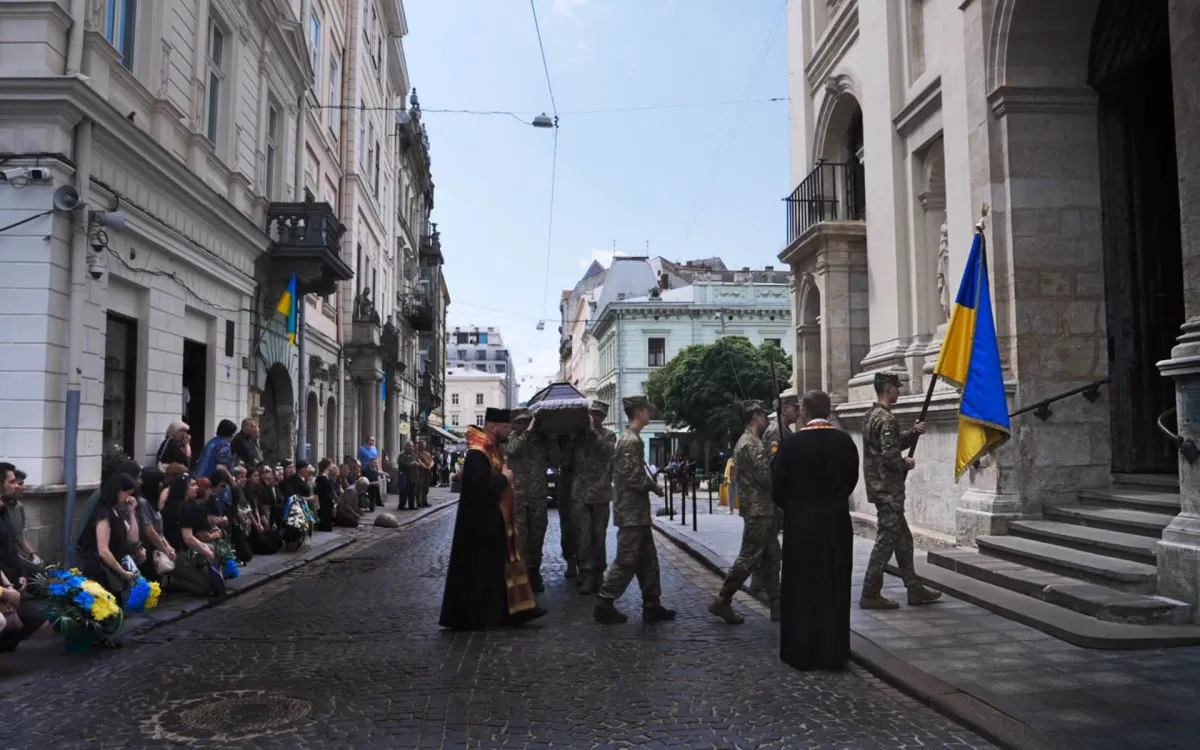


The title of Vitaly Mansky’s Time to the Target refers to “the flight time of a missile or the interval between the departure of an enemy aircraft to perform a combat mission until it reaches the specified target of destruction.” (This we learn at the end of Mansky’s masterful three-hour epic. The text card is followed by the dedication: “With love to my hometown Lviv.”) But the Russian-Ukrainian director’s latest, which will next play IDFA, is much less a “war doc” than a grand cinematic study of a specific place, western Ukraine’s largest city Lviv, where life and death coexist out of necessity.
It’s a place where selfie-taking fashionistas casually share the cobblestone streets with men with missing limbs. (“If you give the Russians a finger, they’ll bite your hand off,” scoffs a soldier.) Where gravediggers complain about working conditions, and a mother in a labor ward speaks of needing to replace the ones who are dying with the newly born.
A musician in the Band of the Hetman Petro Sahaidachnyi National Ground Forces Academy admits to having no plans for the future, since who knows what tomorrow might bring; indeed, he might very well be on the frontlines. And from there we cut to an outdoor dance party that could be a nighttime rave almost anywhere—if not for the little kid determinedly engaged in target practice. (Putin’s face has become the new bullseye.) And still, the funeral-tasked orchestra plays on.
Two days before the February 17 premiere of Time to the Target in the Forum section of this year’s Berlinale, Documentary spoke with the award-winning documentarian (2020’s Gorbachev, Heaven, 2018’s Putin’s Witnesses) and founder of the original ArtDocFest, which was forced to cease activity in 2022 due to Russian censorship and the unjust war. Special thanks to Daria Buteiko for providing translation throughout the Zoom interview. This interview has been edited.
DOCUMENTARY: The film follows three distinct groups—the military band members, the gravediggers, and the city’s everyday citizens. How did you choose these characters and structure? Did you consider including other protagonists?
VITALY MANSKY: When I returned to my hometown, I noticed a big change—there were lots of funerals in Lviv. I started attending, thinking maybe I’d see people I’d known from a past life. But the people I was constantly seeing and meeting were actually the musicians from the military orchestra. Which led me to wonder about what was happening inside these men. How do they process this, seeing the funerals of so many young soldiers? And through them I also found a connection to the ordinary people of Lviv.
And then I was also often going to the cemetery, where I began meeting and talking with the gravediggers. They became the protagonists of the movie, as did the cemetery itself, which is a very important place.
D: Since this film has a nearly three-hour running time, I’m curious to hear what the editing process was like. How much footage did you shoot? How long did it take to get to final cut?
VM: When I first started the movie, I didn’t intend for it to be this long. But once I began editing, I understood that time is very important for this story. And not only time, but also rhythm.
I thought that if I tried to cram in everything I saw at the cemetery, everything I’d experienced, I’d kill the feelings I’d actually had while observing. I chose to just let it breathe. As soon as I made the creative decision to not control the length of the final version, the film started working. After half a year of editing, it became a three-hour cut.
I had quite a lot of material to work with. There was very good footage of people waiting in a bus, for example, and lots of other emotional stories that didn’t make it into the final cut. There was always this question of practicality. As a festival curator myself, I know it’s very inconvenient to program a movie that lasts for three hours. You have to choose between that one film that’s three hours or two films of more conventional length. And we haven’t even talked about television. A lengthy film is problematic for sales and distribution. But in the end, the film cut itself, over practical issues.
D: I found the surreality of daily life in Lviv, where life and death quietly coexist out of necessity, as it does for the rest of Ukraine, quite startling. What most surprised you about your hometown and its inhabitants?
VM: Lauren, you mention life and death coexisting throughout Ukraine, but Lviv is actually quite different from the rest of Ukraine. Take for instance Odesa, where I’m shooting my next movie. There you also have the shelling every day, and wakes for fallen soldiers. That city likewise loses its inhabitants. But in Odesa, you don’t have that feeling of birth and death coexisting that close. In Lviv the feeling is similar to a Bruegel canvas, where life and death occur in one dimension. To some extent, Bruegel’s canvases were my reference for the movie.
As for what surprised me, I met a woman at the cemetery who said, “Thirty-three years ago, my son was born here. And he’s now buried here.” I didn’t understand until she pointed out the maternity ward nearby, which has its windows facing the cemetery. Which is also kind of a metaphor for the coexistence of life and death.
Later when I explored the maternity ward, I was struck by those windows looking out onto the cemetery and the medical operations occurring inside. In winter, the windows are closed. But in the summer, they’re open, and new people are being born, accompanied by the music of funeral marches. So this is a horror. It’s difficult to imagine.
D: You’ve spoken in the past about today’s technology radically changing the language of documentary cinema. Which makes me curious to hear what impact you think our latest tech is having, including when it comes to capturing or shaping images on the ground in Ukraine.
VM: I would say that our new technology actually allows people to live despite being filmed. For example, I might wait an hour in a bus with the musicians. They don’t feel the need to participate in this act of filming with me, they just live. The camera does not turn their reality off. It preserves the reality.
Which is different in comparison to when I first started as a filmmaker. Back then it was wet technology. Documentaries were shot with film and there were just ten minutes of filmstrip that you could put in a camera. It had to be more intense, resources were fewer. With today’s technology, we have a whole new model of talking, a new model of living, which influences how people interact.
D: How, if at all, has your relationship to filmmaking changed since Russia’s annexation of Crimea in 2014 (the same year you were forced to relocate to Latvia), and throughout the full-scale invasion of Ukraine?
VM: I create movies. That is my life. And the annexation of Crimea changed my life. I immigrated from Russia and came to Latvia, leaving behind a country where I’d lived since attending film school, had lived for half my life. A place where my children were born. And yet I realized I didn’t have anything in common with that country.
Ultimately, leaving Russia was a loss, including for my children and family who had to leave their jobs and homes, though nothing can be compared to the sacrifices of the people of Ukraine. But it does feel good to be a free person, just to be able to live my life freely.
D: Is there anything you’d like to add as we wrap up?
VM: I’d like to say that I’m very concerned that people are getting used to the war in Ukraine, have started thinking that Ukraine should give in to Russia in order for the war to end. I consider this to be yet another war, another frontline, started not by Russia this time but by allies. I hope that maybe if people see my films and other Ukrainian films—see the pain that’s inside of these works—then perhaps humanity will win over cynical politicians.