

The magnificent ecosystem of the Florida Everglades is in danger, and one of the most prominent invasive species is the Burmese python, which has flourished to the point that tens, or possibly hundreds, of thousands of them live in those environs. Authorities have their hands full trying to control the population. Since 2013, to raise awareness of the issue, the state has intermittently hosted the Florida Python Challenge, in which anyone can apply for a ten-day free-for-all hunt, and a cash prize goes to whoever removes the most specimens from the wild.
Xander Robin and his crew followed around a dozen of the more than 1,000 people who took part in the 2023 edition of the challenge. The resultant film, The Python Hunt, feels like a burst of barely controlled chaos, as many of the characters scramble through the night yet fail to spot even a single snake, much less capture one.
Robin directed the film under the auspices of fellow native Floridians Lance and Mel Oppenheim, who served as producers, and The Python Hunt unmistakably bears their influence. Its colors are rich, the lighting is saturated, and it’s sometimes shot and edited to resemble a carefully planned fiction film rather than a conventional documentary.
Ahead of The Python Hunt’s theatrical release, we sat down with Robin to discuss Floridian herpetophilia, the logistics of shooting the participants across the Everglades’ sprawling wilderness, and the cinematographic rules his crew set up to abide by. This conversation has been condensed and edited for time and clarity.
DOCUMENTARY: You grew up in Florida. When and how did you learn of the Python Challenge?
XANDER ROBIN: I’ve had this fascination with making movies involving reptiles; I made a short film called Lance Lizardi in 2017. Growing up, there would be these little anole lizards that would get stuck in my house, and we would have a system to remove them. At summer camp, I would play with different amphibians and salamanders. Over the years, you could see that the invasive reptiles had grown larger. At my parents’ house, instead of anoles, there were giant iguanas everywhere. I was incorporating that into some of my work.
So I was aware of the python bounty program. I’d written the python problem into a script, but the movie I was trying to get off the ground about the invasive species issue would have been told mostly through the reptile trade. And Lance [Oppenheim] was just like, “What if you made a documentary about the Python Challenge?” I was like, “What is this?” The next month, I joined the 2022 competition, along with my friend, who ended up becoming our casting director, Harleigh Shaw. The news coverage of the challenge makes it seem like it’s all professionals and that it’s mostly a success. But we saw that 95% of those who joined were amateurs, people trying to be Crocodile Dundee, and for most of them, the challenge is a comedic story of failure.
D: So when you went to observe in 2022, you didn’t necessarily have a plan to film the challenge?
XR: Yeah. The first seven days, we stayed at the Miccosukee Casino, which is right by the Everglades. Richard [Perenyi] goes there in the film. I had a camera, but I was mostly taking photos, meeting people, and seeing if there was something there. After meeting both Jimbo [McCartney] and Richard, I thought there could be a film here. From them, I got opposing viewpoints on the python issue. Everyone was saying different things about it. It was way more interesting than I expected from the news stories.
D: How many participants whom you followed did you meet during that first year, versus the 2023 challenge, which you shot for the documentary?
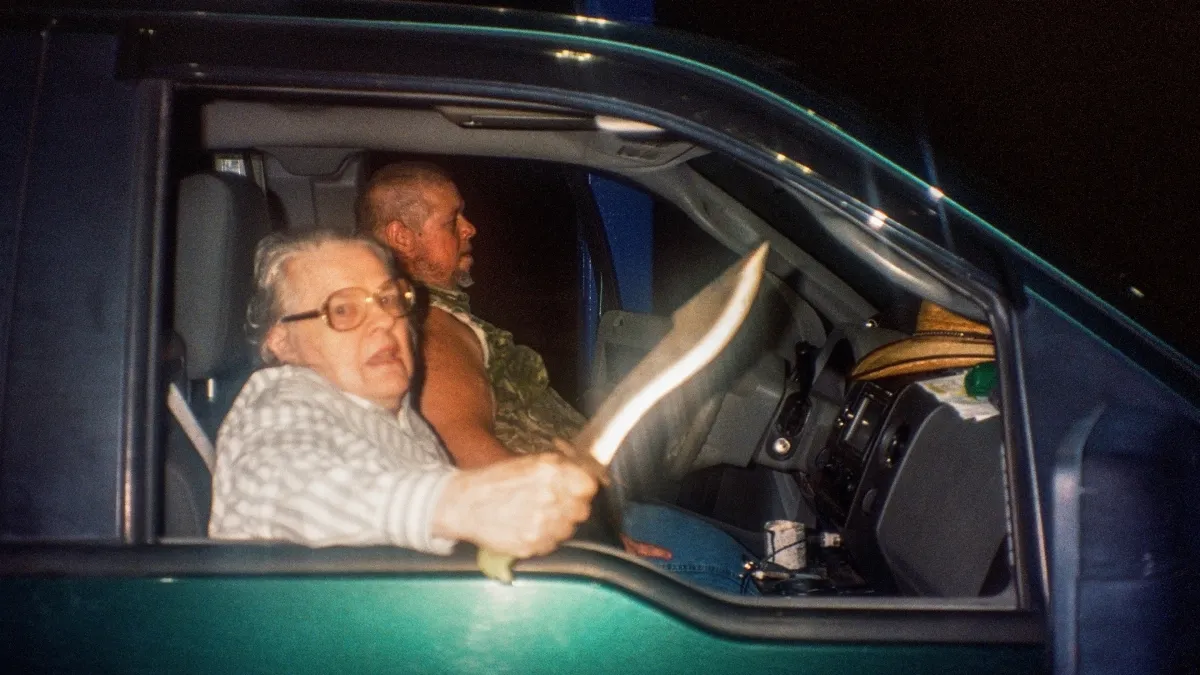
XR: We met a bunch that first year, getting as many people’s information as possible. Harley did some early outreach on Instagram. Most of the people who join the challenge do this kind of thing in some way year-round—even if most of the time, they’re just herping, which is posting pictures of reptiles. A lot of them want some attention for it. We found Toby [Benoit] because he was writing about the challenge for his local newspaper, and he brought a big group. And then there’s Miss Anne, who showed up that first day. We couldn’t have predicted that. Her introduction in the movie was our first time meeting her.
There were some whom we just crossed paths with. Richard had his party, and we met some more participants there. It was almost distracting; there were so many interesting people around, and we were trying to figure out who could be different at the end of the 10 days in a way that could be good for a film, all while doing our due diligence and getting to know them.
D: How did you set up your crew to follow all these people for these 10 days? How did you track them and decide who would have cameras with them at any given time?
XR: We mainly had three single-camera units, with each unit consisting of either me or a unit director, a DP, a sound person, and a producer. Sometimes we would converge, and a unit would have two cameras. There was also a medic and a floating camera assistant, and that was it for the crew. We were based out of a house in Everglades City. It felt like we were making an indie film, the way we concentrated filming into 11-12 days.
As for who to follow, we would feel it out each night, and we would assign a crew with some relationship to go with the characters. Harleigh was one of the unit directors, and she also did some of the casting, so she would gravitate to the people with whom she had a stronger relationship. But we’d also mix and match based on who was available. We’d let the subjects dictate where they were going. If it turned out to be kind of a bust, we’d try to find someone else nearby. We also made sure that each team had a day off. It became a weird chess game to try to figure out who would go with whom. Sometimes members of a unit would have different timings for their 12-hour schedule, so someone could pick up a sunrise. And the hunters were going harder than we were. We had to be ethical about our scheduling, whereas Toby could be out for 18 hours at a time.
D: And for your shooting style, it very much feels in a continuum of the other things that Lance Oppenheim and his team of producers have done. How much input did they have on the look and feel of the film?
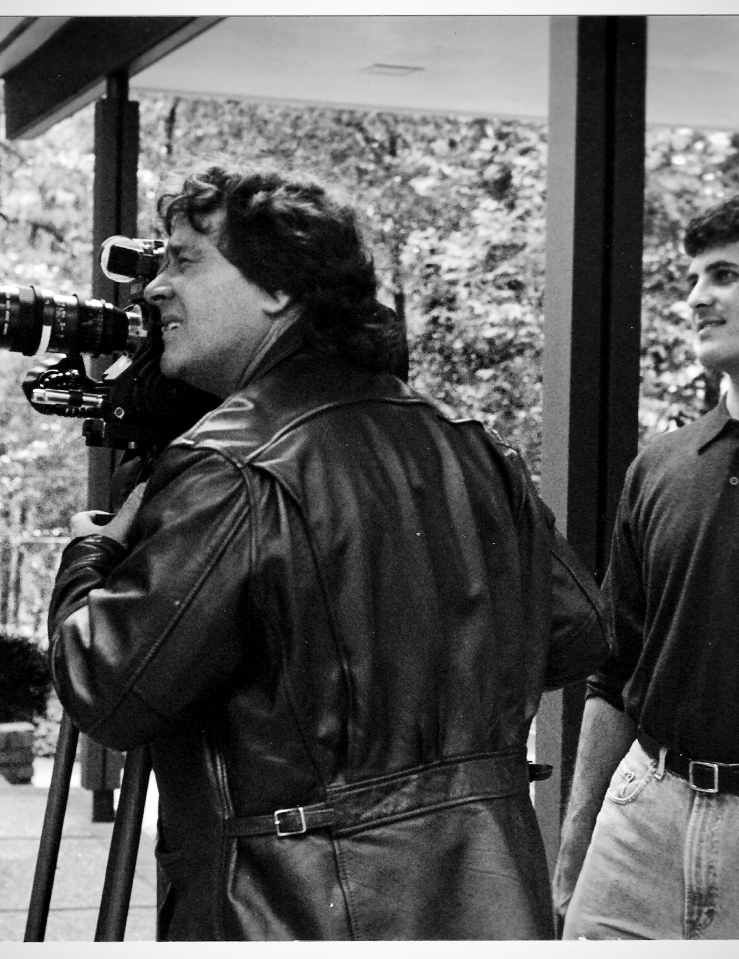
XR: This movie wouldn’t exist without Lance, both with him bringing the challenge up to me and me seeing the documentaries he’s done at that scale. [Cinematographer] David Bolen has worked with Lance a lot. He came down at the last minute to do some shooting and helped set the film’s look. Some of the additional camera operators had also worked with him before. But we tried to create our own set of rules for when to make something beautiful and when to throw that out the window. If something crazy happens, it’s pointless to try to control this or that. The scenario felt cinematic enough to treat it almost like Best in Show [2000], this competition with all these different characters. The DPs and I created a dogma of shooting rules to stick to so our footage would feel unified. But it helped that everyone had worked together before.
D: What were some of those shooting rules?
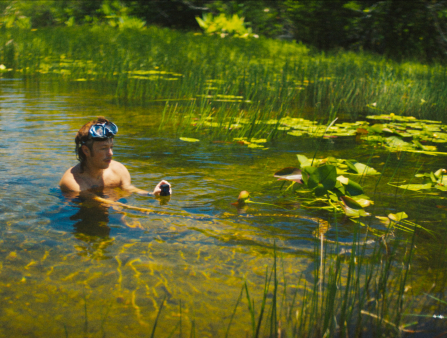
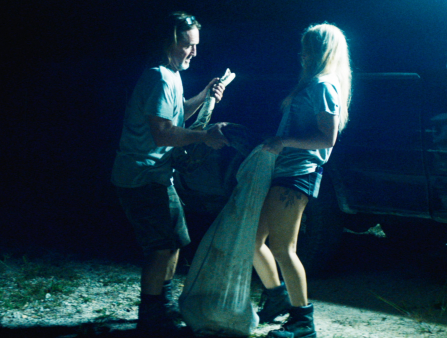
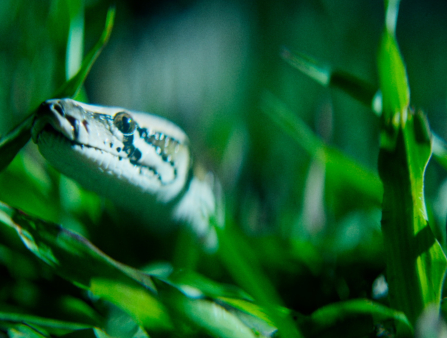
XR: The rules were things like using diopters for special moments, like when we wanted to get into someone’s head, or when someone catches a snake, to try to get that sense of intimacy. That’s how we got all those cool snake shots, by getting up close and personal. And there are simple things, like for the color tones, the days would be hot and vivid, and the nights would be more psychedelic. We’d try to push the brightness at night in strange ways; we were lighting it all with flashlights. Even though it could seem like a horror movie, it never really felt scary at night. I was trying to figure out how to convey the otherworldliness of the hunt at night. After all, you’re running into people in the woods at 4 or 5 in the morning, and it’s not weird. Everyone’s just looking for different creatures.
D: What was the timeline for shooting everything around the event—the events before and after?
XR: The nine-minute section before the title was shot outside of the competition, with Joe Wasilewski giving the rundown of how this all came to be. And then there’s stuff that happened a little later, like the Python Festival. And a lot of Jimbo’s story has more of a suggested timeline, and it was filmed over that summer.
The scenario felt cinematic enough to treat it almost like Best in Show [2000], this competition with all these different characters.
—Xander Robin
D: How’d you learn about the festival? That sequence is so chaotic, this carnival atmosphere where they’re gleefully carving up the snakes. It feels more violent than the hunts. Did you think you’d cut it so quickly when shooting?
XR: I learned about it through Jimbo. He has all these connections in the Everglades community. We covered it mostly full vérité, and as the carnage was happening, we got a little inspired. I thought it was better to editorialize visually rather than be super concrete about the takeaway. That was such a crazy event. It was wild to see all the kids participating and them cutting open snakes. You wonder if all this is really a good conservation alternative, if there’s a reason the state has kept a lot of the carnage hush-hush.
D: The issues are mostly expressed diegetically. Was there a version of this that had more expert testimony or explicit explanations of these topics for the audience?
XR: It’s tough to find the balance. We wanted Joe at the beginning as a trusted source, but then we wanted to be with the characters and in the world as much as possible. I filmed some things that went down different paths to hear more experts, but it always ended up feeling boring and not right for the film. I’d think about what the people in the movie would want to watch. Would they want something that feels like homework? We wanted to explore everything through the lens of the characters. So when Jimbo goes down a rabbit hole, wondering how much the pythons are being scapegoated for the invasive species issue, we thought that was better than using a bunch of talking heads.
D: That reflects this ambivalence around the actual usefulness of the contest. At the end, the movie displays the extremely wide range of estimates for how many pythons are in the ecosystem. Something like half of the people you follow don’t catch a single python; they don’t even see one. It’s existential.
XR: In 2022, I saw zero pythons when I was in the challenge. It’s similar to Hands on a Hard Body [1997], a comedy of errors. But eventually, you just really want to see someone catch a snake, and if you spend enough time out there, you will. And it always happens in strange and unforeseen moments, like in the opening scene. We were looking for chameleons close to the city, and then they caught a python. So much of the Everglades you can’t even travel to, and pythons are semi-aquatic and so good at camouflaging. The huge cold snap that just happened apparently didn’t kill any pythons because they’ve figured out how to burrow and stay warm. The mystery of the Everglades is beautiful to me. I wanted to show that people could do all they can, but they’ll probably never solve this issue, and they’ll never figure out exactly how many snakes are out there.