
Welcome to “Notes From the Real,” a series written by curator, educator, and current IDA Executive Director Dominic Asmall Willsdon. Looking at the reality-based practices documentary trades and allies itself with (the essay, testimony, visual anthropology, and more), the column will illuminate the work, value, and purpose of documentary as seen from the outside, from the edges, from the real.
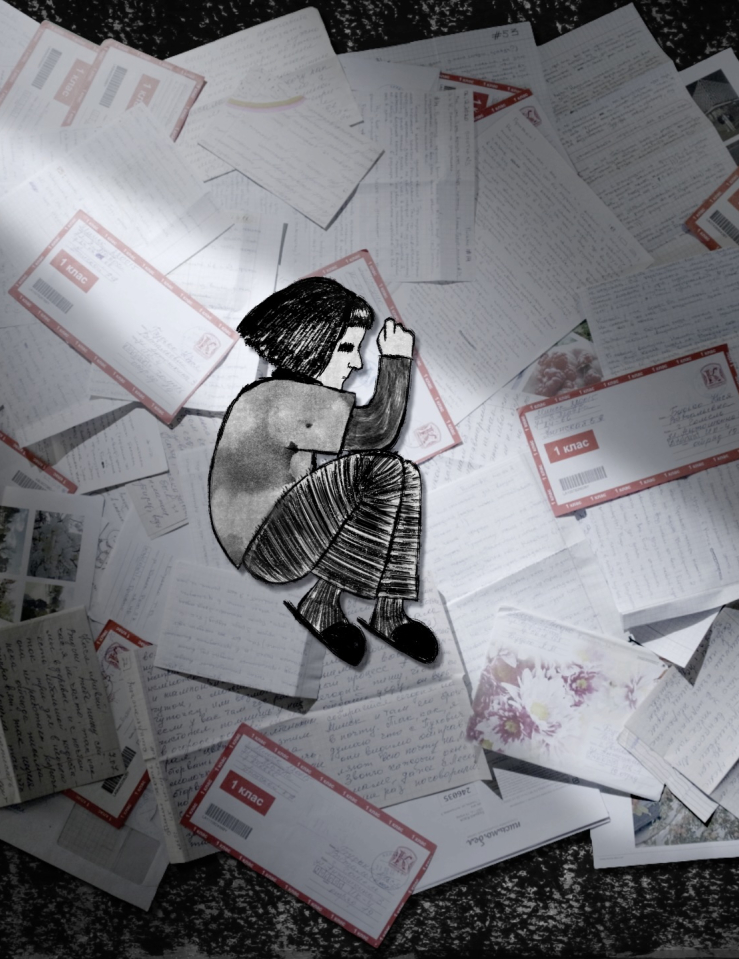
Vladlena Sandu’s Memory (2025), which I saw at Visions du Réel in April, holds schooling and learning in tension, and asks how filmmaking can live in the play between the two. The film recollects Sandu’s childhood in the 1980s and ’90s, broken by the Chechen wars and the legacy of earlier Soviet violence. It begins, before the title, with a tracking shot—black-and-white flickering as if on celluloid—of a figure cradling the head of a gorilla suit. King Kong, we will learn. Sandu’s voiceover begins with remembering: “I remember when the USSR collapsed in 1991,” followed by the facts of the war that Russia initiated against Chechnya in 1994, its casualties and refugees, the destruction of Grozny. This film, she says, is an act of acknowledging her past, both recognizing and admitting to it, as if there were fault, and an effort to understand the cycle of violence across generations.
After the title, a clapperboard—indicating this scene has been created for the camera—introduces a girl playing in the sand at a beach in Crimea, surrounded by rainbow-colored balloons and pinwheel flowers. Throughout the film, Ukraine represents a state of peace. Then come the years of childhood before the war: school uniforms, doctrinaire Soviet-era textbooks fronted with a portrait of Lenin (the artist’s given name is a contraction of Vladimir and Lenin), the child Vlada forced to write and draw with her right hand, dictation and corporal punishment—the state’s constraints on the body and on the mind. Across the street from her school, there’s the Rainbow Cinema: a counterinstitution, where a different kind of learning is possible. The child skips school to see films of King Kong, her hero. A King Kong (someone in a gorilla suit) accompanies her throughout the film like an imaginary friend.
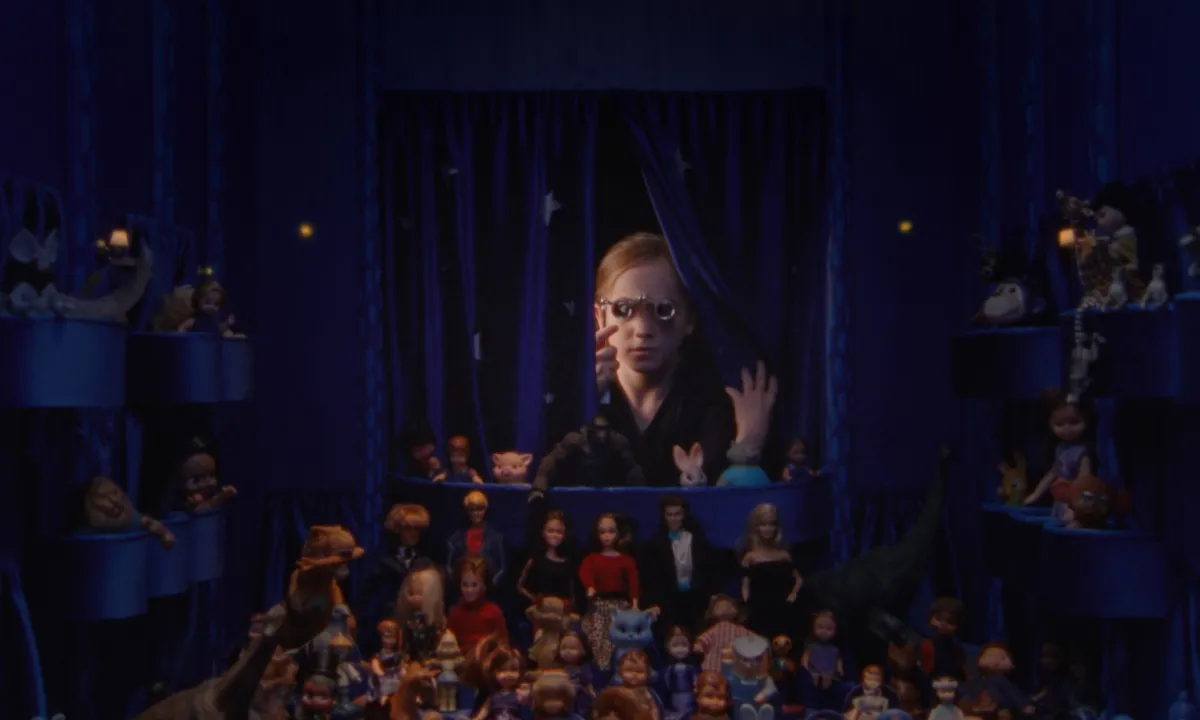
Memory moves between these two institutions—school and cinema—as modes of being in the world. Her voiceover is schooling; her imagery (almost all of it is make-believe) is a space of learning. Visually, the film could be the kind of documentary that a child might make, a true story playing across imagined worlds. Factual testimony runs alongside images created for the film: fashion dolls used as in child therapy, Swan Lake played on loop (the Soviet and then Russian governments’ way of suspending radio and TV broadcasts at moments of national crisis, here referring to the coup against Gorbachev). These are tactics to surface what cannot be faced directly, or to face it by concealing it. It is bold to tell a real and painful story in a way that allows us to doubt its veracity—to doubt what really happened. At the end, the actor in the gorilla suit removes the ape costume head. It is Vlada. It has been Vlada all along. I am cinema, my own imaginary friend.
In a conversation after the screening, Sandu described the film at first as not a documentary, and then as a hybrid documentary—a common term now, though what work the word hybrid is doing and what category it wants to keep clean, is unclear. The artistic model she returns to is Raphael’s School of Athens (itself a memory, of a reproduction in a book of her mother’s she knew before the war): philosophers from different centuries in the same imagined space, in dialogue that history never arranged, in a building that never existed—made for a public place of collective encounter, and the predecessor of the secular tradition of mural painting that followed the church fresco into our streets and civic spaces. Here we see Socrates and Plato together—Plato the documentarian of Socratic dialogue. School of Athens is an allegory of learning as dialogue. Memory functions as a similar allegory: an allegory of documentary. Documentary aspires to cure memory loss. We make documentaries in order that aspects of reality should not be forgotten.
Unlike King Kong, documentary needs to hold schooling and learning together, the real and the imaginary together. A documentary also needs to be cinematic—it is not enough just to tell it as it is, or rather, telling it as it is can involve making things up. The question of what a documentary’s obligation is, beyond what it documents, beyond the story it tells, is one we always need to ask.
Documentary is a reality-based art practice, but it doesn’t always know its neighbors well, and knowing them might help us ask that question.
Social practice—the tradition of art that works through designed and recorded encounters with real people and real situations—is one of documentary’s closest neighbors, though the two have been running parallel tracks without enough acknowledgment of each other. Sandu’s work-in-progress, Transposition, also presented at Visions du Réel, stands at their crossroads.
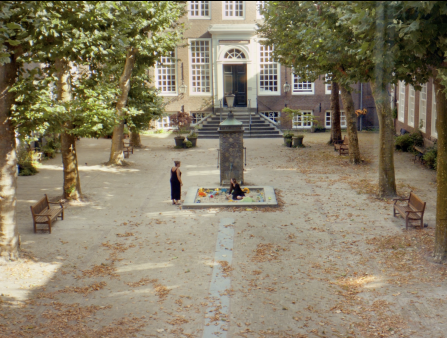
Transposition.
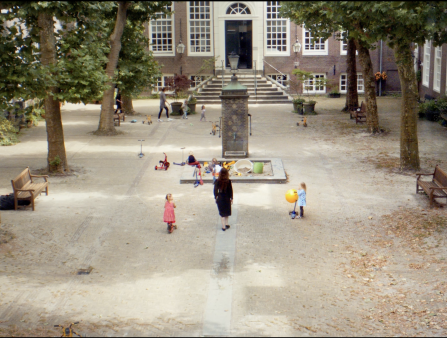
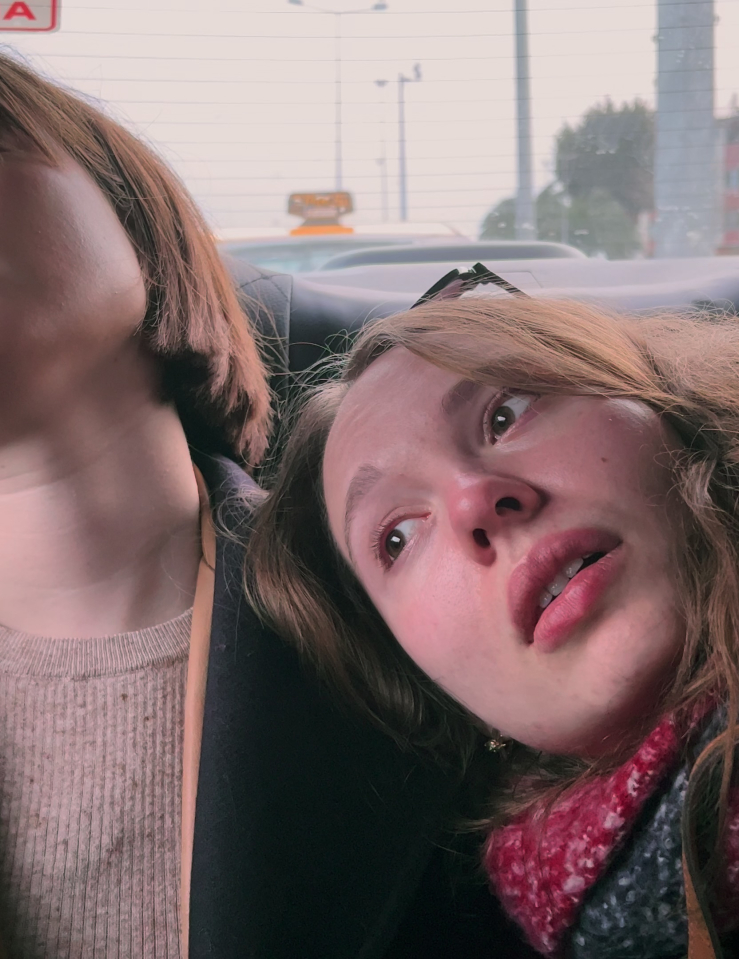
Transposition centers on a children’s sandbox in an Amsterdam courtyard where Sandu temporarily lived after the Russian invasion of Ukraine in 2022. In the pitch trailer, she is in the sandbox—playing with toys, rolling around in the space—when a resident comes out to confront her, with an appearance of kindness: “My children are watching you, are you all right?” It isn’t a trailer describing a film to come. It documents a performance around which a film will later be made. To my eyes, this is social practice: a scripted and unscripted encounter in a space that is partly designed and partly as found, through which something about the surrounding social reality—displacement, belonging, the enclosure of children—becomes visible. The social practice artist is often a guest in someone else’s neighborhood, someone else’s life. You see differently as a guest. You are also accountable in specific ways: for what you take, for what you leave behind, for what your presence changed.
Before joining the documentary field, I spent a long time as a curator of social practice—or what the art world called, at different times and in different registers, public practice, relational aesthetics, community-based art, socially engaged art, new genre public art (none of these names were ever fully accredited). I curated the retrospective of Suzanne Lacy, who is as close as social practice has to a founder. Since the late 1970s, Lacy has been organizing large-scale public and collective performances: on the lives of women, on rape and violence, on aging, on race, class, and political division. Her projects entail working for months or years inside a community, building relationships, organizing a structure, engaging with PR and advocacy—then staging a culminating public encounter that gives final form to the participatory process.
The work is research, organizing, performance, and film in sequence. What remains are archival materials, photographs, and video documents: the material of documentaries. And yet that material rarely comes to take the form of a documentary. Documentary has its conventions. It embraces them. It aspires to approach objectivity, to build trust, to allow something to escape the personal and the familial and enter the minds of strangers. Social practice, for all its vitality, rarely takes on that obligation. And yet in social practice, we feel the contingency and strangeness of human encounter with a vividness that documentary sometimes loses when its stories distract us.
Both practices generate the same questions, arrived at separately, in different idioms. Who had agency in this encounter? What is the artist’s responsibility and debt to the participants? What is the relationship between process and image, and between social impact and artistic impact? The deeper parallel is that both practices are organized around a commitment to making work that produces knowledge of the real rather than alternatives to it. That commitment—to reality as the primary object, to encounter as the typical mode—is, I would say, educational in nature.
The etymology is suggestive: documentum—lesson, instruction—from docere, to teach or to inform. Same root as docent. Same root, to be sure, as doctrine—the settled teaching that closes inquiry rather than opening it. But etymology isn’t meaning.
Learning is what happens in the interaction between two different types of knowledge, not the decanting of something from a full vessel to an empty one.
Social practice didn’t arrive at education by accident. The so-called “educational turn” in contemporary art—the movement that ran roughly from the early 2000s through the 2010s—made explicit what had always been implicit in Lacy’s practice and work like it: that the designed encounter with real people and real situations is a form of inquiry, and that inquiry is a form of learning. Its touchstone was often Ivan Illich’s Deschooling Society (1971), which argued that formal schooling systematically destroys the conditions for genuine learning by replacing them with compliance and certification. Against that, the educational turn proposed art as a space for the kind of learning that schools prohibit.
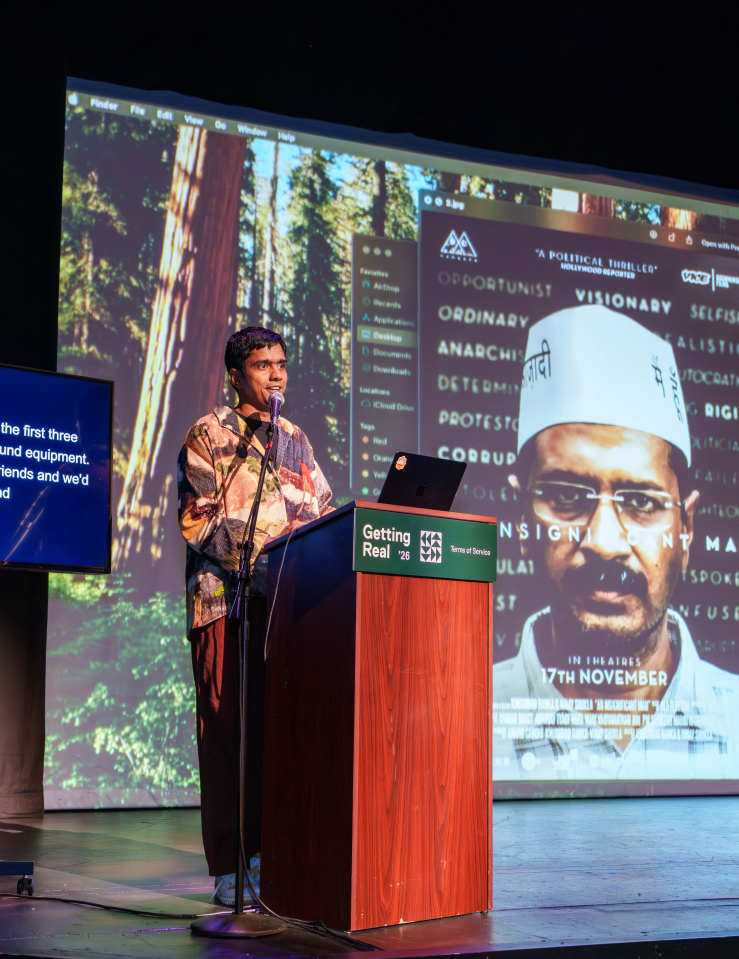
It produced artist-run schools, biennials organized as seminars, exhibitions that functioned as encounters and dialogue rather than displays. Getting Real is to film festivals what the educational turn in art biennials sought to produce in place of the exhibition. This is on my mind as we prepare for Getting Real ’26. The turn, however, transformed some elements of the institutional envelope it was trying to escape, and I know this from the inside.
One of those biennials was the Bienal do Mercosul in Porto Alegre, Brazil, where I was a curator for the 9th edition in 2013. By then, the Mercosul Biennial had developed such an extensive and dedicated educational role—reaching into schools, communities, and public life across Porto Alegre and the surrounding state of Rio Grande do Sul—that it was seen worldwide as “the education biennial,” a perennial pop-up art school. But it was also a large, well-funded institution with inherited metrics and hierarchies of expertise.
The radical aspiration and the institutional envelope were not in opposition; they were intertwined. It was through collaboration with my cocurator of pedagogy, Mônica Hoff, that I got clear about what education should be: the encounter between someone who knows something and someone who knows something else. Learning is what happens in the interaction between two different types of knowledge, not the decanting of something from a full vessel to an empty one.
I was still working through these questions when, with Sarah Rifky and Noah Simblist, I began developing an exhibition—a biennial; in fact, a perennial pop-up school—about the educational impulse in social practice and what it might mean to see all art as educational. Sarah and I both left before it could be realized. It became instead a recently published book edited by Noah: Living to Learn: Art & Education for the Common Good (2025), covering more than 20 years of thinking and practice across the Americas and the Middle East.
During those years, our thinking would return to something Sarah had made a practice of saying: “Every artwork is a school.” Noah would distance himself from it—surely not every artwork is a school? I read it as a mode of aspect seeing: not a claim about what all art is, but a question about what happens when you look at it that way. I wonder now whether social practice and documentary are two art forms—mural painting might be another, the church fresco before it—in which every artwork actually is a school. Not as a way of seeing but as a structural fact. Both are committed, at the core of their practice, to shared learning, to public pedagogy.
Visions du Réel makes room for the imaginary—visions of the real, not its record. Get real, by contrast, is an instruction to dispel illusion, to face what’s actually the case. ‘Here’s what really happened.’ Both modes, it seems to me, equally belong to documentary.
The tension between schooling and deschooling animated social practice through the educational turn. The question was never whether to have structure—it was what kind of structure enables genuine learning and what kind forecloses it. I was inside that tension curating social practice within museums and biennials, which meant working simultaneously with the radical aspiration and the institutional envelope that made it legible to a broad public. I came to feel that the opposition between schooling and learning cannot be overcome because institutions cannot be overcome. Institutions are how work escapes the intimate social relations in which it is made and becomes public—and a public is always composed of strangers.
What interests me now is that this tension is not external to documentary, as it was to social practice. Social practice set itself up, at least rhetorically, as a choice of the experimental over the institutional. Documentary has to be both. Its commitment is to communicate, to transmit something, to hand something over. The inherited, shared conventions of documentary are its school characteristics: what has been accumulated, across a century of practice, about how to carry knowledge of the real to people who were not there or don’t see it. And the departures from those conventions—the formally restless aspects of filmmaking that put the viewer in uncertainty—are its moments of deschooling or of learning. The play between those two is where documentary is alive. You need the school. You also need to keep leaving it. And coming back.
Documentary’s museums and biennials are its festivals and convenings. It depends on funders and buyers in ways comparable to social practice art. From Visions du Réel to Getting Real: two of our field’s institutions whose titles name the real as documentary’s object and task, though they name it differently. Visions du Réel makes room for the imaginary—visions of the real, not its record. Get real, by contrast, is an instruction to dispel illusion, to face what’s actually the case. “Here’s what really happened.” Both modes, it seems to me, equally belong to documentary.
Getting Real is where we talk about the documentary community, what it is, who it encloses, and what they share. In the last issue, I borrowed a formulation from Erika Balsom—that we in documentary are a reality-based community—which is the concept behind this series of notes. I recently came back to remarks Caty Borum Chattoo made at Getting Real in 2018, presenting the “State of the Documentary Field” report. One of the things that’s really special about this community, Chattoo said, is that it is a community. “You can look historically,” she said, “and see that the practice and art [of documentary] was shaped by a group of people who worked together and trained one another [...] Documentary has always been comprised of this training, and generosity and mentorship.”
Training is close to schooling—induction into established habits of mind and practice. There needs to be that. But documentary is, and has been, a group of people who learned from each other, and whose work was produced out of the encounter between someone who knew something and someone who knew something else. Those someones and somethings span documentary’s makers, participants, and audiences. Social practice carved out a special corner of contemporary art that was attuned to such things, which is documentary’s whole being.
We are not only a reality-based community. We are a reality-based school community. Getting Real, returning every two years, is its own kind of perennial pop-up school. This year, as programmers, producers, and participants (there is no audience for Getting Real, only participants), we will want to hold schooling and learning together. But it cannot be a school reunion, rather, it will be a space to honor the conventions of documentary—to sustain and champion the institution that it is—while at the same time crossing the street to dialogue with our neighbors, and allowing what we do to be changed by that encounter.
This piece was first published in Documentary’s Summer 2026 issue.