

Another year, another Sundance—but this is the last one slated in Utah. Although this isn’t the first time Sundance Film Festival has moved (and it wasn’t even named “Sundance Film Festival” until 1991, more than a decade after its first), pre-fest chatter makes the 2026 edition sound like it might be a premature wake. Newly announced Sundance Institute CEO David Linde (most recently head of Participant) officially starts next month. Whatever the atmosphere on the ground, the festival’s documentary programming continues to mix celebrity biodocs, quirky portraiture, and social issue documentaries.
Trends-wise, we spot more of this supposedly elevated true crime, migrant stories, documentary animation, and a bevy of current events, including three Israel-Palestine themed features. Aside from American Doctor and IDA Enterprise–supported Who Killed Alex Odeh?, All About the Money also includes a Gaza activism-related twist. Censorship and the increasing threats on creative freedom of expression are also prevalent.
Our annual curtain raiser of Sundance sales titles attempts a curated list across all of its different sections that we think deserve a second look, or offer more depth than their descriptions may permit. It is not meant to be a comprehensive review of all worthy titles. In the coming week, we’ll be posting nearly a dozen interviews with Sundance-premiering filmmakers. And Anthony Kaufman is covering the sales outlook from the ground (you can refresh with his 2025 report here).
American Doctor
Opening with a single-shot sequence of a young girl arriving via ambulance to Gaza’s Nasser Hospital, American Doctor connects the emergency work of three U.S. surgeons during the short-lived January–March 2025 ceasefire with their political advocacy in the halls of Congress and before the American public. Editors Christopher White (Love Free or Die) and Ema Ryan Yamazaki (Black Box Diaries and the 2024 IDA Best Short–winning Instruments of a Beating Heart) mix together vérité sequences from the hospital with the doctors’ speeches at conferences, media appearances, and archival U.S. broadcast coverage. This forceful documentary brims with cross-cultural compassion and pleas for American accountability, though a furiously paced coda—while devastating for its hospital update—unnecessarily imitates the rhythmic beats of biased broadcast claptrap. First-time feature director Poh Si Teng (producer of St. Louis Superman and IDA’s former director of funds and the Enterprise Program) produces with Kristine Barfod (Black Snow, The Cave) and Reem Haddad (like Teng, a former commissioner for Al Jazeera English). The experienced team’s combination of creative input and investigative chops makes American Doctor a sure bet for broadly accessible documentary rabble-rousing.
—Abby Sun
Closure
Returning to Sundance after premiering his previous feature, All These Sleepless Nights, back in 2016, Michał Marczak arrives armed with a portrait in and of restraint. From its logline alone (a father scours the Vistula River in hopes of finding the body of his son, who mysteriously disappeared), Closure appears to work within the confines of the ever-expansive “true crime” genre of documentary. And while the story of Daniel’s search cannot help but be inflected by that generic association, Marczak insists on a disciplined understanding of bearing witness. Serving as his own cinematographer, Marczak stays close to Daniel, opting for a polished vérité approach that continues the filmmaker’s interest in blending fiction filmmaking with documentary practice (in this, he’s helped by a thrumming synth score that boasts, among its many contributors, award-winning composer Hildur Guðnadóttir). Staid yet dynamic, serious yet never dour, Closure feels like a discovery within the World Cinema Documentary Competition, even as it should serve, instead, as a reminder of Marczak’s talents in making a study in grief play like an audience-friendly crime thriller.
—Manuel Betancourt
Cookie Queens
With the post–Sundance lineup announcement of Archewell Productions’ involvement and thus Meghan, Duchess of Sussex, joining as an executive producer, Cookie Queens appears to be a sickening-sweet entry into the realm of children’s competition documentaries. But behind the nostalgic shiny exterior is a tale as old as America: the valorization of profit-making for others. In this mostly-vérité affair, veteran director and producer Alysa Nahmias rotates between four girls, who each fulfill different archetypes of high-achieving family ambitions. Lensing from Antonio Cisneros is sharp and sensitive. The North Carolina state record-holder, Olive, provides the socioeconomic and emotional base of this tale. Where does the pressure to sell come from? As a former Girl Scout Brownie myself, I was horrified to learn the financial details: scouts earn just $1 per box for their troop activities, and parents pay for their inventory upfront. In the documentary field, we would call this type of distribution offer a junk deal. But Cookie Queens ultimately lands on an uplifting ending for its winsome quartet (I checked out Olive’s cookie website and can report that she has a relatively modest goal of merely 5,000 boxes this season), which should ensure the film’s own positive net sales.
—Abby Sun
The History of Concrete
Don’t let the title fool you, John Wilson’s The History of Concrete is no academic excursion into the origin of the world’s most widely used man-made material. Well, it is that, to an extent. But for anyone who enjoyed the essayistic forays into curiosity that made up HBO’s two-season series, How To With John Wilson, this feature-length extension of Wilson’s visual pun-laden nonfiction work (once more driven by the filmmaker’s playfully anxious voiceover) will feel warmly familiar. Concrete here is but the preamble to various ramblings about everything from infrastructure to Hallmark movies. Backed by the same team that brought How To to life from 2020 to 2023—including producers Clark Filio, Shirel Kozak, and Allie Viti, as well as camera operator Nellie Kluz—and newcomers to the Wilson team, including the Marty Supreme team of Josh Safdie and Ronald Bronstein (whose exec producer titles will make sense to those who catch the film at the fest), The History of Concrete delights precisely because it stretches Wilson’s man-armed-with-a-camera form to its very limits. The result is the closest Wilson might come to making a witty and ironic crowdpleaser.
—Manuel Betancourt
Jaripeo
The rural rodeos in Penjamillo, Mexico, that give Jaripeo its title are rife for the heady, intellectual exploration around queerness, desire, and masculinity that Efraín Mojica and Rebecca Zweig are intent on dissecting in their debut feature, which is backed, it must be noted, by coproducers Juan Pablo González and Gerardo Guerra (who collaborated on Dos Estaciones and Caballerango). Billed as a hybrid documentary that artfully blends flirty Super 8 footage with grounded vérité scenes (not to mention stylized interludes dreamed up by Mojica, a conceptual artist), Jaripeo is ultimately a rather straightforward personal doc, cut together quite capably by editor Analía Goethals. In a year where the LGBTQ offerings at the fest feel decidedly muted (especially given Park City’s long history of supporting bold, queer filmmakers), Jaripeo, tucked away in the NEXT section, stands out precisely because it offers a welcome riff on the coming-out tale. Only this time, that well-worn trope is wrapped around cowboy hats, silver spurs, and a lustful vision of rodeos that complicate simple ideas of Mexican machismo.
—Manuel Betancourt
Kikuyu Land
Produced, among others, by Moses Bwayo (a 2023 IDA Award winner for Bobi Wine: The People’s President), Kikuyu Land is a history lesson on Kenya’s colonial past and an examination of its effects in the country’s present. Co-directed by Andrew H. Brown and Nairobi-based journalist Bea Wangondu, who serves as the film’s guide, the documentary is structured as Bea’s investigation into the land repatriation of the Indigenous Kikuyu people who were swindled out of their ancestral land. Yet the film also doubles as a personal archaeology of Wangondu’s own family’s involvement in such matters, upping the stakes in what would otherwise feel like a dry, didactic piece. Similarly, Brown’s cinematography (which earned him an IDA award nomination in 2023 for Between the Rains) gives this labyrinthine legal battle a sleek aesthetic, capturing the beauty of the land with polished authenticity. Telling a hyper-local story yet brimming with global topicality, Kikuyu Land could easily follow in the steps of Bwayo’s own well-received and well-traveled doc.
—Manuel Betancourt
Once Upon a Time in Harlem
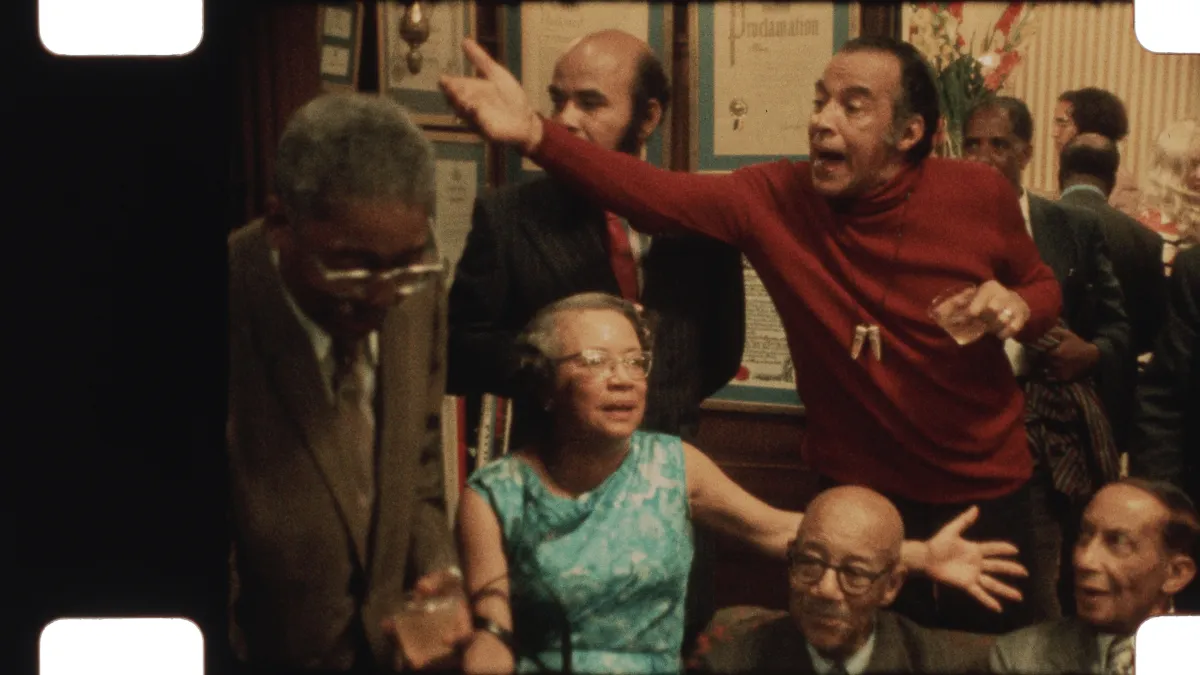
Billed as a co-directed effort between William Greaves, who passed away in 2014, and his son David Greaves, this doc resurrects nearly 30 hours of 16mm footage filmed over one magical evening at Duke Ellington’s house over 50 years ago. This gathering assembled the then-living luminaries of the Harlem Renaissance to explicate and debate the artistic and sociopolitical significance of this specific creative flourishing. On the 100-year anniversary of William Greaves’s birth, this finally-finished film is a family affair: alongside David, his daughter Liani Greaves produces with editor Anne de Mare. Lynn True, best known as a Maysles collaborator, also cuts. The finished film ably weaves together archival photos of the figures, their works, the magazines, and the politicians that were mentioned during the filming. But it’s really the second half of Once Upon a Time in Harlem that comes alive. The historical significance, financiers, mostly female salon organizers, Marcus Garvey’s Back to Africa movement, and more come under scrutiny from the spirited crowd. And in true winking Greaves fashion, the project itself is also a focal point.
—Abby Sun
Editor’s Note, January 21: Jaripeo’s producer credits have been updated.