
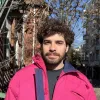
My relationship with cinema is, above all, the search for a voice and an image. Such a search involves finding, within facts, memory, and possible histories, mirrors in which to recognize oneself. Cinema is a way of tracing a map that allows you to situate yourself within a narrative—or, in my case, within a territory.
Despite my having been born in Paraguay, my own country has always felt rather elusive; it has always felt like a territory to be unraveled. Far away from Paraguay, I found a photographic archive by Italian artist and ethnographer Guido Boggiani that offered me an entry point into rediscovering my own homeland. It may seem unthinkable to non-Paraguayans, but it was that moment when I discovered the history of the Chaco.
In Paraguay, we were never taught in history classes about the Indigenous people of the Chaco. The Paraguayan national narrative erased Indigenous peoples from history while proclaiming Guaraní as an official language. Guaraní survived and merged with Spanish to create Jopara, a mixed language that became a tool for building a national identity while erasing the country’s Indigenous cultural diversity.
Miles away from where I was born, I came across documents and writings about this territory that reshaped my idea of my country. I was stunned. Why was I discovering these Chaco communities only now? Why this collective amnesia? What had happened for these images to be forgotten? Who was Boggiani, really?
That Soul Stealing Device is a feature-length documentary whose origins lie in Guido Boggiani’s long-unseen photographs. In the late 19th century, Boggiani captured images of the Ishir-Tomárâho in the Paraguayan Chaco. My documentary revisits these photos over a century later as a tool to deconstruct both the colonial gaze that still shapes our cinema and the dynamic of power behind how Indigenous people are visually represented.
This project, though, has had many lives. The documentary as it exists today is the product of a number of failures—or rather, detours—that eventually helped me sharpen what it is I wanted to accomplish with Boggiani’s archive. That took several trips to Paraguay, many conversations with potential producers, and the kind of production mishap (a broken hard drive!) that nearly derailed the entire project.
I’m writing this in March 2026, when we are still waiting for resources to finish the postproduction of the project.
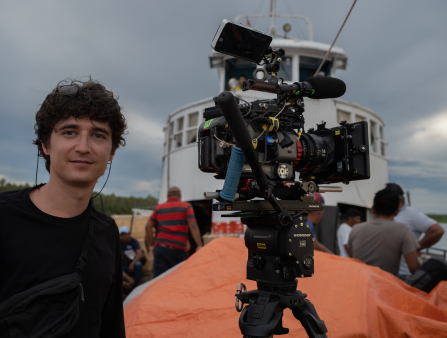
Andrea Pietro Munafò (director of photography). Photo credit: Giuliano Franco Ochipinti.
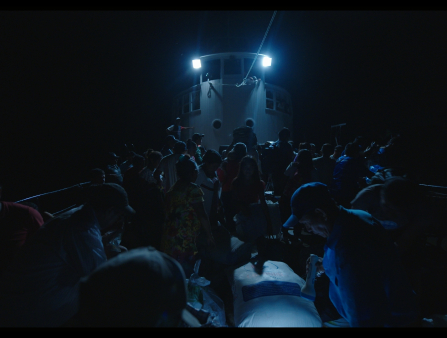
That Soul Stealing Device.
September 2018
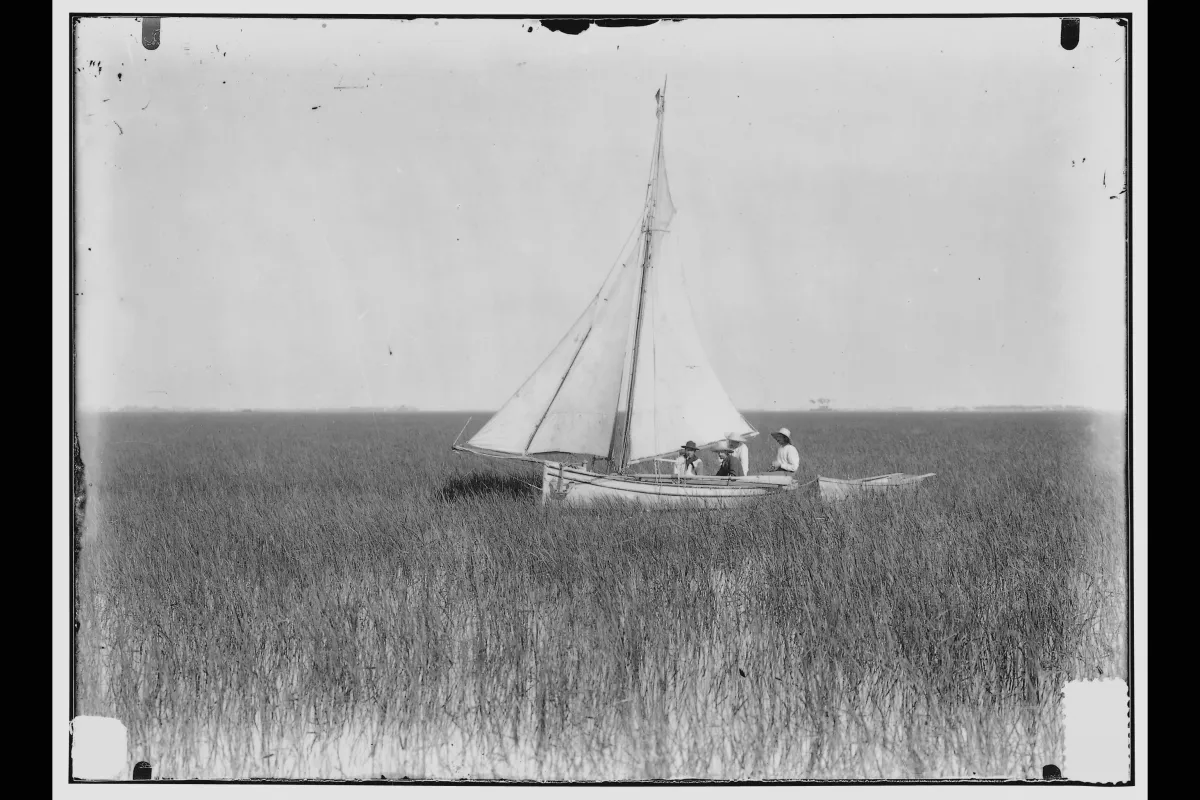
While attending the University of Bologna, I wrote my undergraduate thesis on the Ishir community of the Paraguayan Chaco for my bachelor’s degree in drama, art, and music studies. During my research, I came across the photographic archive of Guido Boggiani, who had produced some of the first photographs of the Chaco while studying the region and its people.
I had already seen his name before. In Asunción, there is an important avenue named after him, but I didn’t really know his work. In the archives, I started to find quotes from his diaries and reproductions of his photographs.
When I saw these photographs, I was struck by how carefully they were made: the technical quality, the composition, the way the landscape was framed. At the same time, what surprised me most was the relationship between Boggiani and the people he photographed. There seemed to be a certain closeness between them. In some photographs, people are smiling at the camera or posing in ways that recall classical sculpture, such as Michelangelo’s David.
Alongside the photographs were always excerpts from his diaries, in which he wrote about the immensity and beauty of the Chaco region. Through these images and texts, I began to construct my own imaginary idea of the Chaco.
November 2019
When I began studying cinema at the Cineteca di Bologna, I returned to the Boggiani archive and started thinking I could use this European historical figure as a kind of access key to go to Paraguay, to the Chaco, and make a documentary. As I was living in Italy at the time, I thought this European connection might help me find production funding there. A small production company, Keep Digging Productions, showed interest in following the project.
I decided to assemble a team to travel to the Chaco and bring this initial idea—mainly a personal exploration of territory, identity, and the lack of an audiovisual imaginary of that place— into practice.
February 2020
Paraguay remains a distant place in the imagination of many, and the Chaco is even more distant for many Paraguayans. This western region of the country, sparsely populated yet covering more than half of its territory, is currently facing multiple crises, particularly due to deforestation, which ranks among the highest in the world. In February 2020, I asked two Italian colleagues to travel with me. Edoardo Ferri and Caterina Basler supported me logistically with their technical equipment. We had no funds, so the trip was entirely self-financed: each of us contributed what we could with the idea of creating a kind of proof of concept while we were there, in hopes of later seeking funding.
After a four-day journey along the Paraguay River on the Aquidabán cargo ferry, we arrived at the community of Karcha Balut, in Ishir Ybytoso territory. As we sat under a tree by the riverbank, the community received us with great generosity, but also with doubts about who we were. After we explained that we did not represent any institution, political party, or university, but simply wanted to get to know the community and make a documentary about that place, the response was one of surprise and curiosity.
We were in the Paraguayan Pantanal, on the frontier of one of the last territories of South American neocolonization, to attempt to construct an idea of the present based on a century-old archive.
In Karcha Balut, the first community we stayed in, there was still no electricity or access to drinking water. Because many infrastructure promises arrived in the form of people getting off the Aquidabán, like us, many members of the community approached us asking whether we brought any news.
During those first days, we formed a close relationship, and they asked us to document their claims and the needs they were facing. The initial silence disappeared, and we began recording testimonies, complaints, and everyday situations, as well as our research on the ethnographer and his archive in the present-day Chaco.
What had started as an attempt to explore or construct an idea became a purely documentary tool: a record of what was happening in the communities, without a clear script, guided mainly by the present issues affecting this remote river region of Alto Paraguay, as well as by our ambiguous position as external observers.
We then traveled to other communities over the course of a month: Puerto Pollo, Puerto Diana, and Puerto María Elena, which is where I met the community leader Nelson Arce.
I realized this was a project about the relationship between the one who looks and the one who is looked at, a relationship shaped by power. The archives were not about memory or recovered identity, but about a long history of appropriation.
March 2020
We filmed for a month and then left the Chaco region. It was the first week of March; soon, we’d be dealing with a rapidly evolving COVID-19 situation. Right after we arrived in Asunción, the borders closed, leaving us stranded in Paraguay.
April 2020
The hard drive containing all the material fell from a glass desk and broke. We had filmed a large amount of material, and since we were self-financed, we had no production structure or backups. We were not thinking in professional production terms, as we did not expect to shoot so much material. We lost everything. Only about two minutes survived on a memory card from the last day of filming.
June 2020
Amid the uncertainty of what was happening in the world, Edoardo and Caterina returned to Italy, and I moved to Berlin.
With those two surviving minutes of film, we decided to create a teaser and a dossier. It gave us a way to not only process everything that had happened but also have something concrete to present: a proof of concept, which is what we had originally set out to create.
September 2020
With the teaser and dossier, we applied to the LINK industry market at the International Documentary Film Festival, Buenos Aires (FIDBA), Argentina. We were selected, and there was significant interest in the project. As a result, the Italian production company that had been supporting us decided to try to repair the hard drive to recover the material.
October 2020
After sending our 10TB hard drive to a repair shop, we learned it was unrepairable without data loss. Since there was no material recovered, the production company decided to withdraw from the project. There were no contracts or formal agreements in place.
January 2021
I encountered Boggiani’s archive again, this time in a library in Berlin through postcards made from his photographs. This reactivated the question of what to do with this project and also made me reflect on the relationships I had built with the community, especially with Nelson, with whom I had stayed in contact since 2020.
I contacted the current custodians of Boggiani’s archive, Yvona Fricova and Pavel Fric in Prague, who granted me access and offered a deeper perspective on Boggiani’s work.
February 2021
I decided to reopen the project, but not as before. Instead, I completely rethought it after the loss of the material. I began rewriting the project, developing a new dossier and a new approach.
At some point, I realized this was a project about the relationship between the one who looks and the one who is looked at, a relationship shaped by power. The archives were not about memory or recovered identity, but about a long history of appropriation. That moment made me understand that these structures are not only part of the past. They are still present today in how the state, society, and even cinema represent Indigenous communities.
September 2021
I applied to Metaponto Film Network, an Italian market for projects connected to Italy. I was selected, pitched the project, and met a producer who showed interest in the film. I also received an award to participate in Meditalents’ market in France.
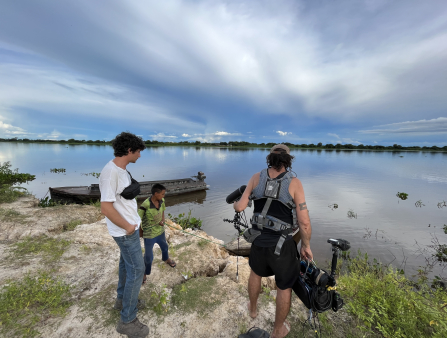
Andrea Pietro Munafò (L) and Diego Martínez (R) alongside Seferino, a young local boy, in Puerto María Elena, Paraguayan Chaco.
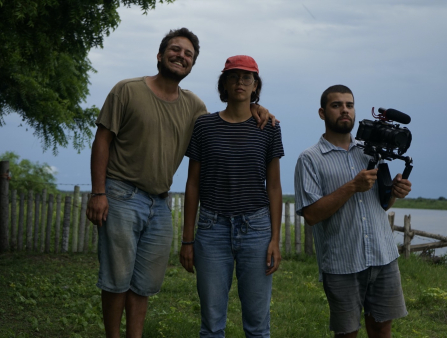
(L to R) Edoardo Ferri, Caterina Basler, and Giuliano Franco Ochipinti in Karcha Balut. Photo credit: Caterina Basler.
March 2022
I returned to the community of Puerto María Elena to speak with Nelson and explain my intention to come back, and together with him, remake the film I had lost.
September 2022
In 2022, almost nothing happened. A producer had promised funding and production, but nothing materialized. Over time, he stopped responding and disappeared.
At that point, I understood that I needed to change the way I was producing the film and that I could not rely on promises from producers who were not truly committed to the project or to the kind of film I wanted to make.
November–December 2022
I decided to take on the film’s production independently and self-finance it again, this time in a more structured way. For the shoot, I brought in Diego Martínez for sound and Andrea Pietro Munafò as director of photography. Thanks to contacts in Berlin, the rental company Delight Rental Services provided technical equipment that made the shoot possible.
At that time, Edoardo and Caterina were not able to join the shoot in Paraguay. We had been developing the project together and continued exchanging ideas throughout the process, but due to distance, limited resources, and the difficulty of organizing travel and accommodations in remote areas of the Chaco, they were unable to participate in this stage of filming. Working with a smaller team was also necessary because many of the locations were difficult to access, and production logistics were greatly limited.
In some ways, their absence also influenced the film’s approach, making it more personal and more closely aligned with my own position within the project.
February 2023
We worked with a very small crew. I still wasn’t sure what film I was going to make, but I was very clear about what I wanted to prioritize while making it: the relationship between the community and the human team, and our work ethic throughout our shoot.
After three years, I had returned to the Tomárâho community in Puerto María Elena, maintaining contact and fulfilling the promise I had made to Nelson Arce, who was no longer the community leader.
The discomfort of returning to a failed film ceased to be an obstacle and became the central axis of the work: filming from failure and everything that it represents became a guiding light for me. From this new beginning, I understood that the narrative and the ethics of the project were deeply intertwined with its filmmaking process.
During the shoot, I held on to a single certainty: to work between the mirages of Boggiani’s 120-year-old photographic archive and the present-day Chaco. Beyond that, nothing was fixed.
April–September 2023
After the shoot, I returned to Berlin and began exploring the material. For a long time, I was quite alone on the project, trying to understand what kind of film it was and to find producers who could understand it, since it was not a typical fil, which made it difficult to position.
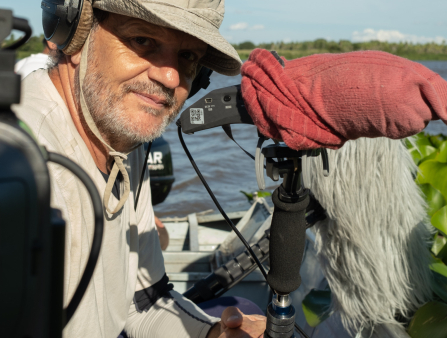
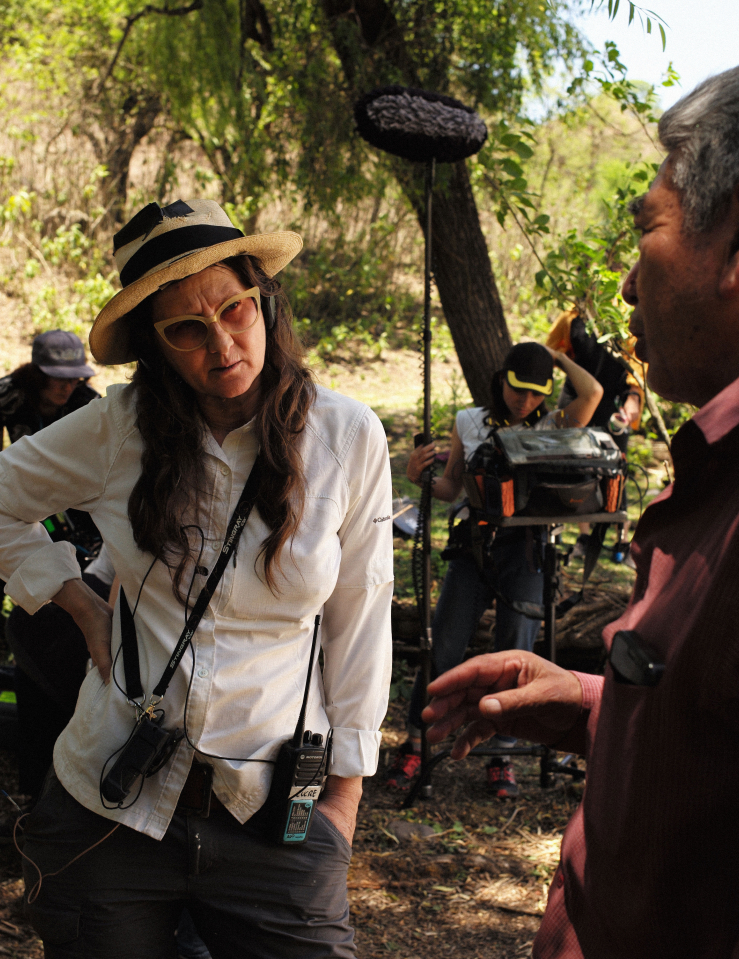
Diego Martínez (sound). Photo credit: Andrea Pietro Munafò.
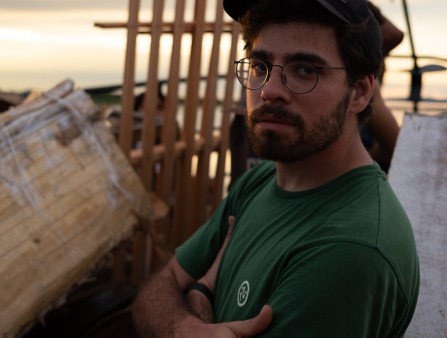
Giuliano Franco Ochipinti. Photo credit: Andrea Pietro Munafò.
March 2024
In mid-2024, I met filmmaker, researcher, and producer Juanjo Pereira, with whom I share not only a common origin but also a similar vision of cinema. We first met at the Málaga Film Festival; a year before, I had sent a short film to the International Contemporary Film Festival of Asunción, where Juanjo is the artistic director. Through that connection, he became familiar with my work.
I did not know his work well at the time, but during the festival he presented a work-in-progress screening of his film Under the Flags, the Sun, which I had the chance to see. After that experience, we began talking and quickly realized we were exploring cinema in similar ways and asking similar questions through our films. From that moment on, a collaboration and dialogue began around our projects.
For the first time, I felt that someone immediately understood the film I was trying to make.
July 2024
Juanjo decided to join the project as a producer. We signed a legal agreement and began working together. Having worked for years on his own film projects, he understood very well the challenges of developing independent nonfiction films in Paraguay, where there are very few producers working in this field. His experience was very important for the project’s development strategy, for connecting the film to regional and international platforms, and for structuring the production process.
Beyond the practical aspects, our collaboration also developed through continuous dialogue about the film itself. In nonfiction cinema, we often move between different roles, and this exchange allowed the project to grow not only on a production level but also on a conceptual and narrative level.
September 2024
This marked the beginning of a new phase focused on one of the greatest challenges of nonfiction filmmaking: assembling all the pieces of the puzzle. We applied to the first feature film fund of the National Film Institute of Paraguay, which had its first call for submissions in 2022.
November 2024
We were awarded G. 160,000,000 (around US$20,000) from the National Film Institute of Paraguay.
January–May 2025
With this funding, we were able to hire an editor, Francesco Di Gioia, and Veronica Diaz, who helped improve translations and sound. We finally could cover everything necessary to move the film forward. We achieved a stronger cut, which clarified the project, and with that version we applied to other international funds and markets.
October 2025
We participated in DOK Leipzig’s DOK Co-Pro Market and Doclisboa’s Arché. Film markets are always complex, because you have to present a project that doesn’t yet exist in its final form. In our case, it was an interesting exchange because we arrived with a lot of material we had already been working on, as well as a rough cut. This can be tricky, either because there is less room to adjust, or because the timing doesn’t always fit the needs of people looking at projects in earlier stages. Nevertheless, it was a beautiful experience, especially for the creative part. All the input you receive, and the way it pushes you to go beyond your original imagination of the film, inevitably shapes what the film can actually become.
Hernan Mazzeo (Lardux Films) joined as a coproducer in France.
December 2025
We took part in Chile Conecta, and Ilaria Malagutti joined as coproducer from Mammut Films in Italy.
January–February 2026
We completed the final cut of the film.
March 2026
We recently received support from the Torino Piemonte Film Commission, bringing greater clarity to the postproduction stage. The project was also selected for the Work in Progress section at Cartagena de Indias International Film Festival (FICCI), marking an encounter with how the film can engage both festival circuits and audiences.
As we near the end of the film’s production, I am looking forward to rediscovering it and seeing it come to life when it premieres. I believe that when this happens, despite my being so deeply immersed in the process, the encounter with the audience will generate a new perspective on the project. More than a film, I hope to create a space for dialogue regarding the Tomárâho community’s current reality. If this doesn’t transform into a tool for visibility and a demand, then we are merely repeating the same colonial cycles of the past. My greatest hope is that the film finds a meaningful screening life, one that finally forces us to look at the Chaco as it is today, not as a distant mirage.
This piece was first published in Documentary’s Summer 2026 issue.