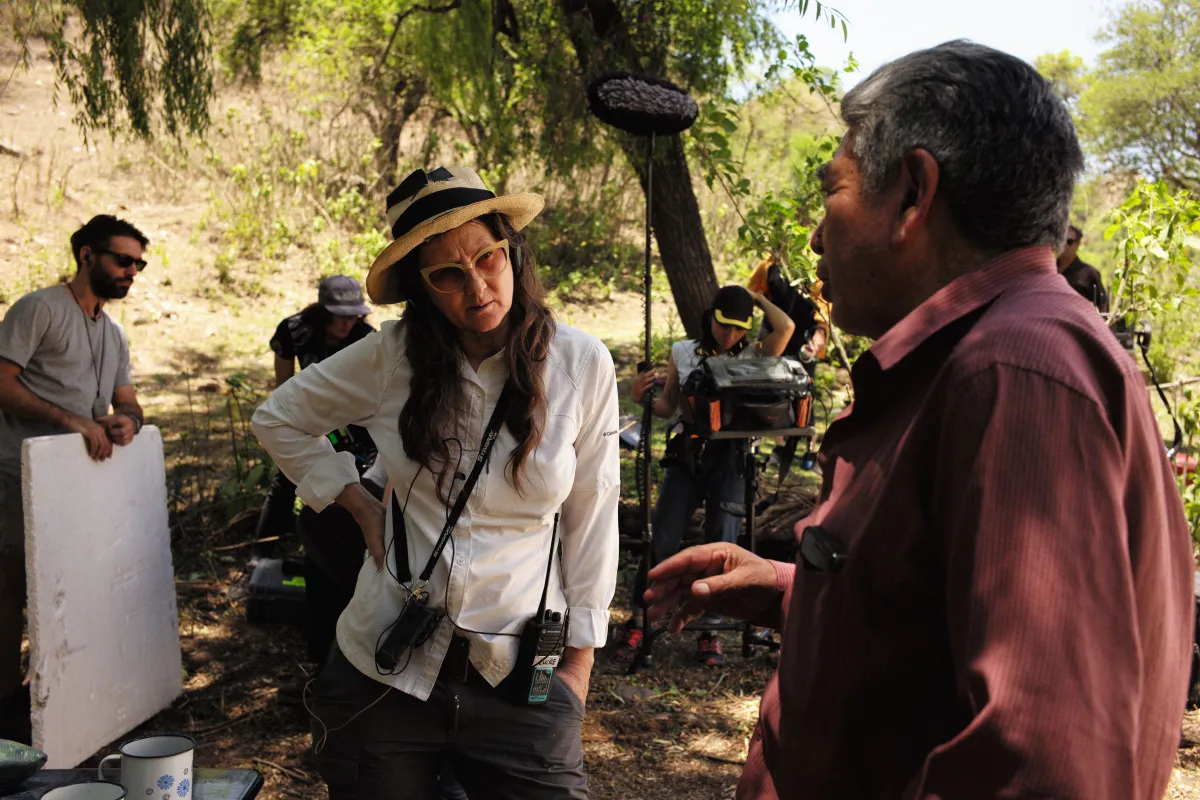


Lucrecia Martel’s recent documentary, Nuestra tierra (Our Land, 2025), draws inspiration from a video shot on a mobile phone. The video depicts the murder of Javier Chocobar, the cacique of the Indigenous community of Chuschagasta, on October 12, 2009, in Tucumán, Argentina, at the hands of landowner Darío Amín. Two former police officers also participated in the attack, which took place during a territorial dispute. The video was circulated soon after on YouTube and used in the legal proceedings that upheld the convictions of the three perpetrators in 2018.
Working from this video, Martel embarked on an investigation that spanned more than a decade, culminating in the creation of a film that delves into not only the case of Chocobar and his community but also the very formation of the Argentine nation—a nation founded violently upon territorial dispossession and the historical erasure of its Indigenous peoples.
In reconstructing the events and the history of what the Chuschagasta community has lived through and suffered, Our Land interweaves segments of the trial in the city, drone footage of the mountains, interviews conducted within the community, and the video footage of the murder. Martel, best known for celebrated fiction films like La ciénaga (2001), La niña santa (2004), La mujer sin cabeza (2008), and Zama (2017), which privilege what she has called the “incomplete image,” aims with this documentary to broaden her political and aesthetic perspective, calling forth documentary practice as a way to pursue themes she has long teased in her own nonfiction work.
Before her intimate, domestic dramas about bourgeois northern Argentine society made her a world-renowned auteur, Martel directed a number of short documentaries (including 1989’s La otra, in which various drag performers discuss their lives and shows, and 1999’s Silvina Ocampo: Las dependencias, which focused on the life of the writer). And, in tandem with her character portraits of contemporary Argentina, Martel has slowly amassed a body of work addressing territorial conflict whose culmination is Our Land.
Her political engagement with national narratives—and the connected issues of territorial dispossession—can be traced back to two short films created five years apart. Leguas (2015)—a fiction short that formed part of the anthology film El aula vacía (The Empty Classroom), under the creative direction of Gael García Bernal—addresses school dropout rates in Indigenous communities. The film posits that children fail to return to school due to the climate of fear fostered by the alliance between the educational institution and the landowners who finance it. In the short, the children of the community learn that the local landowner is a “usurper of the land”—one who is seizing over 3,000 hectares of communal territory—because he has “measured the land however he pleased,” disregarding both the 1833 law enacted in Tucumán regarding the standard measurement of a legua (league) and the specific land dimensions stipulated in the 1909 deed.
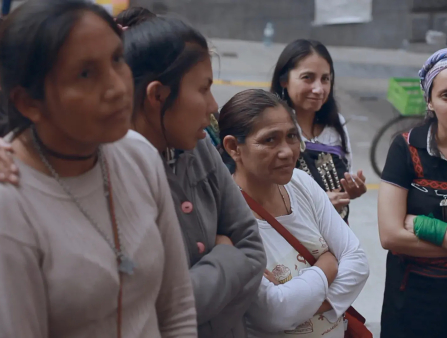
La rebelión de las flores. Courtesy of María Laura Vásquez
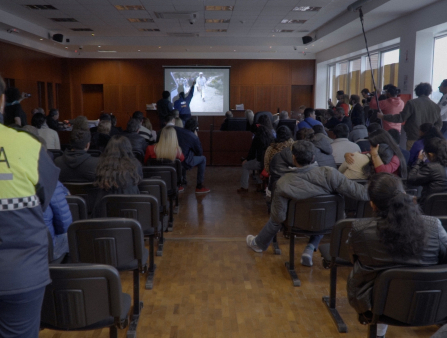
Our Land captures the trial of the murder of activist Javier Chocobar. Courtesy of Rei Pictures
Likewise, her fiction short film Nueva Argirópolis (2010) presents a series of scenes in which nonprofessional Qom actors in the Argentine Chaco embark on a journey down the Bermejo River to reach a set of islands that belong to no one; along the way, they are intercepted by police. Created as part of 25 miradas, 200 minutos (2010), a commissioned project by the Argentine government to celebrate the country’s bicentennial—which also included work by Pablo Trapero and Albertina Carri—Martel’s short recounts an Indigenous conspiracy to reclaim a land of their own, a land displaced by the flowing course of the river and which moves in tandem with the river’s course, like so many migrant Indigenous populations.
With Our Land the director definitively joins the ranks of Argentine filmmakers whose work with Indigenous communities centers on land issues. In the province of Salta, director Daniela Seggiaro has been working with the Wichí communities for decades. In 2024, she released her film Senda india, a montage of archival footage shot by Miguel Ángel Lorenzo, a community member who documented the Wichí people’s efforts during a legal trial to prove their land tenure rights. Similarly, director María Laura Vásquez filmed the occupation of the Ministry of the Interior in October 2019 by the group Mujeres Indígenas por el Buen Vivir (Indigenous Women for Good Living), led by the Mapuche writer and land defender Moira Millán. In Vásquez’s documentary La rebelión de las flores (2022), the camera follows 23 women belonging to the Qom, Colla, Wichí, Mapuche, and Guaraní nations over the course of 11 days—women who traveled from their territories in Formosa, Chaco, Santa Fe, Misiones, Salta, Neuquén, and Chubut to the city of Buenos Aires to demand the right to life. Martel’s work, like that of these and other contemporary filmmakers, brings visibility to the still underrepresented history of land disputes and violence against Indigenous communities in Argentina.
In Our Land, Martel turns to modern vision technologies, such as NASA satellite imagery and drone footage—often tied to ideals of objectivity—to reinforce and question these very techniques of truth construction, especially as they pertain to Indigenous populations in her country. For instance, NASA—as a scientific institution of global renown for capturing images from space (images that have shaped the collective idea we hold of the planet we inhabit)—underpins a “scientific,” “neutral,” and “veracious” truth, characteristic of the documentary genre. Yet these images are not innocent; indeed, they have not been so since their very inception. They function as not merely mechanisms of surveillance but also a specific way of conceiving our relationship with the planet. As Bruno Latour observes in Où atterrir? (2017), a planet observed from a distance—and in its totality—is far easier to exploit. Amidst the global climate crisis, such images foster a sense of detachment—a detachment standing in stark opposition to the intimacy and mutual interdependence with the Pachamama (Mother Earth) that Indigenous peoples have experienced since time immemorial.
I try to withdraw from that sense of certainty, because it seems to me that the moment these things settle into place, a certain state of alertness within the human spirit begins to dissipate
—Lucrecia Martel
For her part, Martel has reflected upon—and indeed positioned herself against—the notion of visual totality: images that powerfully impose a fixed, finished vision of the world. Significantly, her previous films are characterized by a fragmentary framing style in which spaces are typically intimate and immediate, rendering it impossible to glimpse a complete, panoramic setting. As Martel writes in Un destino común (2025), which gathers many lectures and talks she’s given on her filmmaking this past decade, “When I frame something, I try to avoid that sense of totality—the kind that immediately makes us feel, ‘Ah, we’re in the kitchen,’ or ‘Ah, that’s the father and the mother’ [...] I try to withdraw from that sense of certainty, because it seems to me that the moment these things settle into place, a certain state of alertness within the human spirit begins to dissipate” (my translation). It is for this very reason that the NASA images—depicting the planet in its full spatial totality—make us wonder about their use in Martel’s film. During a recent discussion in Mexico, Martel noted that her intention was to emphasize that the land problem is a planetary issue, as evidenced by the armed conflicts and genocides of the present day.
Indeed, NASA imagery situates us within a global framework. Closer to home, Latin America as a whole has endured centuries of dispossession and territorial plundering inflicted on Indigenous peoples—peoples who have raised their voices and organized themselves into movements to reclaim their lands, their sacred sites, their languages, and their knowledge and spirituality, all of which are inseparable from the territory itself. An emblematic case is that of Berta Cáceres, a Lenca leader murdered on March 2, 2016, for opposing the Agua Zarca hydroelectric project on the Gualcarque River in Honduras—a river held sacred by her community. According to a 2022 report by the organization Cultural Survival, approximately 50 Indigenous activists were murdered in Latin America that year alone—a figure representing three out of every four killings of environmental defenders worldwide.
What happens in Tucumán holds true throughout the world. Much like NASA imagery, drones also contribute to creating this atmosphere of veracity and visibility grounded in technology, even as they are now a much derided and overused trope in documentary filmmaking. Playing with such an aesthetic tradition (namely, borrowing a most familiar mode of documentary aesthetics), Martel insists on the drone as an artificial apparatus of vision—or, rather, unmasks it as a producer of artifice. The film deliberately incorporates the mechanical whirring it emits so that the viewer is not beguiled by any purported neutrality or transparency of its gaze.
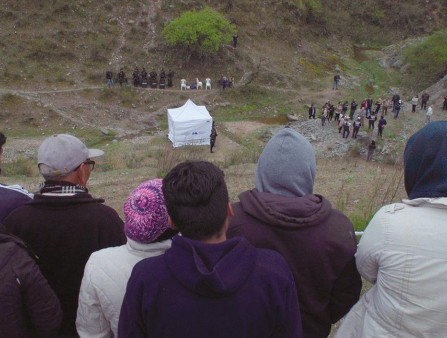
Lucrecia Martel's documentary hinges on broadening the audience's perspectives.
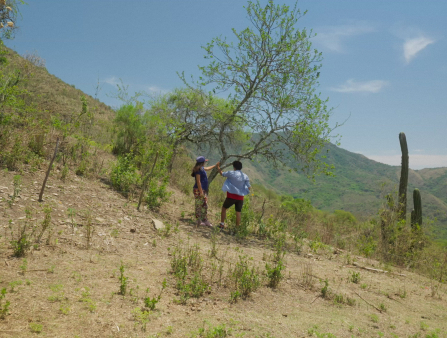
Nevertheless, by filming from above, the drone’s framing becomes expansive, generating breathtaking panoramic images of the Andes. While this broad framing might seem antithetical to Martel’s cinematic style, the elevated perspective serves as a proposed interpretive lens for understanding the gaze of the mountain’s inhabitants. This is illustrated, for instance, when a couple ascends to the summit of a hill where they intend to build their home, discussing how, from that vantage point, they will be able to watch their children coming and going from school. To an outsider lacking firsthand knowledge of these mountains, they might all appear identical; indeed, certain houses and individuals situated there might intentionally remain unseen. Yet, the Chuschas—the local inhabitants—and the drones share a bird’s-eye view. A keen, all-encompassing gaze is essential in a territory currently under dispute. The drone, then, is not merely an objective, all-encompassing gaze that revels in certainty, but one that instead mirrors the community Martel is capturing with her gaze.
At the 1:45:54 mark, a bird collides with the drone, causing it to crash; nevertheless, it continues to film from the ground, capturing the scene from an angle that disrupts the conventional perspective. The images appear inverted, with the horses shown upside down. It is at this precise moment—for the first time, and nearly at the film’s conclusion—that an off-screen voiceover narration is heard. Although characteristic of the documentary genre, this narration is inserted fictionally, presented as testimony delivered during a legal trial. This testimony summarizes the history contained within the archives of land claims: It recounts the convoluted transfers of land between landowners, instances of expropriation, and the existence—or nonexistence—of official property deeds. Thus, the documentary reveals that one of the landowning families—the Colombres—used receipts for illegitimate leases granted to the Chuschagasta inhabitants as proof of their own “legitimate” tenure.
This narrative lays bare the murky fabric of the documents used to legitimize usurpation, the very documents Martel uses to present this history. As one of the characters—the cacique Valderrama—puts it, this is how power “muestra la hilacha.” The phrase is a colloquial expression widely used in northern Argentina that signifies revealing one’s “true colors.” The “hilacha”—literally a loose, untidy thread—is an imperfection that, once exposed, unmasks precisely what it sought to conceal.
The renowned historian Carlos Páez de la Torre also reveals his true colors when admitting—seemingly without remorse, in an interview included in the documentary—that he is unable to verify what he wrote several decades ago in the local newspaper, La Gaceta de Tucumán: namely, that the Chuschagasta people had gone extinct in the early 19th century. Regarding this, he states: “Did I write that? I wrote every day, imagine … if I had to do research to write this stuff, I would die.”
The image exists on one level, whereas sound is what invades everything—what touches the spectator effectively and tangibly
—Lucrecia Martel
Seeking to highlight the long-standing presence of the Chuschagasta families in the region, Martel includes photographs contributed by the community members and narrated by the interviewees themselves. Typically, these are photos of family members—or of the subjects themselves in their younger days—taken during significant life events. Some of these photographs depict the temporary journey to Buenos Aires in search of work following the closure of the sugar mills in Tucumán. These photos capture a moment from the past that will never return, while also revealing anxieties about spaces one does not possess—a key theme, given that many of these individuals were migrants, first displaced from their ancestral lands by landowners and subsequently driven toward the metropolis. In all cases, the photographs serve as a record of these places and of family histories, and as a reinforcement of their identity through community ties in their territory.
There is one more element added to the archive of voices and files of the Chuschas. The photographs are presented accompanied by a soundscape drawn from the audio recordings found on the community members’ mobile phones. Thus, the archive is not merely visual but also auditory—and not external to the community, but intrinsic to it. Furthermore, sound creates a space of its own, instantaneous and immediate, in which the listeners are immersed. Admirers of Martel’s cinema will recognize in these cinematic choices the persistence of her focus on the multiple sonic layers within her scenes. Martel notes in Un destino común that the fundamental condition of sound is the absence of a void: “It requires the presence of air—an elastic medium through which waves can travel […] and air connects us” (my translation). Unlike the image, with its inherent discontinuities, sound immerses us in continuity: “We are all enveloped within the same air,” she writes. Thus, the images within photographs and the spectator enter into the same sonic space because “the image exists on one level, whereas sound is what invades everything—what touches the spectator effectively and tangibly.” The sonic space introduced here was created by the community itself, at times distinct from those captured in the photographs, thereby adding new layers of temporality and further entangling the stories of the community.
Whereas Martel’s cinema had previously been characterized by a conscious, incomplete framing and the fragmentation of both narrative and cinematic aesthetics, Our Land seeks to offer a comprehensive account of the complexity of national narratives. Interested in reaching a broader audience and advocating quite vocally for her documentary subjects, Martel is expanding widely to incorporate voices and perspectives silenced by the violence of the national discourse against Indigenous peoples and their right to the land. The message is clear and forceful, devoid of ambiguity: Dispossession of the land lies at the very foundation of the nation and its history.
This piece was first published in Documentary’s Summer 2026 issue.