
Mstyslav Chernov always dreamed of becoming a filmmaker—but its realization came through time and tragedy. After he had spent years in fine art and documentary photography, the 2013–14 Revolution of Dignity redirected Chernov’s focus to conflict reporting, leading him to work as a freelance multiformat journalist for the Associated Press. In 2014, on just the third day of his assignment, Chernov captured the first images of the Russia-downed Malaysia Airlines Flight MH17. Over the next eight years, he worked across continents documenting wars, genocides, political and migration crises, and epidemics—narrowly surviving, even when, in Mosul, a sniper’s bullet pierced his camera and lodged in his gear. But as he would later say in interviews, nothing was comparable to the siege of Mariupol.
In 2022, as Russian forces targeted residential neighborhoods with airstrikes and used starvation as a weapon, Chernov remained in Mariupol with AP colleagues Evgeniy Maloletka and Vasilisa Stepanenko filming the living and the dead. Their work became not only the sole professionally documented visual record of Russian war crimes in the city but also brought Chernov international prominence and ultimate recognition with a Pulitzer Prize.
This footage also gave him the bitter opportunity to try filmmaking. The film that resulted from cutting together their on-the-ground reporting, 20 Days in Mariupol, premiered at Sundance in 2023.
Basing the film on the most dramatic excerpts from the news, Chernov structures it as a 20-day diary, overwhelmed with footage of children’s deaths, makeshift graves, hunger, and shelling—all intensified by dramatic music and his lyrical reflections, both as a war reporter and as a Ukrainian. Its mission is to evoke deep empathy and force attention on Ukraine, which it did with exceptional success, crystalized by copious festival screenings and a number of awards, and eventually bringing the first Oscar for Ukraine. Yet there was a price for that attention. The film’s deliberate crossing of conventional boundaries in its depiction of human suffering and intentional blurring between journalism and documentary raised concerns among Ukrainian documentarians and some emotional fatigue among the international audience.
If one assumes Chernov simply found himself with unique footage in the right place at the right time—using documentary as a convenient political vehicle, his new film, 2000 Meters to Andriivka, proves otherwise. When Chernov accepted his Oscar for Best Documentary Feature, he was already developing this new project, which was made with different methods and, unlike 20 Days in Mariupol, was conceived as a film from the very beginning.
Chernov’s second feature covers Ukraine’s 2023 summer counteroffensive, following a platoon whose mission is to cross a heavily fortified forest and liberate a strategic village. The protagonists are Ukrainian soldiers, whose perspective Chernov centers as the viewer is plunged into the trenches. The film is divided into chapters with titles that count down, by hundreds of meters, the soldiers’ advancement toward Andriivka. Using multiple types of cameras and perspectives, a haunting score composed from the sonic debris of war, and a seamless montage that fuses multiple temporalities, Chernov constructs a highly immersive and unsettling cinematic excursion into the harrowing spatial dimension of war in the heart of Europe.
The film is a triumph of digital-age documentary—a convergence of full-scale warfare and the full force of contemporary audiovisual technology, echoing the evolution of the tools used in modern war. It also marks the transformation of a war reporter into a film director, whose talent and vision had long awaited their moment. Documentary spoke to Mstyslav Chernov about the incredible craft and personal importance of 2000 Meters to Andriivka, which begins streaming for free online beginning November 25 on PBS+. This interview has been edited.
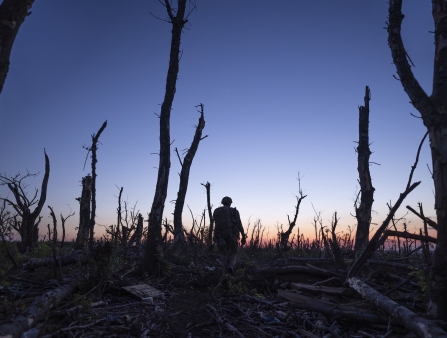
Ukrainian servicemen walk through a charred forest at the frontline a few kilometers from Andriivka, Donetsk region, Ukraine, Saturday, Sept. 16, 2023. Ukrainian brigade’s two-month battle to fight its way through a charred forest shows the challenges of the country’s counteroffensive in the east and south. Photo Credit: AP Photo/Mstyslav Chernov
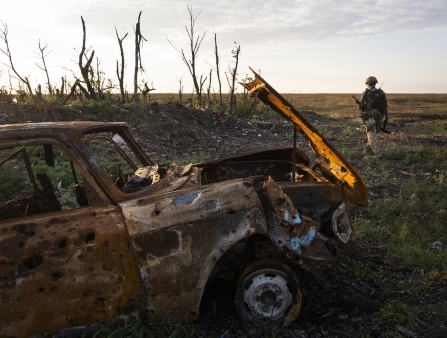
Andriivka, Donetsk region, Ukraine, Saturday, Sept. 16, 2023. The 3rd Assault Brigade announced Friday they had recaptured the war-ravaged settlement which lies 10 kilometers south of Russian-occupied city of Bakhmut, in the country's embattled east. Photo Credit: Mstyslav Chernov
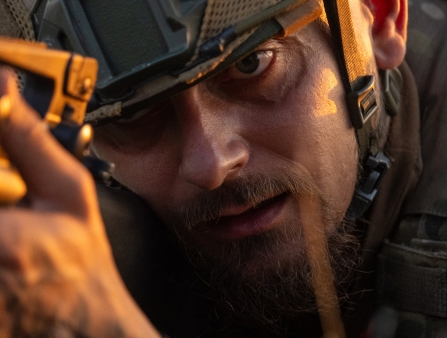
Kobzar, a Ukrainian serviceman, practices shooting during preparation for the next military operation of the 3rd Assault Brigade. Five months later, he will be killed. Photo Credit: Mstyslav Chernov
DOCUMENTARY: You started making 2000 Meters to Andriivka in the summer of 2023, when 20 Days in Mariupol was screening at many festivals, and you were giving an enormous number of interviews and panels, followed by an Oscar campaign. Can you guide me through the timeline and how you managed to focus separately on the life of one film and the creation of another?
MSTYSLAV CHERNOV: The trajectory between these two films was strange, sometimes even absurd, as I existed simultaneously in two different worlds: the world of Russia’s invasion of Ukraine and the world of elegant venues where we premiered and screened 20 Days in Mariupol. The collision of these two worlds brought me to the necessity to make 2000 Meters to Andriivka. In the summer of 2023, people in the U.S. and Europe were discussing the Ukrainian counteroffensive—its scale, the kilometers gained, the names of cities, and the number of casualties Ukraine reported sustaining—but it was all so abstract and detached. I felt almost angry talking to them, as I couldn’t adequately explain how real the situation was. In those days, I would fly from the U.S. back to Poland, and from Poland drive to Kyiv. From Kyiv, I would take a train to Donbas, then a car to the frontline. All of this would happen within 24 hours. So you practically travel back to the other side of the planet, almost 100 years back in time. Visually, it felt like the First World War, and the soldiers’ experience also felt like that. Sometimes it felt like another planet.
I decided to focus my next film on the experience of soldiers. 20 Days in Mariupol was a film about the destruction of Mariupol and the impact of war on the civilian population. 2000 Meters to Andriivka is a film about the experience of those civilians who took up arms to protect my homeland. But it is very personal too, as Andriivka is a two-hour drive from my hometown, Kharkiv. Those fields and forests are also where my grandfather fought during the Second World War. It’s located near Bakhmut. Kharkiv Region and Donbas are places where my parents and I used to visit my grandmothers. So there’s a very personal connection to this native land, which has now been mutilated by bombs. It’s no wonder the film is about distance—not only the meters soldiers have to walk in the film, but also my own attempt to shorten the distance between the West and Ukraine.
D: You entered Andriivka fully aware of your role as a director—and that shift is palpable in the stark contrast of methods between your two films. In 20 Days in Mariupol, you demanded an overwhelming emotional response from the viewer, and it was hard to watch. In 2000 Meters to Andriivka, the subject matter remains just as harrowing, yet I found it more watchable—not because it’s any less urgent, but because you skillfully employ cinematic language to create an almost hypnotic effect. How did you develop the specific form of storytelling and the clear mediation with the viewer?
MC: Indeed, 20 Days in Mariupol began as a series of news dispatches that later became a film. This worked well because one of the themes of this film is journalism and its impact—or sometimes lack of it. In the case of 2000 Meters to Andriivka, it was conceived as a film and shot with filmmaking in mind, so it possesses a more cinematic quality.
If we are working with the medium of cinema, and we are aiming to show the film in theaters and targeting a wide audience, which is a very natural goal for a film director, it is essential to make sure that people will not turn away. Fortunately, reality provided us with a clear dramatic structure, almost like in scripted cinema: there are protagonists who have a clear goal and there is time pressure and life danger. We just had to make sure that those elements are preserved. Our main goal was to engage the audience, to bring them into the trenches to let them walk with the soldiers and with me, and to not let them go.
D: I’d like to unpack this immersive quality further by focusing on the use of video formats. Can you tell me how many types of cameras or recording devices you used in the film, and how you worked with that variety of footage during editing?
MC: The war is changing, weaponry is developing, and the tools available to documentary filmmakers attempting to adequately portray war are also expanding. Today, we can realistically portray the actual experience of the soldier on the front line. In the past, the way to portray the experience of a soldier going through, let’s say, the Battle of Verdun in the First World War, was through the paintings of Paul Nash or the writings of Remarque. But now we have tools that are pushing the boundaries of documentary cinema.
But you can’t just drop the audience into the chaos of the battle, so we build up to it. Together with Michelle Mizner, brilliant editor and producer, who has worked with me since 20 Days in Mariupol, we start the film from a very simple, single perspective, and as we go further, we add more and more cameras. By doing so, we are acclimating the audience to multi-perception scenes. You can see that the third of “1,000 meters” has two different perspectives—we add the drone footage. The battle of “600 meters” has six different cameras. Two of them are on the battlefield: a bodycam and a 360-degree camera, allowing you to reframe the perspective of the shot in post. There are also two drones, one of which is a suicide drone; two cameras at the headquarters; and a camera on the injured arriving at the hospital. That’s actually seven cameras.
Drones, infrared, Sony mirrorless, 360 bodycam, GoPro, the occasional smartphone—all of these are in different formats and of different quality, but if introduced gradually, by the middle of the film the audience forgets there is a big visual difference between them.
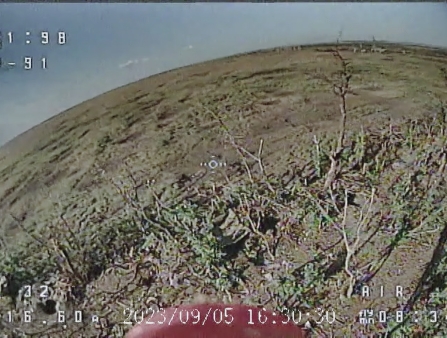
Suicide drone POV. Courtesy of Mstyslav Chernov
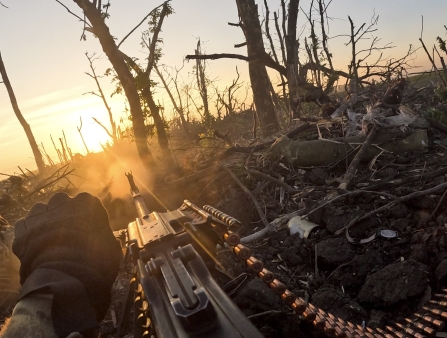
Helmet cam. Courtesy of Mstyslav Chernov
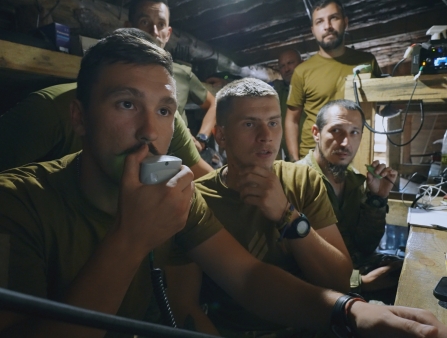
Camera at HQ. Courtesy of Mstyslav Chernov
D: Those camera qualities, combined with an almost fictional dramatic arc, bring us into the territory of the film theory term war spectacle. It can create the sense that we’re spectating a sort of video game. In addition, the use of inhuman, mechanical camera gazes risks dehumanizing the material. You seem aware of that risk and include personal perspectives of the soldiers and yourself. How did you practically deal with the risks of dehumanization and derealization during editing—and were there any ethical boundaries you set in postproduction?
MC: We searched for that thin line of engaging the audience while remaining respectful to all the pain. That’s why the film took so long to edit. War may seem thrilling, but it is a tragedy that should not be romanticized or made to look beautiful. The biggest crime a documentary filmmaker or war reporter can probably commit is to make the audience walk out of the cinema and say, “Ah, that was a beautiful film.” For me, that means they didn’t do a good job.
In that sense, the most difficult parts were, surprisingly, the bodycam footage scenes and its combination with GoPro footage. Initially, we thought that it would be the easiest part for the audience to connect with because you are literally “in the boots” of the soldiers, seeing the world through their eyes. But during the editing, we figured that was not the case. We struggled to find the right length and pace for those scenes. When they were too long, the audience became disengaged and bored. When we cut them too quickly, the audience detached from the experience and felt like they were watching a computer game.
The placement of the scenes within the film was very dependent on that feeling of detachment or attachment to the protagonist. The problem with bodycam footage is that you rarely see faces. There isn’t much talk on the battlefield. We knew that if we don’t show the faces through whose eyes we later see the battle, the audience will not connect to them. That’s a problem. Especially for audiences who, unlike Ukrainians, have no stakes in this war. Add the fact that, to the untrained eye, soldiers in uniforms all kind of look the same.
The solution was to find those conversations that would reflect normal civilian life, something that is natural for us as humans to talk about, rather than big ideas or patriotic views. When you do that, then the rest of the film becomes more relatable, human. The audience sees a civilian who’s thinking about his cigarettes, about fixing the toilet at home, or the university that he has enrolled in and couldn’t finish because of the war. Small things to the world, but huge to us, and then everything else around just falls into the right place.
D: The music in the film clearly supports the audiovisual, never allowing the viewer to relax, since any kind of synchrony or catharsis only happens at the end. How did you work on the audio layer of the film in relation to the editing process?
MC: The original score was written by Sam Slater, an amazing composer, who is now a good friend. One of the first questions Sam asked me was, “What is the genre of this film?” I explained that for me, 20 Days in Mariupol is a horror film, so we searched for a composer who specializes in horror films, and Jordan Dykstra did an amazing work on it. In 2000 Meters to Andriivka’s case, I was searching for someone who could create an action thriller, but a highly realistic one. A music that would correspond to the auditory experience of being on the battlefield.
I love Sam’s work on Chernobyl (2019) and how he created music from the sounds of a nuclear reactor. I wanted 2000 Meters to Andriivka to have music that reflects what the war feels and sounds like. You don’t hear an orchestra on a battlefield. You hear the whizz of bullets, explosions, the buzzing of drones, and the radio crackling. We decided to incorporate all of those sounds into the score. Sam used the sounds of the battlefield as musical instruments; machine gun bursts became drum sequences, distorted radio transmissions replaced stings. For a while, Sam was looking for a signature sound that appears at the title card and then repeats throughout the film. He and Jakob Vasak, music producer of the film, created an entirely new musical instrument, the Kobophone [a DIY feedback module that amplifies the percussive elements of the score and distorts sounds, turning them into chaotic growls].
Lastly, to preserve a feeling of “rawness” of the material, I decided not to use a sound designer on this film. Everything you hear is recorded by the cameras on the battlefield, which means the music takes on the weight of creating the sound landscape of this reality.
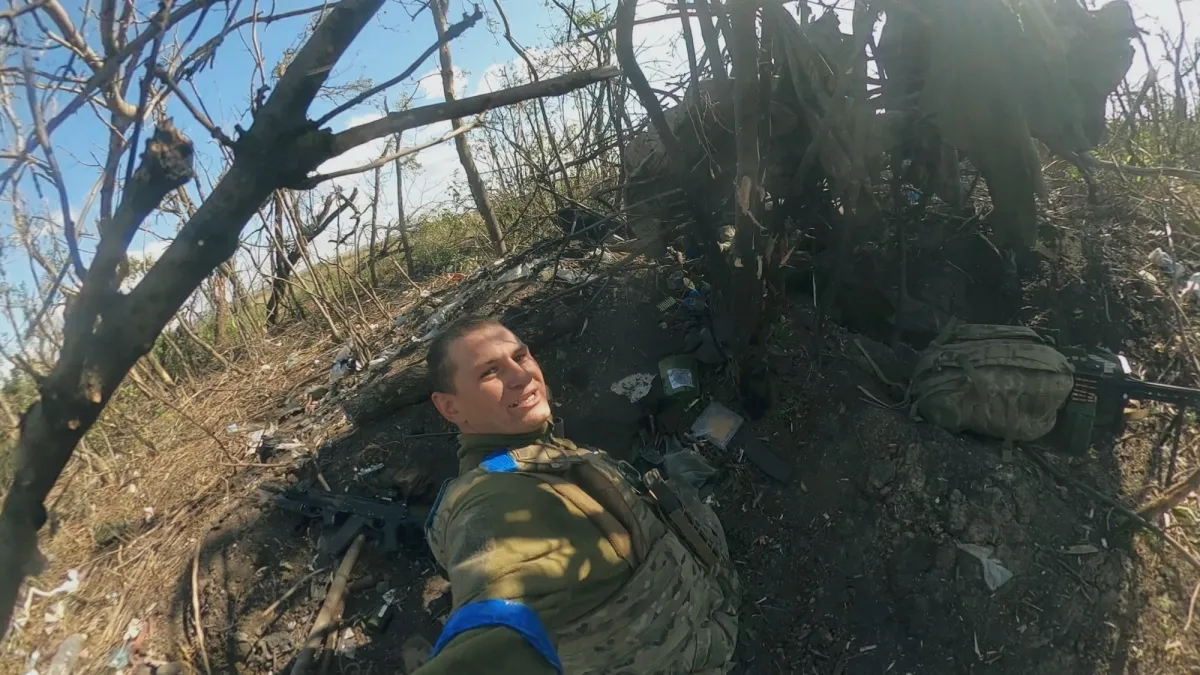
Helmet cam. Courtesy of Mstyslav Chernov
D: Speaking broadly about the whole experience of the post and production process—do you now trace your transformation from war reporter to film director?
MC: Before becoming a journalist, I always wanted to be a film director. Journalism felt like the right path when the Revolution of Dignity and then Russian invasion in Ukraine began. But my experience in Mariupol marked a turning point. It was just the right moment to transition from journalism to filmmaking. It wasn’t just about fulfilling a long-held dream; I feel that films in general are more impactful nowadays. Political, emotional, historical impact and the way we preserve memory. Journalism was attacked and keeps being discredited, and I see that people don’t trust facts anymore. But I see that people are still able to emotionally connect to the films. I guess that’s the medium I want to work with, and this is what I will continue to do.
D: I wanted to touch on the political comment you personally convey via voiceover about the exhaustion and even hopelessness of this war. Back in 2023, that would have been called pessimistic, but now I would rather call it realistic. How did this rhetoric build up, and does the condition on the frontline shape it?
MC: I believe this is a natural progression of what I felt about war and humans at war, even before 20 Days. I have been through six wars—Syria, Iraq, Afghanistan, Gaza, Nagorno-Karabakh, and Ukraine—and I hate war with every fiber of my being. Yet I find it important to talk about it, though I have no illusions about what we can or cannot achieve with a camera. The only thing we can do is ensure that reality is recorded and reflected back to people. And this is not just a personal work, but also the work of a collective. All the Ukrainian film directors we see this year at festivals are now engaged in this collective effort of preserving the country’s struggle and the transformation its society is undergoing. Everyone is bringing their brick to build this building.
Personally, I do not find 2000 Meters to Andriivka pessimistic; it reflects my dark view of the nature of war I experienced. I tried to balance my personal view of war with the very different, much more hopeful and stronger vision of Ukrainian soldiers fighting on the front line. Fortunately, they don’t see war as I see it. And if they did, there would be no Ukraine. Even though we know this is a war for our survival and Ukrainian soldiers are heroes, when we show war to the world, we have to walk on thin ice and maintain that balance between glorifying the war and honoring the experiences of Ukrainian soldiers.
D: And if we talk about the realistic state of the contemporary Ukrainian documentary and its collective work, as you describe it, what, in your opinion, is its strength today, and what challenges is it time for it to face?
MC: Fortunately or not—the discussion about the direction of Ukrainian cinema falls on academics and critics. But I think the world’s best art wasn’t created by attempting to be part of a movement, but rather by navigating in the dark, trying to figure out the way to express what artists lived through. Ukrainian cinema is now facing a difficult time for many reasons. Many filmmakers and members of their teams went to fight the invasion. Some were killed. Some left the country.
Another reason is our conscious rejection of the Soviet Union’s legacy. No cultural movement, especially cinema that so heavily relies on tradition, can exist in a vacuum. It exists as a flow. I feel that most of the Ukrainian documentary and fiction filmmakers are rejecting the Soviet Union’s legacy. We found ourselves in this strange position of starting everything from scratch. The demand is high, resources are available. However, we still need to develop our unique language. How do we speak about war? How do we speak about the transformation of society? Our traumas? And also, how do we speak about topics unrelated to war? How do we talk about love, friendship, identity, beauty? There are so many important things besides our fight for survival. And we need to learn how to talk about them when this war is finally over.
This piece was first published in Documentary’s Fall 2025 issue.