

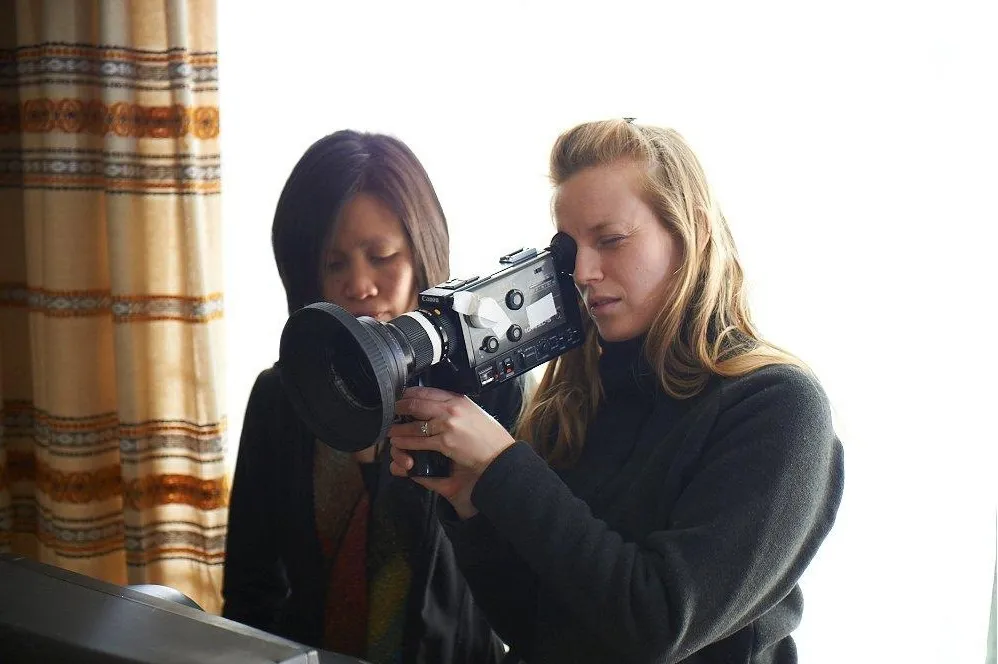

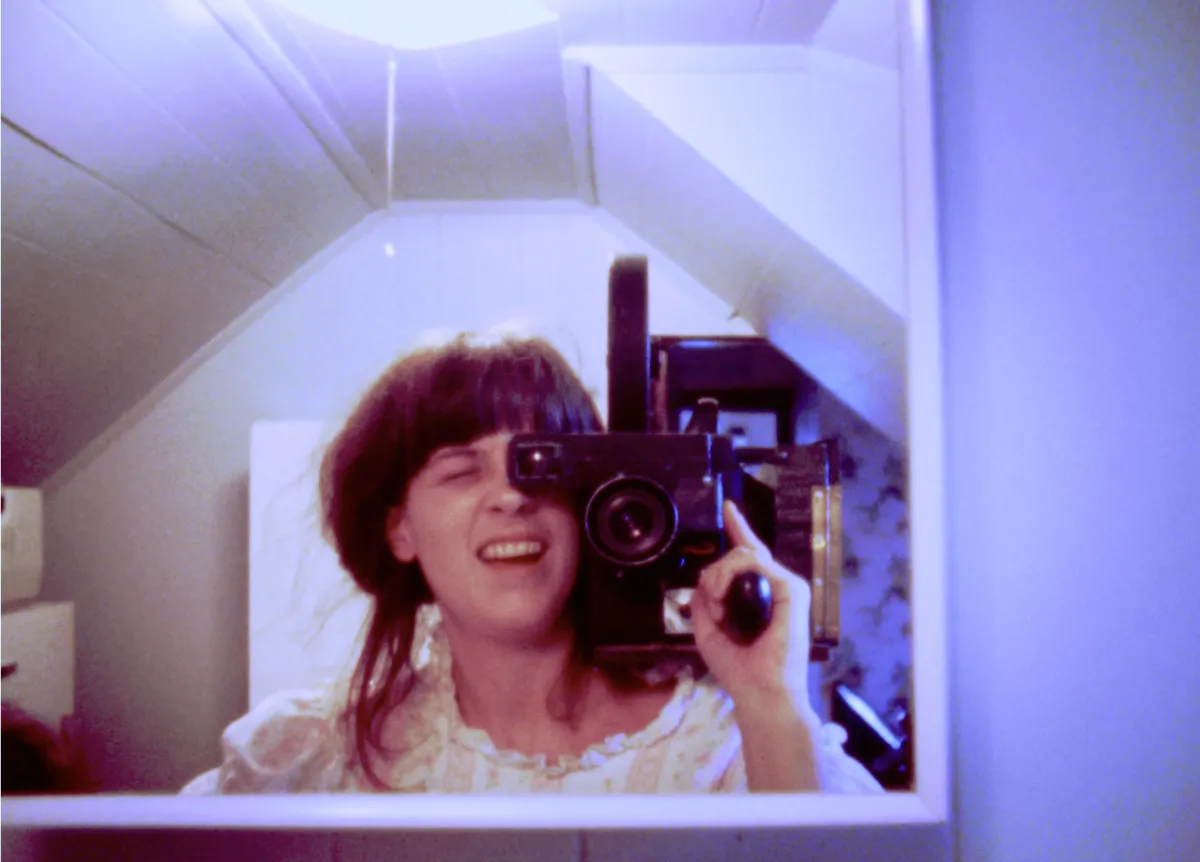
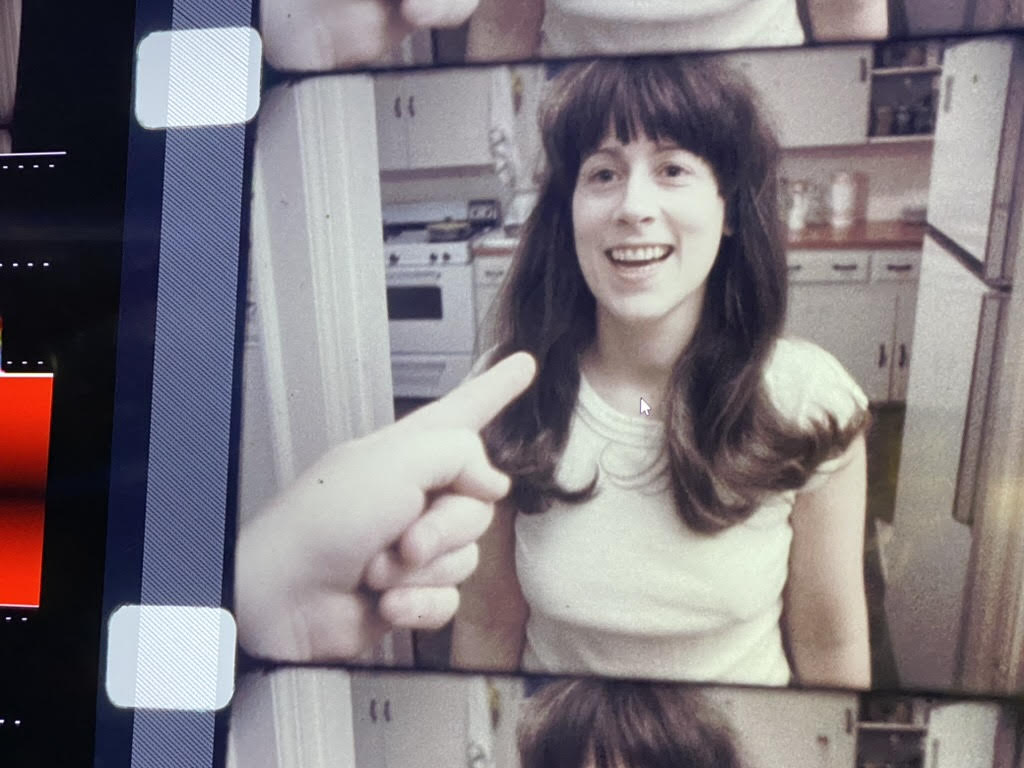
Joel DeMott. All images courtesy of Jeff Kreines
Joel DeMott, renowned cinema vérité filmmaker, died on June 13, 2025.
DeMott is best known for her films Seventeen (1983), which she co-directed with Jeff Kreines, and Demon Lover Diary (1980). Alongside Kreines, DeMott created a model of intimate cinema vérité filmmaking that has inspired countless filmmakers.
DeMott was an incisive and punchy writer. Here is how she summarized her early life in a 1979 bio for the Whitney Museum: “Born April 22, 1947, in Washington, D.C. Grew up and attended public school in Amherst, Massachusetts—with the exception of a happy year at an English school in Portugal and three miserable years at a girls’ cloister in Northampton. Graduated from Radcliffe in 1967—unspectacular academic career—spent most of the time directing plays. After college: worked on the Sunday Arts and Leisure Section of the Times for a couple of years; hitchhiked around the South; taught Greek history and American literature to high school kids; became a hotel chambermaid; graded economics papers; hitchhiked through Europe; joined the staff of the Boston Museum of Fine Arts briefly; moved to Northern Ireland. Straightened myself out and went to MIT for a year as a special student in filmmaking. After that, worked as a film editor for WCVB-TV, supposedly progressive ABC affiliate in Boston, and as a stitcher in a printing plant. Left those jobs—with enough money to buy a camera.”
At MIT, DeMott studied under Richard Leacock and Ed Pincus, nonfiction filmmaking pioneers who embraced emerging technology in order to more naturally document life. In the same spirit, DeMott sought to escape the conventional means of cinema vérité filmmaking in the ’70s: bulky rigs that required multi-person crews, which, she argued, created unnecessary distance between filmmakers and the people they film.
In the MIT equipment room, DeMott met an industrious Chicago teenager, Jeff Kreines, who felt similarly. DeMott and Kreines together developed a one-person sync 16mm rig that opened up extraordinary new possibilities for cinema vérité. With a Nagra SN—a tiny 1-pound tape recorder made for the CIA— built into the side of their camera, and a small microphone in their left hand, they were now able to simultaneously capture images and record synchronized sound solo. This ingeniously simple rig, which rested on a filmmaker’s shoulder, also demystified the filmmaking process for the people being filmed, transforming the filmmaker from a “Technical Monster,” as DeMott put it, “back into a human being; acknowledged as a presence, responding autonomously.”
DeMott and Kreines became creative and romantic partners for the next five decades. They called Montgomery, Alabama, home and shot their movies in the U.S. South and Midwest. They were ingeniously thrifty filmmakers, cadging fallen-off-the-truck Kodak stock from corrupt TV news motorcycle couriers and scoring cheap processing from friends who worked at TV stations. The films they made together focused on daily life. DeMott and Kreines’s first project together, Vince and Mary Ann Get Married, captures a mafia wedding in Cicero, Illinois. Ed Pincus called it “one of the most beautiful documentaries ever.”
While filming, Kreines and DeMott kept their approach simple: never interview, never ask anyone to do (or repeat) anything, never ask people what their plans are, never turn on the lights, and never ever show up without your camera. DeMott and Kreines did not act like “flies on the wall” (as they would point out, flies are meant to be swatted). Their philosophy was to hang out, shoot, and be themselves. They filmed with a 10mm lens to approximate human perspective and never used zooms (the human eye doesn’t zoom) typically shooting from 1.5 to 3 feet away. And for similar reasons, they didn’t use cutaways. A viewer senses the filmmaker’s physical presence and real-time decision-making in every frame.
In an article for The Independent, David Leitner described the resulting aesthetic as “verité without voyeurism.” In a better world, DeMott and Kreines’s rig and principles would be called revolutionary, but while many artists have drawn inspiration from their work, none have come close to replicating their singular aesthetic.
In 1980, DeMott received significant critical attention for her film Demon Lover Diary, which documents a hapless Kreines as he helps two driven but somewhat deranged Michigan factory workers shoot their low-budget horror film. DeMott films this disastrous production with an unflinching eye. She described Demon Lover Diary as a film about “cultural snobbery, the disintegration of friendship, puppy love, violence, boredom, money… a diary about encountering the Midwest when you’re from someplace else.” She narrates the film in a wry, confessional voiceover that has, knowingly or not, inspired countless filmmakers.
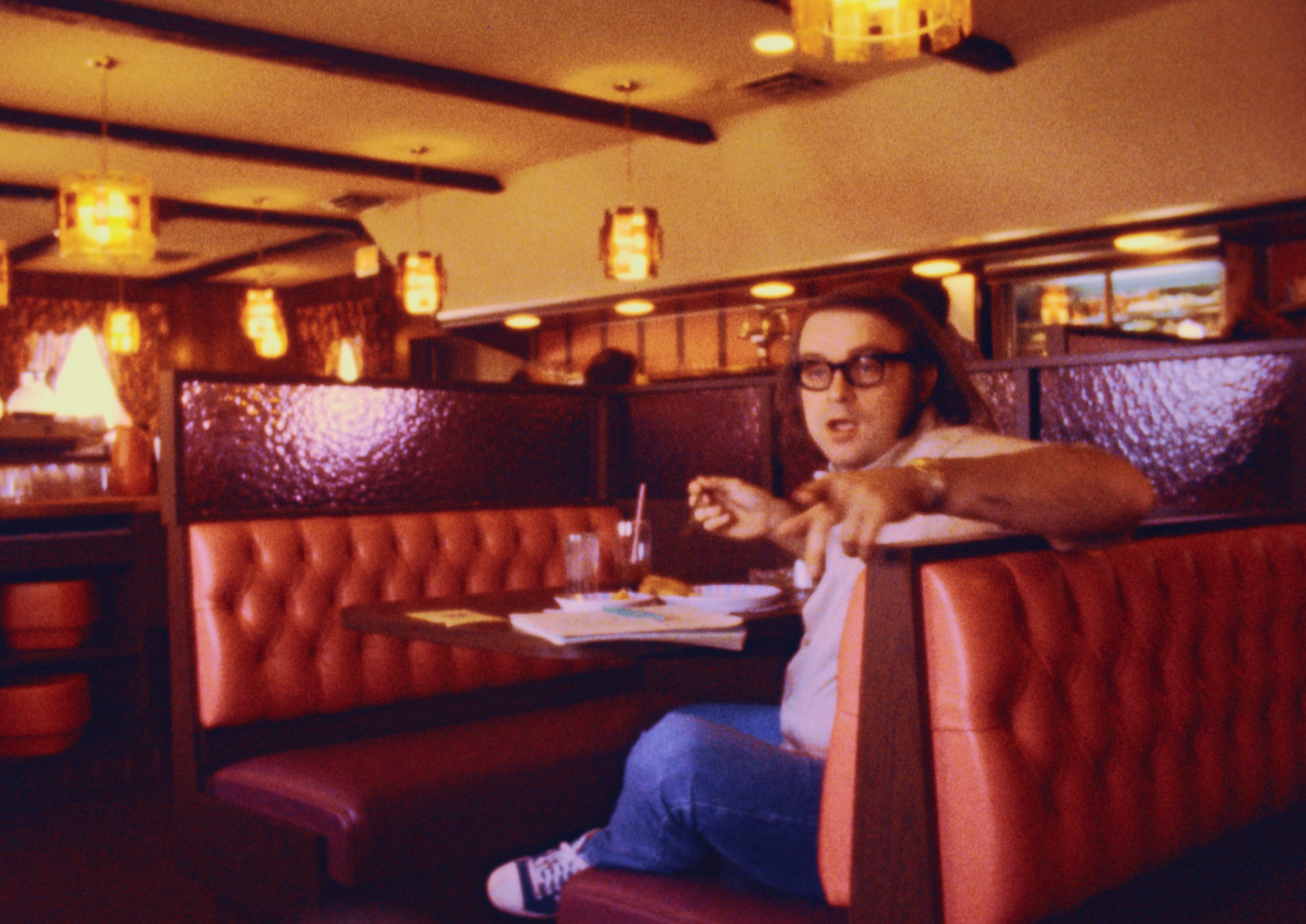
Shot and processed for just US$600, Demon Lover Diary was the first recipient of the Los Angeles Film Critic Association’s annual award for Best Independent/Experimental Feature, reflecting critical consensus.Variety described it as “emotional, tense and jagged … an involving piece of visceral verite, radically different from conventional documentaries.” The Los Angeles Herald Examiner’s David Ehrenstein called it “a funny, frightening exhilarating film.” In The Observer, Philip French praised the film as “an alarming look beneath the floorboards of American lower-middle-class life, at the madness engendered by pathetic dreams of sudden success. Fantastic.”
The film also left a mark on many filmmakers, including D.A. Pennebaker, who called DeMott and Kreines “two of the best filmmakers of their kind that I know—anywhere in the world.” In 1997, Pennebaker and Chris Hegedus included Demon Lover Diary on their list of the best documentaries of all time for IDFA. Ross McElwee called DeMott an “absolutely fearless” filmmaker and cited her and Kreines’s work as a major inspiration for Sherman’s March. Kelly Reichardt, after hosting a screening of Demon Lover Diary, wrote DeMott: “I just don’t know how you managed to make movies in the way you did. It would have changed my life if I would have seen that image of you in the mirror holding that camera in 1975 when I was 11 years old. It feels startling and important to me now at age 54.” The film screened at numerous festivals, including London, Edinburgh, Berlin, Rotterdam, Sydney, Hong Kong, Taiwan, Athens, and The Hague.
DeMott and Kreines’s next film was 1983’s Seventeen, an electrifying masterpiece filmed in Muncie, Indiana. DeMott described Seventeen as "a film about coming of age in the working class. We decided to follow a group of teenagers—girls and boys, white and black—whose lives intertwine during their last year in high school. By filming for more than a year, and by living where we were filming, we encountered a range of experience. A white girl has a cross burned in her yard because she has a black boyfriend. A pal of hers from the neighborhood loses his best friend, who is killed in a car accident. Another classmate fathers an illegitimate baby.” She continued, “We respected the kids’ complexity, celebrated their liveliness, despaired of their future. And we loved them dearly."
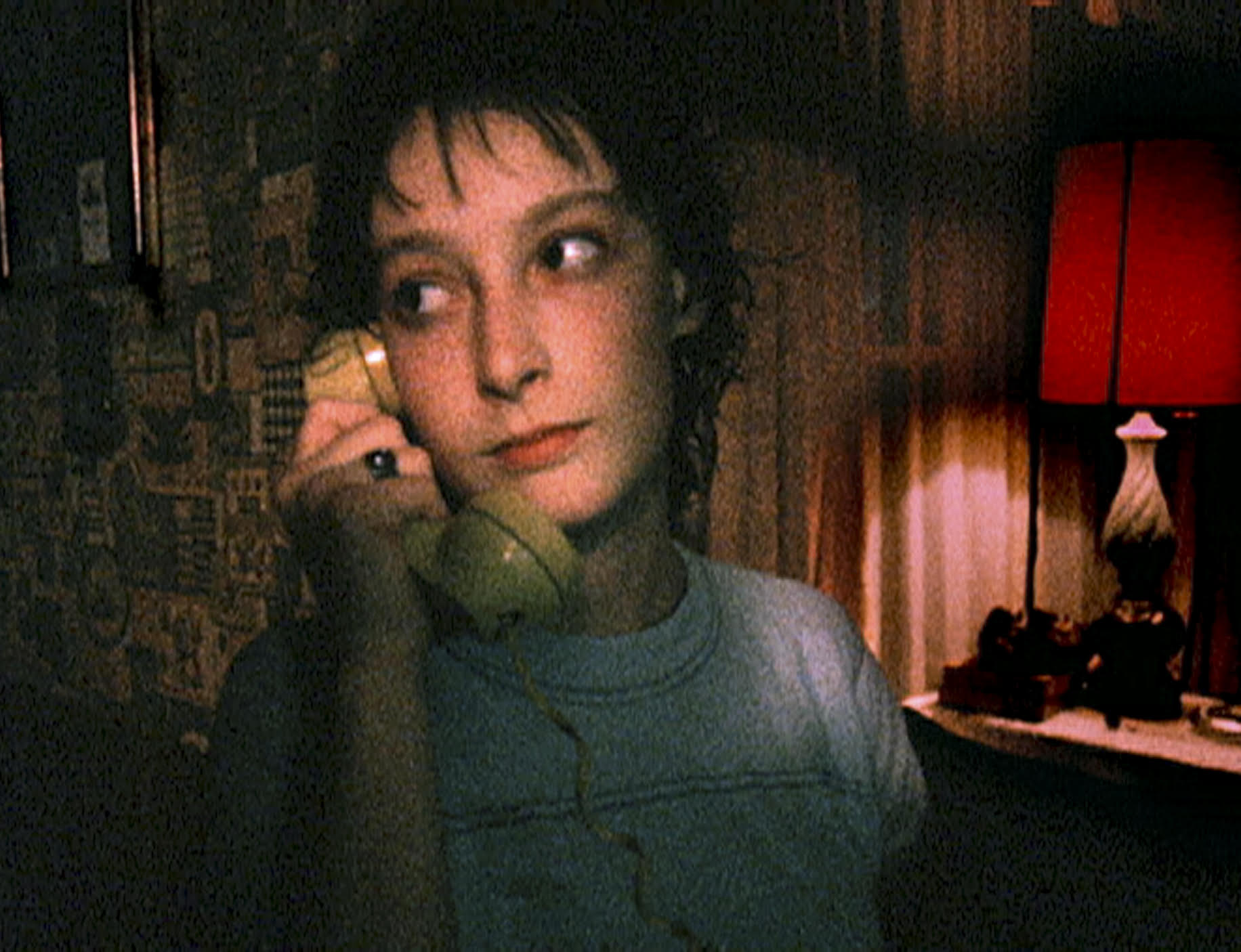
Beyond being a tremendously perceptive cinematographer, DeMott was also a precise and playful editor. For evidence of her mastery of structure, we can watch Seventeen, which weaves together a large cast of characters, delivering both humor and heartbreak as it reveals uncomfortable truths about race, class, and gender.
Though Seventeen was suppressed by PBS (an infuriating saga detailed by DeMott in her extensive screed “Some Notes on Seventeen”), it still screened at theaters and festivals around the world. Frederick Wiseman, Barbara Kopple, and D.A. Pennebaker selected Seventeen as the Grand Jury Prize winner at Sundance in 1985. In The New York Times, Vincent Canby called it “one of the best and most scarifying reports on American life to be seen on a theater screen… It’s Seventeen that haunts the memory. It has the characters and the language—as well as the vitality and honesty—that are the material of the best fiction. Ferociously provocative. ONE OF THE YEAR’S BEST FILMS.”
DeMott’s films have stood the test of time. In a 2008 appraisal for Film Comment, Rob Nelson wrote, “Both Seventeen and Demon Lover Diary are positively crucial to documentary film history.”
Like many great film artists, wide distribution eluded DeMott and Kreines. Their projects included Montgomery Songs (1976), 36 Girls (1976), Down on the Farm (1977), God & Country (1978), A Simple Trip, and Goldbug Street (which will be released in 2027), but none of them are publicly accessible. The filmmakers self-distributed 16mm prints, but sadly, most people have watched their films via low-quality bootlegs. Fortunately, preservation efforts are underway, with Kreines and the Chicago Film Society currently collaborating on a 35mm restoration of Demon Lover Diary.
DeMott was a brilliant, fiercely serious artist with a terrific sense of humor and a deep love for those she filmed. She made her art with integrity and imagination, opening up exhilarating new paths for nonfiction cinema.
She survived her father Benjamin, her mother Margaret, her brother Tommy. She is survived by Jeff Kreines, her partner of fifty years, her brother Benj, her sister Megan, her sister-in-law Maria, and many other DeMott kidlets.
Chris Boeckmann is currently the director of development at Impact Partners, as well as a documentary story consultant. From 2009 to 2020, he programmed at the True/False Film Fest.