


“We Do Need Art in Order to Reach Each Other”: Tatyana Tenenbaum Reconfigures Choreographer Hadar Ahuvia’s Dance in ‘Everything You Have Is Yours’
By Carly Mattox
Image courtesy of the filmmaker
In Everything You Have Is Yours, we see dancer Hadar Ahuvia as she develops her performance by the same name, the culmination of years spent celebrating her own Jewish identity while also challenging Israeli tradition. The title itself was inspired by a question Ahuvia had been asked by an Israeli security officer while renewing her passport; she reflects in her own artist’s statement, “I know he’s asking, “Did you take something, knowingly or unknowingly, that might not be yours?’” The film by choreographer-turned-filmmaker Tatyana Tenenbaum not only contextualizes Israeli folk dance within the cultural history of Israel and Palestine, but also contends with the embodied performance of culpability and appropriation.
Since the film’s streaming premiere and festival run over the last year, the capacity for dance—or any art form—to serve as an avenue for radical activism has become increasingly scrutinized. A month after President Trump’s inauguration, a group of dancers from across the DMV arrived in Washington, organizing themselves single-file along the slim stretch of road between the Kennedy Center and the Potomac. In silence, their limbs swayed and gestured in elegant unison, formal grace rendered blunt by thick gloves and downy windbreakers. Their performance—an act of peaceful protest against Trump’s overhaul of Center leadership—was largely decried across social media as a performative stunt, though most snarky comments neglected to mention that the dancers were recreating Pina Bausch’s Nelken Line.
There is a very real and immediate danger that the Trump administration poses to those bodies most precarious—immigrants, trans youth, Palestinian activists on college campuses—and it is a danger paralleled by protestors organizing boycotts and rallying in the streets. Choosing to direct finite energy into an artistic endeavor is not an unconscious decision, but it is also not necessarily an insignificant one. Earlier this year in Cambridge, Massachusetts, the José Mateo Ballet Theatre hosted the first conference dedicated to the discussion of dance activism. As a supplement to the theatre’s annual Dance for World Community Festival, now in its fifteenth year, the conference sought to offer a space where such questions could be discussed, if not answered. More than anything, the conference encouraged participants to consider the narrative that every style of dance perpetuates.
Everything You Have Is Yours (which is fiscally sponsored by IDA) reckons with many of those same questions. Completed before the current genocide began, Palestinian dancers from the Freedom Dabka Group, based in Staten Island, share their stories; on-screen interviews allow these individuals to speak for themselves, if not offered equal narrative weight. Behind the camera, Tenenbaum demonstrates a keen eye for cinematography, with the help of co-editor Colin Nusbaum. The resulting film is a complicated and thorny portrait of dance as a form of cultural expression that cannot exist without context.
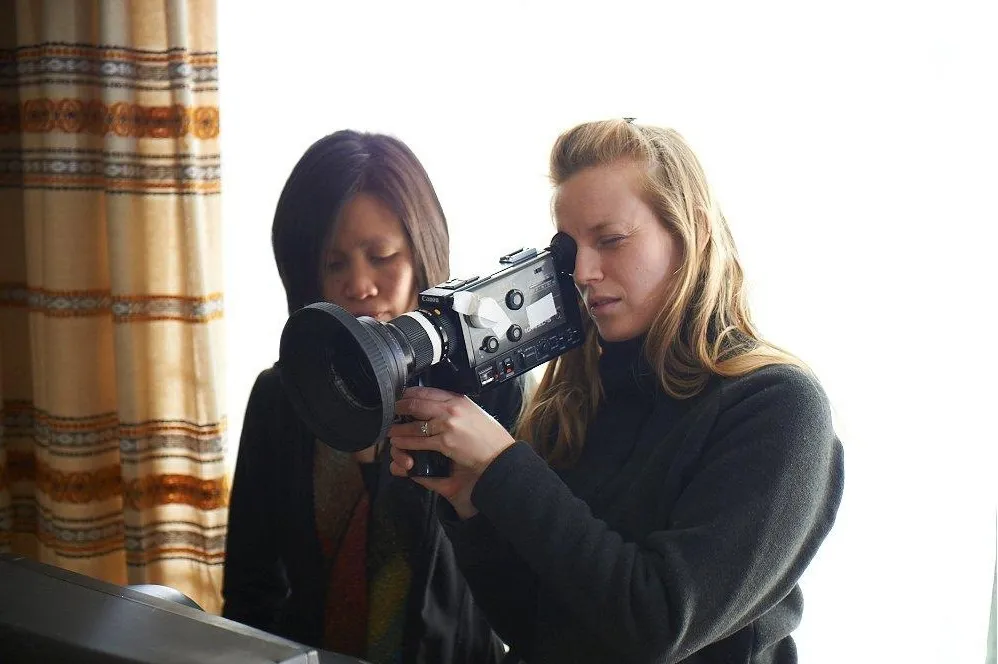
After its theatrical run in NY, Documentary spoke to Tenenbaum about adapting her work in dance documentation to documentary, dance film tropes, and political activism in a nonverbal art form. Everything You Have Is Yours plays next in the August edition of Film Independent’s Festival Visions program. This interview has been edited for length and clarity.
DOCUMENTARY: You came to filmmaking in 2011, when you started doing videography for a few different dance organizations. Having had 15 years to develop your vision, to what extent is filmmaking now part of your own artistic practice?
TATYANA TENENBAUM: I’m someone that has a really hard time doing work that I’m not interested in. When I started doing videography and then building artist portraits through that—mostly for Baryshnikov Arts Center and then a few other organizations—I was making it interesting for myself by thinking a lot about embodiment and aliveness. I had to go through interview footage with a lot of artists, even before I started this project, and I learned a lot about what it looks like when people are really tapped into themselves, what that sounds like. I feel like embodiment is the connective tissue.
Filmmaking is also an incredibly collaborative medium, even beyond what I’m used to. I think it was really humbling to, at a certain point, take a step back from all that I had created. I did a lot of intuitive shooting from the hip, both filming and editing, and so I built an artistic language in a playfully naive way. At some point, I needed a lot of help to really scaffold that into a narrative that can take on so many complicated things.
D: How did your background in live performance inform your approach to the visual language of the film, especially the dancing?
TT: Because I came from dance documentation, by the time I had started this film, I had strong opinions and an aesthetic that I believed in. I love the democracy of a wide shot, which really allows your eye to follow things in the space, to take it in the way you would in a theater. And then, with a few exceptions, I tend not to hyper-fragment the body. I try to follow centers of gravity, but I like for a close-up to at least have three-quarters of the body. I try to capture the way that people relate to the space.
When I began this film, I had no idea it was gonna be a feature. I thought it was gonna be a short project and all I knew was that I could film dance well, and I wanted to give that to Hadar—to document her work well, because if work isn’t documented well, then it just evaporates. I insisted on Hadar wearing a lav all the time, because there’s a lot of texture in her work.
With that being said, I learned things as I went—probably about 7 years of filming—where I was constantly growing as a cinematographer. It was important to me in the beginning to actually limit myself, and have a very clear set of rules aesthetically, because if you’re constantly changing your approach, there’s no cohesive visual language. The film works because it’s a process film. If I were to do this again, I would feel even more free to break rules. At the time, I wanted to preserve the audience experience. Sometimes, with dance films, there’s beautiful cinematography, but you can’t really see the dancing.
D: Throughout the film, there are certain markers of time—we see Hadar reacting to the Great March of Return on the news, and you see people protesting the death of Shireen Abu Akleh. What was the timeline for production, and did you feel a sense of urgency to complete the film after October 7?
TT: At a certain point, we knew we weren’t going to succeed in making a film that was hyper-located in time. Things were just evolving constantly. The opening dance is archival—I didn’t shoot it, but it took place at the beginning of my friendship with Hadar. That was a dance that she created in response to the 2014 assault on Gaza, which killed a little over 2,000 Palestinians, and it was an outrage, you know? When you hear the reference to the Great March of Return, that was happening in the moment, when I was filming her. It felt important for the integrity of our process, to hold on to those moments.
There were bombings of Gaza during the last few years of production—that’s when we expanded the story to include dancers who were not part of Hadar’s process, so Freedom Dabka became a part of the film. We were already planning to finish by fall 2023, and we had our last confirmed shoot with Freedom Dabka on the calendar, and then this horrific event happens. The very last thing that we shot was Freedom Dabka performing in the park around October 14th, and I don’t think that anyone was processing it. We were all just trying to do whatever activism we could do in that moment, and it felt like part of my activism was this film, finishing it.
There was a limit to what we could capture in terms of our chronology, but we hoped that the feeling of these moments always brought the audience back to the tangible harm that Palestinians were facing. The Great March of Return [2018–2019] was a nonviolent protest of the blockade, of their conditions in Gaza, and it was met with violent retaliation by the IDF. There’s a lot of information, but it’s for people who will know what it means and will understand what happened.
D: Not only does the film begin with a land acknowledgement, but you also locate a lot of the events in New York City. We often see dancers physically interacting with their environment. How did that visual thread come to be, and how did it end up facilitating the themes of the film?
TT: The film began as an archive of Hadar’s work, which took place within indoor theater spaces, and where she had created her own visual language with projectionist Gil Sperling, referencing historical images and landscapes. There’s a motif where they’re dancing, and there’s plants surrounding them, illustrating this cliche of how Israelis made the desert bloom by turning this dry, barren place into a modern, successful place.
The beautiful thing about how long it took me to make this film, especially as a first-time filmmaker, was that I was continuously adding layers. During the pandemic, I was spending more time outside and seeing the city in slow motion. We were really contending in that moment with how to invite Palestinians to have their own voice in the film. Hadar didn’t want to represent Palestinian bodies in her own work, because she didn’t want to speak for them. At some point it became this very simple revelation that we were actually here. And every character, every subject of the film at that point, lived here in New York.
It was also in that moment that I invited Hadar to recreate some of her performance texts. We started collaborating in more of an active way—before, I was documenting Hadar’s work, but now, I was actually inviting her to read a certain text out in Shirley Chisholm Park. There was another text, one about Hadar’s great grandfather in Poland, and we shot that in the oldest reformed synagogue in Brooklyn, Congregation Beth Elohim. Once Freedom Dabka Group joined the piece, Staten Island became a location, and it became a practice, more and more, that I was really trying to document the land. I was particularly interested in water and where land meets water—these places which have been remediated over the years, where traditionally the edges were filled in and hard lines were created where soft marshes used to be. This transformation of the land also mirrors how Israeli agriculture, especially with the Kibbutz movement, transformed the desert into a more agrarian, European idea of what productive land looks like.
D: A lot of people within the dance community take for granted how political and nuanced dance is because it’s not necessarily intuitive for a general audience, who might argue that there are better avenues for activism. How do you navigate both dancing and filmmaking as artistic practices, as well as forms of protest?
TT: First, I just want to name and acknowledge the lineages of political labor that preceded this film, that preceded Hadar’s work and informed it, the decades and decades of Palestinian resistance and Jewish activism working towards and pushing for us to be where we are now. Jewish Voice for Peace created an Artist Council, which Hadar had been invited to join. At the time, Hadar was someone who had been questioning her Zionism, but still had—as you see in the film—complicated feelings about it. This tactical organizing and the labor of so many people allowed Hadar to metabolize a political transformation and create her work. The two things are not separate.
There was also healing in it—that people who have historically been pitted against each other, who are in a complex web of oppressions with one another, could share space in this film, and in good faith work towards a shared dream: an end to the genocide, Palestinian sovereignty, liberation in the future.
As much as dance, poetry is really woven into this film, and the way that words are used leans more toward poetic and less towards didactic. Dance does that as well. Since we began screening the film 9 or 10 months ago, it seems like it has been able to reach people who may not even agree with all of Hadar’s politics, but are still able to feel a certain cathartic release. As political organizers, we do need art in order to reach each other, because political language can just as often entrench and divide us.
Of course, I share your concern about whether dancing “matters,” but it was easy in this instance to be somewhat removed, watching and documenting other artists, weaving it together in a story. There were members of the cast who struggled, even as the film came out, to see their own utility in it. They felt very vulnerable and exposed, and it took repeat viewings and hearing from many people that it was, in fact, valuable to witness the human responses to this tragedy. We have to be really careful not to use annihilation as a way to replicate annihilation on ourselves, culturally, in pursuit of liberation.
Carly Mattox is a film writer, cultural programmer, video essayist, and occasional amateur ballroom dancer based in New York. Her writing has appeared in MUBI Notebook, Sight and Sound, Little White Lies, and the Brooklyn Rail, among other publications.