

On August 14, the BBC suspended Mohamed Shalaby, a freelance filmmaker and contracted fact-checker, after he raised concerns about the broadcaster’s reporting on Gaza and the killing of journalist Anas al-Sharif. As Shalaby has explained in his own words across several media outlets, he had been working with BBC Verify, a flagship fact-checking initiative, when he was stripped of his credentials after making several complaints.
Shalaby’s complaints centered on the BBC’s live report on August 11 and subsequent coverage on August 13, both allegedly linking Pulitzer Prize-winning Palestinian journalist Anas al-Sharif—who worked for Al Jazeera and was targeted by Israeli forces in an airstrike on August 10—to Hamas, echoing the Israeli state’s official justification for assassinating al-Sharif and four additional colleagues. As early as October 24, 2024, the IDF publicly labeled Palestinian journalist Anas al-Sharif as a terrorist and a member of Hamas; shortly after the strike on August 10, it reiterated this claim on X.
As a producer for BBC Verify, Shalaby first emailed his supervisor with a formal editorial complaint on August 11 regarding the tenuous alleged connection between Hamas and al-Sharif. As part of his own fact-checking process, Shalaby coordinated an interview with Al Jazeera managing editor Mohamed Moawad and found little support for the claims beyond statements by the IDF.
Despite reiterating these complaints between August 11 and August 13, addressing the senior news executive at BBC Verify, Shalaby was summarily ignored. He began criticizing the reporting through his social media account on August 13. Documentary reviewed a series of messages from a supervisor at BBC Verify, in which Shalaby was told that his ID was revoked on August 13. He was no longer allowed access to the BBC’s headquarters in London, was asked to speak with HR, and was instructed to return his work laptop the next day.
This abrupt ending to his eight years of working for the BBC both shocked and disappointed Shalaby, as it was the BBC that had inspired him to embark on a career in documentary filmmaking, first at Bahçeşehir University in Istanbul and then at the National Film and Television School (NFTS) in England. The latter boasts such alumni as Nick Broomfield and Kim Longinotto. “It was at film school where I was first taught to question who should be telling these stories, and why,” Shalaby explains.
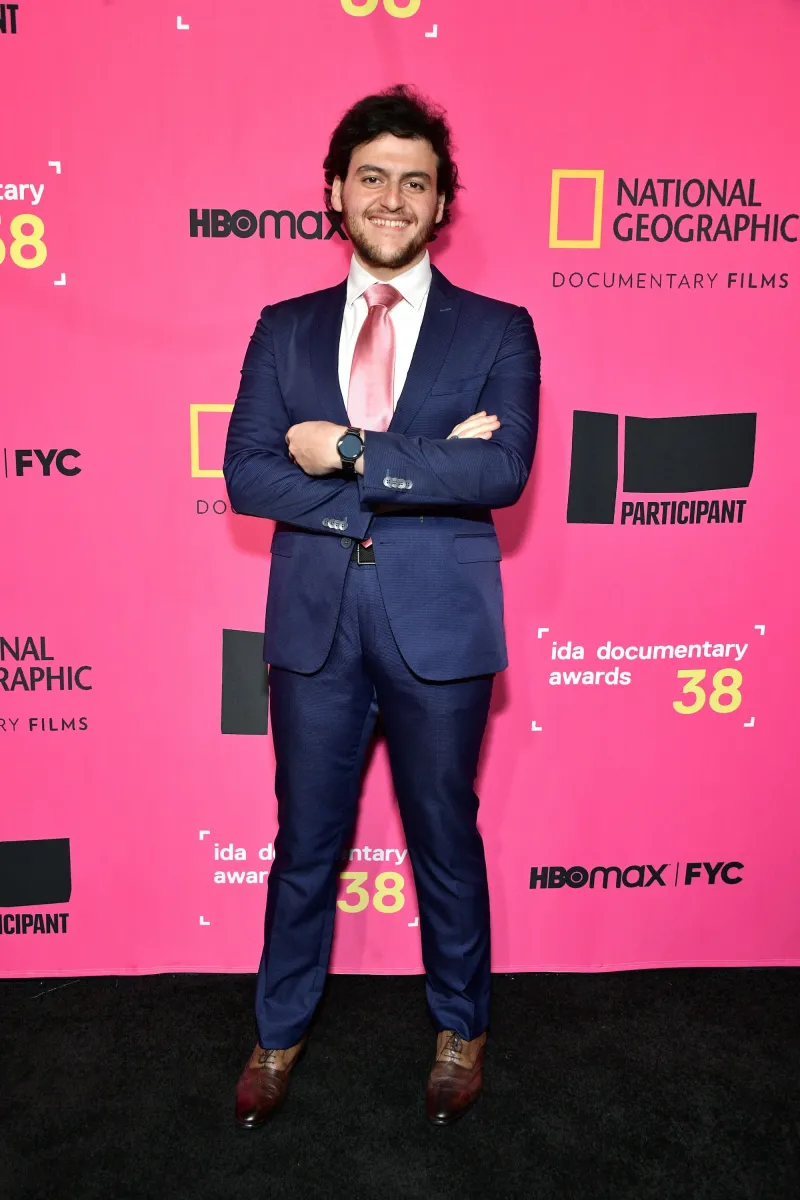
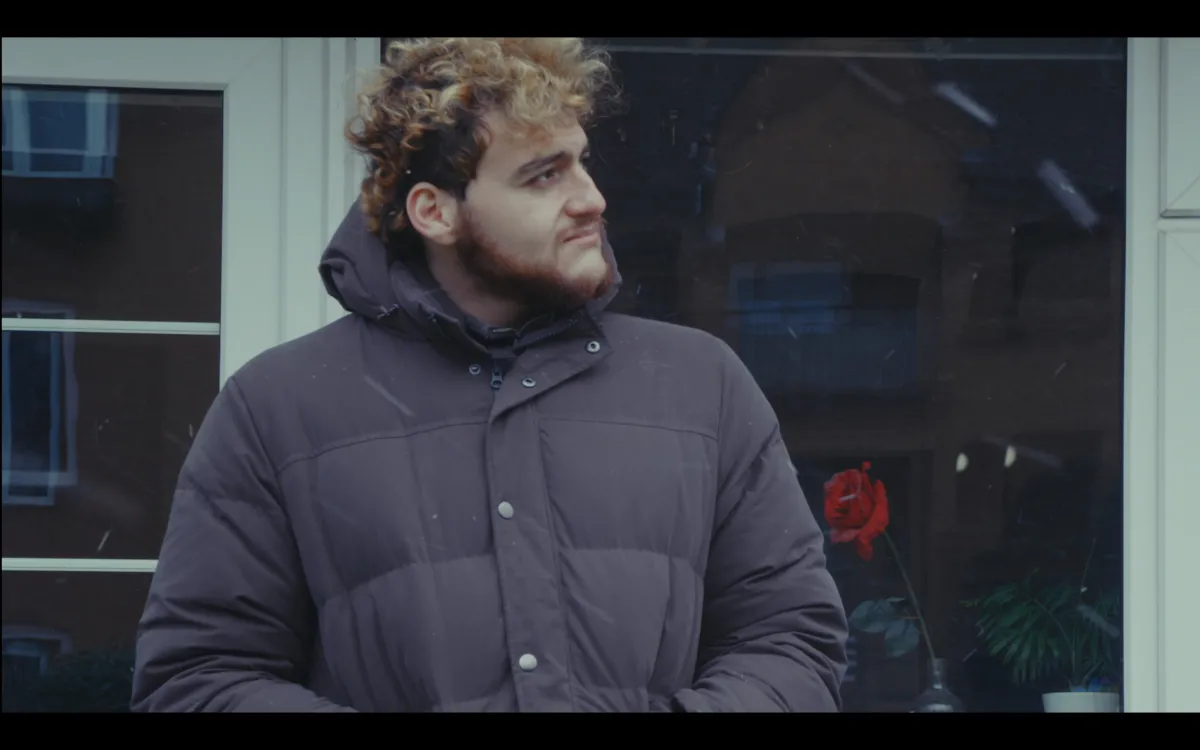
Mohamed Shalaby at the 38th IDA Awards in 2022.
When Shalaby graduated in 2022, he won the prestigious Christie prize for Most Promising Student. His documentary short, 3 Promises (2022), was later nominated for an IDA Best Student Documentary Award and shortlisted for a Student Academy Award. The autobiographical film is an honest and tender chronicle of Shalaby’s coming-of-age, from his native Egypt to Turkey and the United Kingdom, where he sought asylum after losing his passport. Peter Dale, head of documentary at the NFTS, said the film was “a remarkable piece of personal filmmaking” when presenting the Christie award to Shalaby.
“There were a lot of ideas that we had learned about in film school, like the ethics of representation—ideas that were quite academic,” Shalaby says. “When I began working for the BBC, I was suddenly confronted with these issues in real life.” Shalaby’s first contract with the broadcaster was for his documentary short, 51 Kilos (2018), which was commissioned by BBC Arabic.
As his work with the BBC slowly increased over the years, his understanding of journalistic ethics, as informed by his time at the NFTS, was often complicated by the broadcaster’s approach to certain stories. “There’s always that first impression, when you start doing something differently than how you were taught,” Shalaby admits. “At first, I was maybe more critical, but gradually I became a part of that world without realizing.”
The “Inverted Pyramid” of BBC Editorial Oversight
The circumstances of Shalaby’s suspension aren’t unique, but rather reflect a pervasive issue across the BBC, where authorial voice takes precedence over any individual contributors. Shalaby describes a kind of “inverted pyramid,” where a journalist on the ground serves as the most narrow point at the bottom; above them, there is a senior journalist, plus an editor, and then a news controller who coordinates with relevant legal teams and editorial policy. At the top, there is the news director.
Director Karim Shah, who has worked for a wide range of broadcasting companies in the United Kingdom, explains that a certain level of oversight isn’t surprising. Across feature-length projects for the BBC, ITV, Channel 4, and PBS Frontline (he was nominated for a BAFTA for Afghanistan: No Country for Women (2022), part of ITV’s investigative series Exposure), Shah explains: “For somewhere like ITV or Channel 4, there’s usually an executive producer, and then maybe a commissioning editor.” However, on his most recent project for the BBC, Gaza: Doctors Under Attack (2025), the level of scrutiny was greater than expected.
Gaza: Doctors Under Attack was scheduled to air in February 2025. “We were having to deal with a lot of compliance people, dealing with editorial policy,” says Shah. “Advisors were becoming a little obstructive, and questions were no longer about the journalism itself. That is unique to the BBC.” What followed was nearly six months of delays, during which the BBC had conducted a separate investigation into another documentary, Gaza: How to Survive in a Warzone (2025), a film which had been initially broadcast before being pulled from the program.
Behind the scenes, Shah and producer Ben de Pear received numerous excuses for this delay, on email chains with names of executives whom they didn’t recognize and who had no part in making the film. “They are framing it as this independently made film, which wasn’t the case at all,” Shah explains. “The commissioner was sitting in on the edit; it seemed like we were all on the same page.” The BBC hasn’t responded to a request to comment on the editing of Gaza: Doctors Under Attack.
Based on several off-the-record conversations with previous BBC contributors, the BBC seems to heighten scrutiny of journalists for their personal views. Ramita Navai, a producer on Gaza: Doctors Under Attack and the film’s most significant voice on-screen, drew on her prior experience in the region with PBS Frontline and ITV Exposure. The latter garnered her a BAFTA nomination. According to Navai, the BBC had been well aware of Navai's social media presence before she was hired for the role. As recorded in The Observer, in May, de Pear and Navai were called into a meeting where senior BBC executives suggested that Navai’s role be downgraded to a contributor or third party presenter. Both producers refused.
In the end, the BBC explained in a statement on June 20, 2025, that Gaza: Doctors Under Attack was shelved because it was not “in line with [the BBC’s] impartiality standards.” As previously covered in Documentary, the film’s rights were then transferred to Basement Films, de Pear’s production company, and the film was broadcast on Channel 4 in early July.
Working with the BBC offers a tradeoff, which Shalaby acknowledges. “It’s true that I was able to use the strength of the BBC to get certain access, certain opportunities,” he concedes, with a certain amount of pride in his work on award-winning investigative documentaries such as Queer Egypt Under Attack (2023), Under Poisoned Skies: Investigating Oil’s Deadly Toll in Iraq (2023) and Life and Death in Gaza (2024).
“At the same time, the BBC also got a lot from me—my knowledge of the region and of the language, my own skills in the craft,” Shalaby says.
“There’s Nothing Like Having a Proper Journalist With Our Standards”
Despite contracting journalists with direct regional knowledge, the BBC prioritizes its most familiar correspondents on screen. Yet these well-known journalists—along with contracted filmmakers such as Shalaby and Shah—have been unable to enter Gaza for nearly two years due to Israel’s siege. Al Jazeera takes a different approach, relying primarily oncontracted freelance journalists based in Gaza.
Such is the case with Fault Lines for Al Jazeera English, with executive producer Laila al-Arian at the helm of the series. Since October 2023, Fault Lines has produced five films about the ongoing genocide in Gaza, including The Night Won’t End: Biden’s War on Gaza (2024) and The Disappearance of Dr. Abu Sharif (2025). These documentaries feature a crew mostly composed of journalists in Gaza and the Gaza-based production company Media Town, including cinematographer Bilal Salem and production manager Hussein Jaber.
Al Jazeera’s emphasis on this collaboration offers an intimate, on-the-ground glimpse into the conflict that international journalists aren’t able to access, while also allowing native Gazans to tell their own stories with some semblance of agency.
“We wanted to focus on specific cases of families who had been impacted by Israel’s bombardment of Gaza,” Al-Arian explained in an interview with Drop Site News. “These journalists worked under the most extraordinary circumstances, the most difficult circumstances imaginable.” While filming for The Night Won’t End: Biden’s War on Gaza, members of the production team were dealing with their own tragedies nearly every day; as just one example, production manager Jaber’s six-year-old daughter was shot and killed by an Israeli ground troop in December 2024, while Jaber himself suffered gunshot wounds.
Such a collaborative approach is far from the industry standard. Rather than building a relationship with local professionals like Media Town, the BBC continues to insist on the authority of journalists outside of Gaza. When BBC director general Tim Davie was questioned by members of Parliament on September 9 regarding the BBC’s coverage of Gaza, he advocated for the allowance of international journalists into Gaza while commenting, “There’s nothing like having a proper journalist with our standards on the ground doing the work.”
For Shalaby, the biggest issue is that the BBC only prioritizes external voices for the sake of representation, rather than for the quality of the journalism they might offer. “The BBC is a brand that overrides any individual voice,” Shalaby explains.
Is Any Media Outlet “Ever Truly Free”?
For investigative journalist Nada-Mai Issa, who has produced factual programming for a wide range of broadcasters, issues of editorial oversight and perspective are not isolated to the BBC, or even Al Jazeera, Channel 4, and ITV. “I don’t think we have a free media anywhere in the world,” Issa says. Having spent two decades in the industry, she approaches her job with a certain pragmatism. “When we talk about a ‘free press,’ no broadcast media is ever truly free. Every outlet operates within an editorial framework—you already know, broadly, what worldview you’re stepping into.”
At Al Jazeera, Laila Al-Arian is also candid about her own frustration with the documentary industry. “The way that the documentary world has responded [to the war in Gaza] has been woefully inadequate,” she laments. “There has been a stunning lack of solidarity.”
In the two months since publishing the report that al-Sharif had ties to Hamas, the BBC has refused to retract or correct the singular statement that Mohamed Shalaby called into question: “The BBC understands Sharif worked for a Hamas media team in Gaza before the current conflict.”
Some journalists have maintained their resolve for the sake of their subject matter. Karim Shah has continued working with the BBC, despite his recent experience with Gaza: Doctors Under Attack. “The BBC is an important space, with an important audience,” he explains. “They have a certain reach that you can’t compare to other publications.” For Shah, a level of distrust remains, as the BBC editorial line continues to shift in step with the British government’s own policies.
When Gaza: Doctors Under Attack was broadcast on Channel 4 in July, critics praised the film’s incomparable proximity to the doctors. “The biggest, and possibly only, failure of Gaza: Doctors Under Attack is that the circumstances of its broadcast threaten to overshadow its content,” wrote Stuart Heritage in a five-star review for The Guardian. “There is no clear manipulation, no central villain. What there is, however, is an unceasing timeline of horrors.”
As Issa also moves forward to her next project, a documentary with the London-based Wonderhood Studios, she acknowledges that one potential path forward is similarly small, independent production companies. “I do think we need to be more honest about what we mean by ‘impartiality’ today,” Issa says. “In an ideal world, we wouldn’t have outlets held hostage by government influence or commercial pressures. Until then, the challenge is how to reshape the ecosystem.”
“I never meant to be a journalist,” Shalaby admits. Since leaving the BBC, he has worked with independent production companies such as de Pear’s Basement Films, rather than joining another broadcaster as an investigative journalist. Shalaby’s latest film, titled Soaked in Blood: The Killing of Ameen Sameer Khalifa, was recently released by Middle East Eye. “When it comes to telling the truth, telling the stories of these individuals, the only path forward is documentary film.”
Editor’s Note, October 21: An earlier version of this article misquoted Sara Obeidat.
Editor's Note, October 28: The timeline of Ramita Navai's social media profile has been updated.