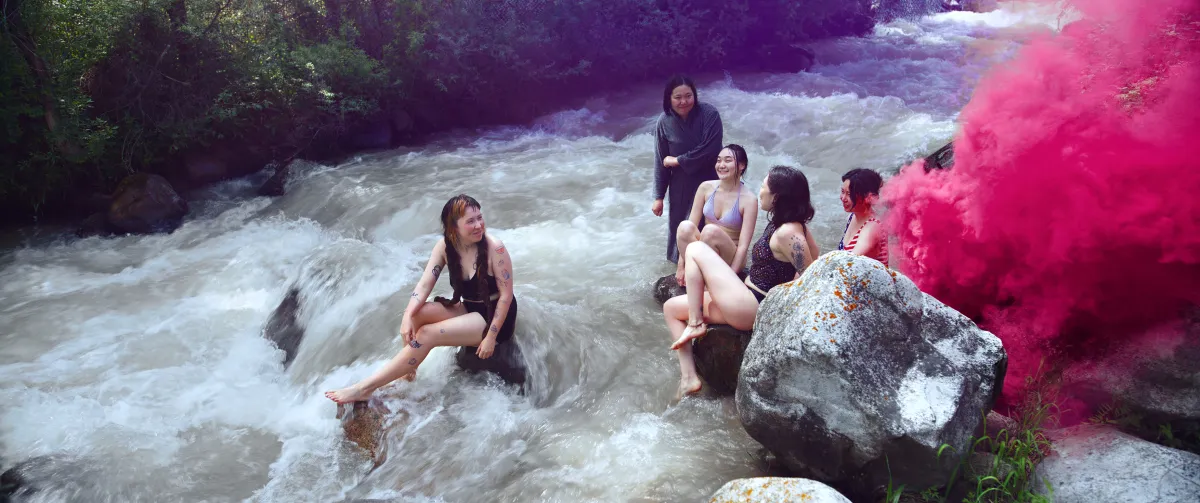


In River Dreams, director Kristina Mikhailova follows the Aksay River in southern Kazakhstan, rendering the river’s “voice” through the voices of young women. They are interviewed against carefully composed backdrops, filmed “dreaming” (standing with their eyes closed), or performing songs or dances. Moving from artists and activists to inmates and schoolgirls, Mikhailova constructs a sociological portrait of womanhood—or “sisterhood,” as she herself says—in contemporary Kazakhstan.
Mikhailova’s hybrid feature is the first documentary from Kazakhstan to have its world premiere at the Berlinale. The road there has not been easy. In attempting to combine national financing with international coproduction for the first time, Mikhailova and producer Dana Sabitova (with whom she co-founded 24 FPS, an Almaty-based production company) encountered obstacles on both fronts. According to Mikhailova, despite winning the national pitch three times, they were denied funding. Likewise, working with an international coproducer proved to be another bureaucratic maze.
The challenges faced by the filmmakers mirror those experienced by their protagonists—human and non-human alike.
Echoing the river itself, the film adopts a meandering structure, drifting from one girl’s voice to another while remaining deeply committed to its central theme. The personal stories of the “river girls” are punctuated by key events in recent Kazakh history: youth-led feminist marches later banned by the regime; the trial of a former minister of economy who brutally murdered his wife, Saltanat Nukenova; and devastating floods that disproportionally affected economically precarious suburban populations.
Ahead of its premiere in the Berlinale Forum Special, Documentary spoke with Mikhailova about the trials and tribulations of national and international financing, the film’s hybridity, the dearth of grassroots initiatives for documentary filmmakers in Kazakhstan, and what it means to be a Kazakhstani woman today. This interview has been translated from Russian and edited for length and clarity.
DOCUMENTARY: When did you start working on the film?
KRISTINA MIKHAILOVA: The first organization I turned to was Kazakhfilm after pitching the idea at the Eurasia Project Marketin 2018. At the initial stage, they supported me, saying, “Coproduction is cool. If you can make something happen, we’ll support you.” They thought it would be possible to make a modest project for 50 million tenge (around US$102,000). In 2022, I was able to do the first shoot. Kazakhfilm provided me with the camera I wanted to work with. But later, unfortunately, our paths diverged. After that, we pieced together financing bit by bit, adding shooting days as we went. I have to emphasize that the anger and despair I encountered as a young woman director became the main fuel that sustained the production for all five years.
D: You mentioned that you won the pitch from the State Center for National Film Support, but did not receive the money. How is that possible?
KM: Kazakhstan has a monstrously constructed film industry full of Kafkaesque bureaucracy. It’s all mostly ideological propaganda disguised as a so-called democratic pitching system. An even bigger problem is the absence of mutual support and grassroots structures that could help filmmakers act collectively. The state has done everything to prevent even the possibility of our uniting. We have to compete for every resource, and resources are scarce.
We won the national pitching competition three times. But every time it came to signing a coproduction agreement, new obstacles appeared. Most often, we were accused of our producer not actually contributing money: “Let them submit a bank certificate confirming that they have the amount they plan to invest,” we were told. This shows a complete lack of understanding of how budgets are structured at different stages of production.
D: You also faced difficulties working with foreign coproducers.
KM: International coproduction was, unfortunately, the only way for us to make the film. At some point, we realized we were not receiving support in Kazakhstan, nor the support we had expected from our coproducer. In the end, around 70-80% of the film’s financing came from producer Dana Sabitova and me.
Kazakhstan’s cooperation with European countries is limited. We are not part of coproduction treaties like the Council of Europe Convention on Cinematographic Co-production. This severely ties our hands.
We invited an editor from India, Arya Rothe. She believes that documentary cinema exists without solid ground beneath it—that you must travel and remain a kind of nomad.
—Kristina Mikhailova
D: Alongside working on the film, you were also part of the Association of Documentary Filmmakers in Kazakhstan (Qazdoc), founded during the pandemic. How viable was that collaboration?
KM: While traveling to different labs, we saw how filmmakers in other countries fight injustice. We realized that we also needed to unite documentary filmmakers. But once we did, it felt as though we were recreating another state structure. For example, we wanted to jointly send a letter to the Ministry of Culture and Information proposing a separate jury for documentary cinema within the National Fund. We couldn’t agree, because most people were afraid that signing it would affect their chances of receiving funding in the future. At some point, Dana and I realized the space had become too constricting. We created Women Make Docs, a much smaller group that initially consisted of just three women documentary filmmakers.
D: As Women Make Docs, you were very actively engaged in activism and in promoting documentary cinema more broadly, right?
KM: After traveling to DOK Leipzig and IDFA—the first time Kazakhstan was represented there—we had a revelation. We finally understood how the industry works, and we realized that Kazakhstan was far behind.
In one year, we accomplished what the larger Qazdoc association couldn’t do due to bureaucracy. We organized online lectures with institutions such as IDFA Academy, IDFA Bertha Fund, Berlinale’s Doc Station, and others. We curated documentary screenings on decoloniality in Almaty. We organized documentary shorts screenings in cities across Kazakhstan. Even though the screenings were small, they mattered to us.
I also conducted research on documentary filmmaking in Central Asia. We announced an open call, and people filled out questionnaires if they identified as documentary filmmakers. I personally contacted all 80 documentary filmmakers in the region. That’s how the network was formed.
D: Why did the river become a personification of young women?
KM: Initially, my idea was about how the river became personified through young women. When I travelled along the entire river, I was curious about why people treated it with such neglect, failing to notice the beauty of very ordinary things. I tried to find that beauty, and this grew into a story about the river. The more I shared the project with others and participated in different labs, the more I realized that people connect more easily with women’s stories. For me, this became a good reason to look for the right balance between the river and women.
D: What struck me most about the film is its meandering river-like methodology, where the narrative flows from one woman’s voice to another while remaining deeply committed to its central theme: contemporary womanhood in Kazakhstan.
KM: Sisterhood! We invited an editor from India, Arya Rothe. She believes that documentary cinema exists without solid ground beneath it—that you must travel and remain a kind of nomad. I thought this was perfect; we needed nomadic thinking.
D: Major changes in Kazakhstan’s recent history—since roughly 2019— feminist marches that were later banned, the murder of Saltanat, and the floods permeate the film. Did you have this systemic vision from the start?
KM: I have always carried a deep sense of grievance toward the painful political tightening that keeps intensifying. What I’ve witnessed in my conscious political life over the past 10–15 years has felt like a constant regression. I struggle to see progress, even though I am optimistic by nature.
I wanted everything to intertwine and flow smoothly from one thing to the next, focusing on women’s voices because women’s agency is a litmus test. I didn’t want this to be rhetorical criticism. I wanted it to be a sensory, emotional statement so that by the end, viewers would feel the same inner scream that I feel when I confront what is happening in our country.
I have always carried a deep sense of grievance toward the painful political tightening that keeps intensifying. What I’ve witnessed in my conscious political life over the past 10–15 years has felt like a constant regression. I struggle to see progress, even though I am optimistic by nature.
—Kristina Mikhailova
D: Conversations about violence run throughout the film, across the human and the non-human. I am now thinking about the film’s striking final image: a yurt pinned to the roof of a house by floodwaters.
KM: When the floods happened, I had no idea how we would use them, but I couldn’t allow them to be absent from the film. Since cinematographer Amir Zarubekov wasn’t available, I filmed them myself, wearing a vest, with the RED camera.
Violence was never a topic I set out to research. I was simply talking to the girls about what kind of rivers they were. And then I realized that almost every single one of them brought up the violence they’d suffered on their own. Every girl, from a fifteen-year-old during a half-hour casting to an actress from central Almaty, spoke about it. During filming, after setting up the frame, we would stay alone for two or three hours, just me and the girl. Very quickly, they stopped noticing the camera, and we simply talked. That atmosphere of trust led them to share stories of violence they had never told anyone before.
D: The film gradually reveals a dialectic between traditional Muslim values and the promise of Western-centric feminism. Was it important for you to show different women’s voices from the beginning? How did you choose them?
KM: Yes, that was very important. It matters which social layer of women we show. I wanted the selection to be as random as possible, yet relevant to as many women as possible.
At first, we simply posted announcements in villages saying: “Come if you feel that you are a river.” Just like that, very abstract. Then I paid attention to the women I encountered in Almaty—at events or simply on the street. If I felt emotionally that someone was a river, I asked whether she wanted to participate. We eventually also posted casting notices through our media and Instagram.
D: Funnily enough, I was touched by the scene where a group of men poses for you—factory workers, I assume? They laugh, saying they’ll become famous. Behind their bravado, as the camera lingers on their faces, you can see bitterness, exhaustion, and hardship. In your film’s poetics, men also find their place.
KM: These men are quarry workers. Interestingly, the river is cleanest there. When women talk about perpetrators of violence, we often imagine some abstract evil man. One of my heroines says at the end, “I understand why my father beat me. I don’t want to justify him, but I know why he did it.” I deeply respect that position. These men are defenseless in front of the camera, with tired eyes, despite their bravado, like children. And yet, you can’t escape the feeling that these are the very same men being talked about.