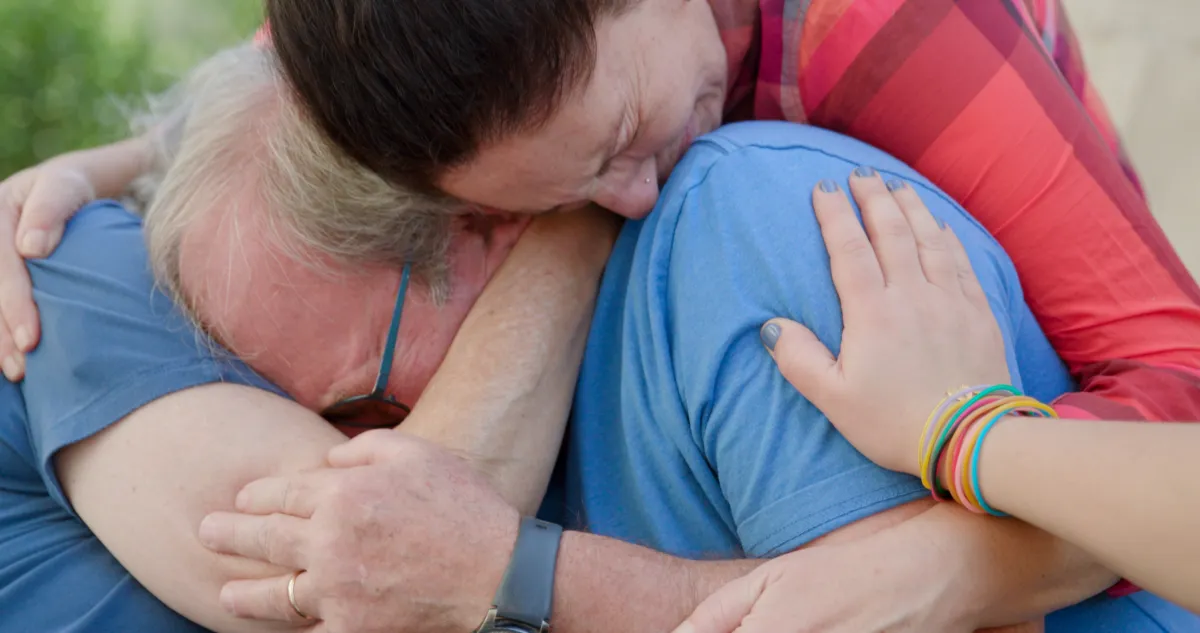


For the past twenty years, director Brandon Kramer and his brother, producer Lance Kramer, have been quite close with Yehuda and Chaya Beinin. Their cousin married into the Beinin family, and over the years, their paths continued to cross. When Lance moved to Portland after college, he lived in Yehuda’s brother’s home and became close to Tal, the Beinin’s daughter, who lived in Portland as well after leaving Israel. When Brandon and Lance first visited Israel, they stayed with Yehuda and Chaya.
That’s why, after the October 7 Hamas attack on Israel, the Kramer brothers were quick to call the Beinins once they heard their daughter, Liat, and son-in-law, Aviv Atzili, were missing and presumed to have been taken hostage. The brothers reached out after the attack as family, not filmmakers.
During their call, Yehuda told them that he was not getting a satisfactory response from the Israeli government regarding plans to return the hostages. And because the Beinins and their children are dual U.S. citizens, he was planning a trip to Washington, D.C. (where the Kramers live) to lobby for assistance. His grandson Netta, who had only barely escaped being killed or kidnapped himself, was coming too.
Holding Liat chronicles that journey, and the agony of uncertainty Yehuda, Chaya, Tal, and Netta experienced during the weeks when they didn’t know when or if they’d ever see Liat again, as well as what happened when Liat eventually came home. The documentary, which premiered at the Berlinale Forum, has been making festival rounds internationally and domestically. A U.S. theatrical run is set for January 2026, starting in New York City at the Film Forum.
Documentary caught up with the Kramer brothers to discuss the thorny ethical dilemmas they faced while making their most recent film, how knowing their subjects so intimately came with its own challenges, and why consent was so complicated when making a film about someone who wasn’t present to give it. This interview has been edited for length and clarity.
DOCUMENTARY: With Liat’s dad, Yehuda, coming to D.C. to lobby for help bringing her and other hostages home, what made you take the leap to start filming it?
BRANDON KRAMER: We talked about how it might be important to put something short together that could help continue to raise awareness around what they’re going through. What they were experiencing was so much more complicated than any of the narratives that were being presented around the hostage families in the media. Liat’s father did not want what was happening to his daughter and son-in-law to be used as justification for further violence. He actually wanted the opposite. He wanted to use the moment to call for peace and reconciliation, and coexistence.
LANCE KRAMER: It was frankly a surprise to us that they were very open to the idea of documenting their experience. Liat is a history teacher, and Yehuda was thinking about ways that he could honor her, whether she lived or died.
D: You had permission from Liat’s parents, but what about the rest of the family?
BK: Lance and I had never met Liat’s children, so we’d never met Netta [Liat’s young adult son] before. Unlike Yehuda, Chaya, and Tal, we had to develop a relationship with him within days. His parents were missing. He was in extraordinary trauma and grief. And he was in the impossible situation of coming to Washington, D.C., to speak with senators and congresspeople and Fox News and all these media outlets, trying to just get word out about his parents’ plight.
What I tried to do is spend as much time as I could off-camera with Netta and explain to him that we wanted to understand how he feels, not just how his grandfather feels. We had to build consent and trust every single day.
Gordon Quinn taught me and Lance how to approach these kinds of questions around the protagonist’s consent at a very early stage. That way, they can rest assured that we are not going to swoop in and film some sensitive moments and then just go out and broadcast them to the world [without further conversation].
D: In a sense, you are allowing your protagonists to co-create the film with you. Do you see a risk in that?
BK: No, it creates a level of trust and intimacy. Every single time Lance and I have shown a nearly finished film to protagonists, it has resulted in either not having to make any changes or having to make very small factual corrections. It’s only a risk if you don’t trust the protagonist in your film or they don’t trust you.
LK: If you just go there without these ethics, I think it’s extraordinarily risky for everyone involved. I think that by having these guideposts, it makes it so that you can go to those places of vulnerability responsibly. And at the end of the storytelling process, the relationships are strengthened.
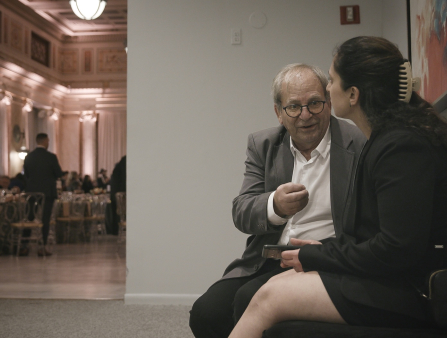
Yehuda Beinin and Tal Beinin in Washington, DC.
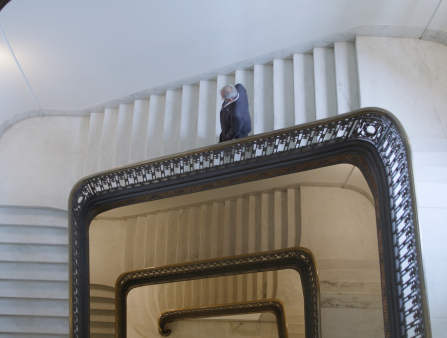
Yehuda Beinin in Washington, DC.
D: You were able to have these conversations with everyone you filmed, but not with the very person who was the focus of the film. How did you approach getting consent from Liat?
BK: It was about three o’clock in the morning when the IDF [Israeli Defense Forces] called to say that Liat was coming out after 54 days. The IDF officer told the family that they would have multiple cameras in the hospital filming the reunification. It’s very important to note that, irrespective of whatever we were doing, the IDF was already filming the reunification. The IDF did not want us there at all and said, “No cameras are allowed.” But I asked them, “Can I take some video on a cell phone?” And they said, “That’s fine.”
There’s no way for us to ask Liat how she feels about us documenting this in advance. So as long as Yehuda, Chaya, and Tal felt good about it, we were going to document this moment. Whether that footage was used or erased would be up to Liat.
D: Did your immediate intimacy with the family ever become a problem? Was there ever a time when you made a misstep and crossed a line?
BK: Twelve hours after Liat’s release, the IDF told her that they had verification that her husband, Aviv, was killed on October 7. It truly was the most painful thing I’ve ever witnessed in my life. In that moment, there was no question in my mind: there’s no way I am filming this.
Aviv’s body was not returned, but Liat wanted to have a funeral for him. I basically said to her, “Look, the only thing that matters here is what you want. I am more than happy to document the funeral that you’re planning. It can be something that you just keep private, or we can use it as part of this film. I will let you determine that.” My M.O. with Liat was, This is somebody who was just taken against her will and had zero agency, and I’m going to give her 100 percent agency. She said she wanted it documented.
The next day after the funeral was the Shiva. We didn’t film the Shiva at all, but Yehuda and Chaya mentioned that they wanted to have a conversation with their daughter at some point. I approached Liat, and I said, “I completely defer to you if you feel like it would be helpful to document this.” And she said, “Yeah, I think that’s okay.” And then in the middle, Liat turned to me, and she said, “You know what? This is too difficult. I don’t want this to be filmed.” And I told Yoni [Brook, the film’s DP] and the sound person to go away. I stayed there without filming, and they started a really beautiful, healing conversation. After five minutes, Liat turned to me and said, “Could you ask them to come back and film it?” And that’s just an example of why it was so important to put the agency in her court.
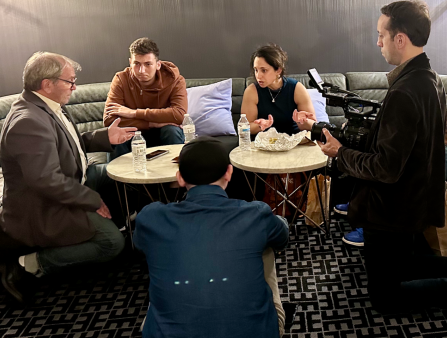
(L to R) Yehuda Beinin, Netta Atzili, and Tal Beinin engage in a family conversation, filmed by director of photography/producer Yoni Brook and producer Lance Kramer (back to camera). Photo courtesy of the filmmakers.
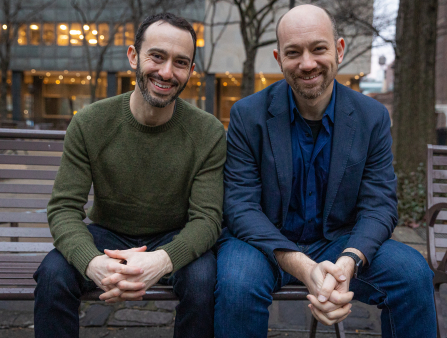
Brandon (L) and Lance Kramer (R). Photo credit: Lou Aguilar
D: You promised to show the film to all the participants before you locked the cut. What was that like?
BK: Every single time Lance and I have shown a nearly finished film to protagonists, it has resulted in either not having to make any changes or having to make very small factual corrections. This time, it was a layered experience. We showed it to everybody, but those screenings happened in very different ways. We had one-on-ones with Chaya and Yehuda on Zoom. We did the same thing with Tal. We had Liat on Zoom with our collaborator, Hilla Medalia [the film’s co-producer], in person with Liat. That was really important, somebody from our team being there with her. It was the most emotional 90 minutes I’ve ever lived through.
Liat’s kids were not ready to watch the film when we finished it. We had a conversation with Liat, and she said, “I give you my blessing. They’re okay with it, as long as I’m okay with the film, and I love the film.” But still, the weight of them not having seen the film was really on our shoulders. We premiered the film in Berlin without them having seen it.
D: Eventually, Liat’s children, Ofri and Aya, watched the film with you and approved, but even as the film won the Berlinale Best Documentary Award, Netta still hadn’t seen it. Has he seen it now?
BK: He said he couldn’t relive it. But when the movie was playing in cinemas in Israel, he went and saw the film with a friend and reported back to Liat that he loved it.
The weight of not knowing how all of your protagonists will feel about the film was hard. We had their blessing to keep moving forward, releasing the film. They knew that we were after something deep and truthful and messy. After they all saw the film, it was the first time that I could really take a breath.