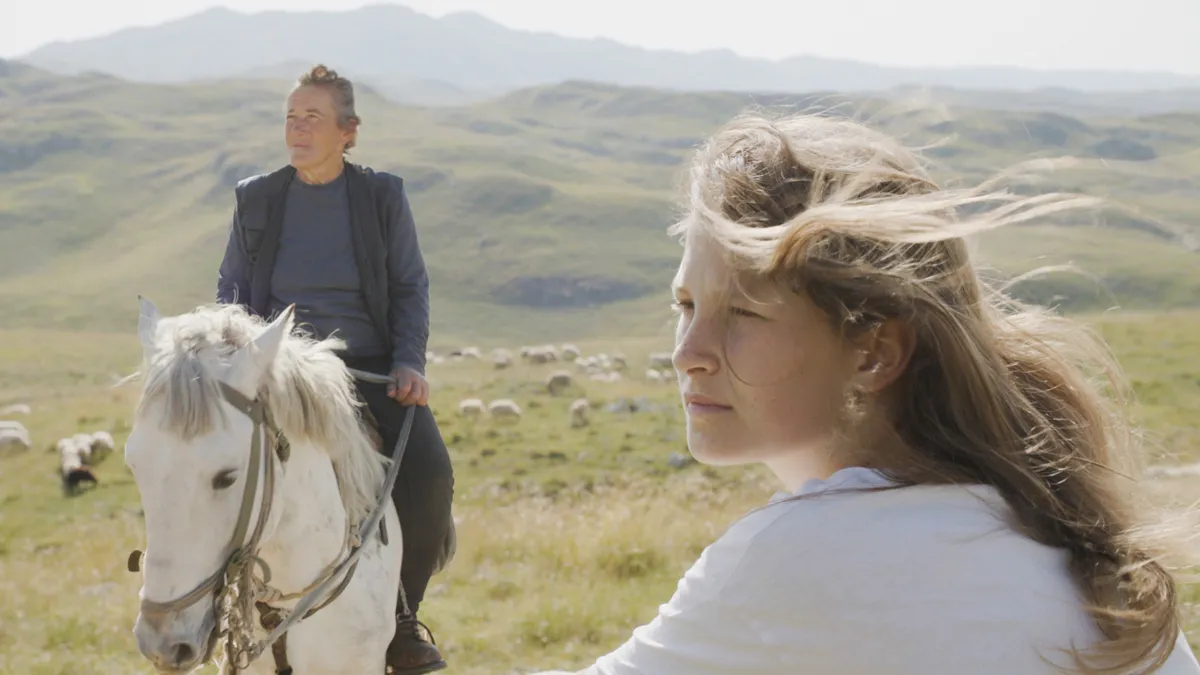

The title of Biljana Tutorov and Petar Glomazić’s documentary premiering in the World Cinema Documentary competition at Sundance, To Hold a Mountain (an IDA Enterprise grantee), comes from its plot. The doc’s protagonists Gara and her thirteen-year-old daughter Nada lead the communal resistance to the project of establishing a NATO base on Mount Sinjajevina in Montenegro. On the surface, the film checks many of the boxes of what is trending in contemporary documentaries in and of the region, offering a portrait of strong-willed women living in a remote, rural area. But while the film does contain some of those elements, it tells a compelling story that shifts from the external political backdrop to a deeply personal one, in an articulate and heartfelt way.
Tutorov, a writer, producer, and filmmaker with a considerable body of work in documentaries and fiction films, and Glomazić, an aerospace engineer, mountain climber, and filmmaker, spent years chronicling Gara’s everyday life. The core crew lived on the mountain for days and sometimes weeks on end with the film’s protagonists, participating and observing their life, work, and legal battles. However, the film is far from easily described as “Spartan” or “austere.” On the contrary, it features lavish summer landscapes, detailed portraits of its protagonists, sincere emotion, and revelations of deep-held secrets.
Just before the film’s premiere at Sundance, Documentary chatted with Tutorov and Glomazić to discuss the eight-year process of getting their debut feature-length documentary made, why meeting Gara helped clarify what they hoped this project could be, and why they never set out to make an activist film. The interview has been edited for length and clarity.
DOCUMENTARY: How did you get to do this documentary? Who came up with the idea?
PETAR GLOMAZIĆ: From early childhood, I was fascinated by this landscape and this way of life. I spent my summers with my relatives herding sheep, carrying water from distant springs, gazing at skies scattered with countless stars, and listening to wolves howling from a mountain hut that smelled of milk and was lit at night by a gas lamp. I had always wanted to tell a story about that life, or to place a story within that epic, ancient setting. Later on, I became a passionate mountaineer, and over the years, I spent long periods in the Montenegrin mountains, photographing landscapes and people and recording their stories. It was in this way, on the remote heights of Sinjajevina, that I encountered the local pastoral community to which our protagonist Gara and her family belong.
BILJANA TUTOROV: First, we fell in love with the landscape. When Montenegro joined NATO and Sinjajevina officially became a military training and shooting ground, I went there with a group of French scientists. The very same day we met Gara, our idea of a film with Sinjajevina’s community immediately became a project. Her life story was so vast and profound, deeply resonating with what was happening to her land. The film suddenly began to take a very different shape, and Petar and I decided to join forces, inviting our director of photography Eva Kraljević into the core team. For years, she travelled back and forth from London, where she taught at a film school, and the three of us became a trio that gradually shaped the idea into the film.
D: It would seem that Gara and Nada live lonely lives in the mountain, but it turns out that they are a part of a community. What kind of community is it? How is their communication with the “outer world” going?
PG: The seasonal movement with livestock to the katuns (mountain pastures) during the summer months is a millennia-old tradition in our region. Herders arrive on the mountain with their flocks in early June and remain there until autumn and the first snows. While the men stay in the village to tend to the household and land, women and children spend the summer in the mountains, guarding the herds and making cheese and other dairy delicacies. The men visit them from time to time to help out. But livestock cannot be left alone in the mountains: someone must always be present to protect them from wolves and other predators, to milk them, and to feed them.
BT: The community of women is a strong element in the pastoral life, and central to our film. There is a broader community of local herders. They all work a lot, and the outer world is a place for business. For Gara, it’s also a place for politics; she’s a community leader who speaks to politicians and citizens about Sinjajevina and the role it plays in the collective past and present, in the context of economy, culture, and ecosystem.
The very same day we met Gara, our idea of a film with Sinjajevina’s community immediately became a project. Her life story was so vast and profound, deeply resonating with what was happening to her land.
— Biljana Tutorov
D: Can you provide us with some historical context on why it is so important for them to stop the plans to turn the mountain into a NATO practice ground?
PG: Mount Sinjajevina has for centuries been, and still is today, a “komun,” shared land of several traditional Montenegrin tribes, local pastoral communities that use this mountain as summer pasture for their livestock. “Komun” is a traditional legal land governance model that exists in several European countries (Spain, France, Italy). Over the centuries, rules for the collective use of pastures, water, and forests have been developed. According to these traditional, experience-based rules, these resources cannot be owned or privatized, but they can be used. For the people who live there, the mountain is far more than an economic resource or something to be monetized. It is the world they live in and of which they are a part. They call it “Mother” and pass it on to their children in the same condition in which they inherited it. Sinjajevina is under UNESCO protection since 1977. There are numerous conservation frameworks for it, yet these people understand the value of their natural environment even without all these prestigious labels.
D: Was it hard to have them open up and share their personal traumas with regard to sexual violence? How was your relationship with the other community members?
BT: We didn’t try to open them up. It was not what pulled us to the story. We didn’t plan to include it or explain it. These delicate scenes happened as we were filming something totally different. We decided to respect the taboo (in our cultures, it’s a shame to have such a story in the family; everybody avoids talking about it, particularly when women are concerned). This decision to respect the silence informed our approach to filming and working with them. But after a few years, our participants started using the space we created together to work things out. They never expressed it in psychological terms, but it was obvious that they also needed to work on their narrative, and it became very clear that between us, we had a fair exchange. Everybody was interested in participating. Whenever we felt embarrassed and proposed not to use a scene (many strong scenes didn’t end up in the film), Gara was clear about her need to share her life story with audiences. It was a subtle process that evolved with time.
PG: I can only add that, over time, through our long presence and sincere engagement in protecting the mountain, we became a true part of this community. Many of the boundaries that are usually difficult to cross disappeared. We stopped being just a film crew and became their “extended family,” as Gara’s husband Marjan puts it. This created the space for the camera to capture truly observational, vérité material with deep dramatic potential.
D: We imagine communities like this to be very patriarchal, but your focus is on women. How come? Is this a new blend of feminism, marked with resilience?
BT: For me, Gara cast us to tell her story. [That] corresponded with my interest in the intersection of the intimate and the political, and of mature, strong women who spontaneously take a political role in their community. This is not a manifesto but a genuine trace of what we lived, observed, contemplated, and got to share over nearly eight years.
PG: As one of our protagonists says in the film, “Every mother must be a lioness in order to survive in such circumstances.” History is full of male figures, mostly remembered for their warrior deeds. Women are almost absent from the collective memory of such societies; they appear only as nameless mothers who gave birth to “heroes.” This is an enormous limitation that we, as a society, have imposed on ourselves. I was deeply interested in making a film about women and in addressing themes that could help bring awareness to entrenched and normalized social anomalies.
As one of our protagonists says in the film, ‘Every mother must be a lioness in order to survive in such circumstances.’ History is full of male figures, mostly remembered for their warrior deeds. Women are almost absent from the collective memory of such societies
— Petar Glomazić
D: Did you know from the start that you would balance your focus between their communal efforts and personal struggles, or did it crystallize during the filming process, or even during the edit?
BT: This was clear immediately when we met Gara and Nada in 2019. We filmed a lot of the communal efforts, [but] I was personally interested in the more epic and lyrical dimension of the story.
PG: We never intended to make an activist film, even though both of us are sincerely committed to activism, which, in a time of compromised and abused democracy, represents perhaps the only civilized way of fighting for the public interest. Our aim was to make a film about a world that is disappearing, about human destinies and true heroes who carry their fate and ideals like the heroes of ancient tragedy.
D: Filming on such a secluded mountain certainly presents a challenge, yet your film looks stunning and technically polished. How did you achieve that?
BT: It was a very strenuous shooting. [Our DP] Eva Kraljević was travelling from London, often several times a month. We were also travelling, both of us working on other projects, Petar even in a totally another field. There was no road, no electricity, no signal; it was a couple of hours of a bumpy ride to get there. We had to keep a fire going all day, charge the batteries through a generator, copy the material, make bread, draft plans, get water from the source, receive locals, and carry the equipment on our shoulders. The three of us were living together in a shepherd’s hut of 12 square meters. Throughout the years, we had other team members coming and going (sound recordists, assistants, co-producers, additional camera operators), but it was even more challenging than working silently just the three of us. We had a great complicity and were very demanding on ourselves. We were greatly inspired by old masters’ paintings, recognising many elements of works we know in unusual lights and colours of Sinjajevina. This “polished” side probably also comes from thinking of [painters like] Giorgione, Claude Lorrain, and Caspar David Friedrich. We tried to be free and neat at the same time.
Our international team was great. George Cragg, our amazing editor, and also Catherine Rascon, who helped in the last phases of editing, contributed to this art vision. At the end, the sound designers Julij Zornik and Samo Jurca, composer Draško Adžic, as well as our colourist Emil Svetlik, all brought their art to the film. We wanted it to be a kind of opera.
You might have noticed that we deliberately left some “imperfections” and glances at the camera to remind the audience of our presence. This is also the role of the music: to say that even though this is truly observational vérité material, we cut it looking for deep layers where the mountain’s and Gara and Nada’s stories are larger than life. Also, this “big” story they embody called for a more ambitious vision. We started in a much more modest way, but are happy to be surrounded by the amazing executive producers who encouraged us to explore all the dramatic potential of observational footage.
D: It seems that the documentaries about people living traditional lifestyles in sync with nature and about secluded communities are trending now in the Balkans. Do you see your film as a part of a wider movement?
BT: For us, this film goes in the opposite direction. We wanted at all costs to avoid the cliché of the rural and wild Balkans that is trending. We were actually inspired by how Gara and Nada are modern in their way of being. We avoided all anthropological details. But the landscape is stunning. Nature is also a shelter in a psychological sense, and the [context] on overwhelming militarisation that we are pulled into from a woman’s point of view is what we were interested in.
D: What are your plans for the future?
BT: We plan to enjoy Sundance as much as we can with Gara and Nada, and our full team coming to Park City. The finish of the film was stressful as we edited until the end of November, and we probably need some rest and looking in another direction for some time.
We are both working on other projects. I have another completed documentary titled “Symphony Interrupted” to be launched in 2026, which I’ve been working on in parallel for years, about war, poetry, and exile. I’m also working on my new film project and a theatre project. I’m very much involved in CIRCLE, a filmmakers’ network and training initiative that I founded and that gathers an amazing community across all continents.
PG: Over the past year, I have begun working on a feature film: a story of my family, set during the Second World War – a story of survival seen through the eyes of an eleven-year-old boy. When the dark spirits of war are once again being revived, this story becomes deeply relevant.
We long for rest, yet I already find myself thinking about the painful emptiness that will follow once the story around this film settles. I always feel a sense of sadness when a play or a film comes to an end, when the lights come up in the theatre, and the magic disappears. It is the same with the creative process.