

With the defunding and impending closure of the Corporation for Public Broadcasting, independent documentaries have become the latest targets of the Trump Republican Party’s relentless attacks on local economies, small businesses, and public information. In the short term, many documentaries in production have been affected, either left unfunded or adrift in terms of their future distribution. In the long term, as early-career filmmaker Rebecca Zweig notes, “we’re going to be losing an entire generation of films.”
Since 1967, the Corporation for Public Broadcasting was the largest funder of public television across the U.S. According to its 2025 budget, CPB allotted US$268 million to PBS TV stations across the country, and another US$97 million in programming grants. While CPB money accounted for only 15% of PBS’s overall budget, the impact of its loss is already being felt by a wide range of entities that are a part of this complex ecosystem. Those outfits include independent media nonprofits, such as ITVS, American Documentary/POV, the organizations of the National Multicultural Media Alliance, and Firelight Media, as well as PBS stations, such as Boston’s GBH, a crucial platform for independent documentaries through its support for programming strands like American Experience and the wholly separate network WORLD Channel.
“We’re Going to Be Losing an Entire Generation of Films”
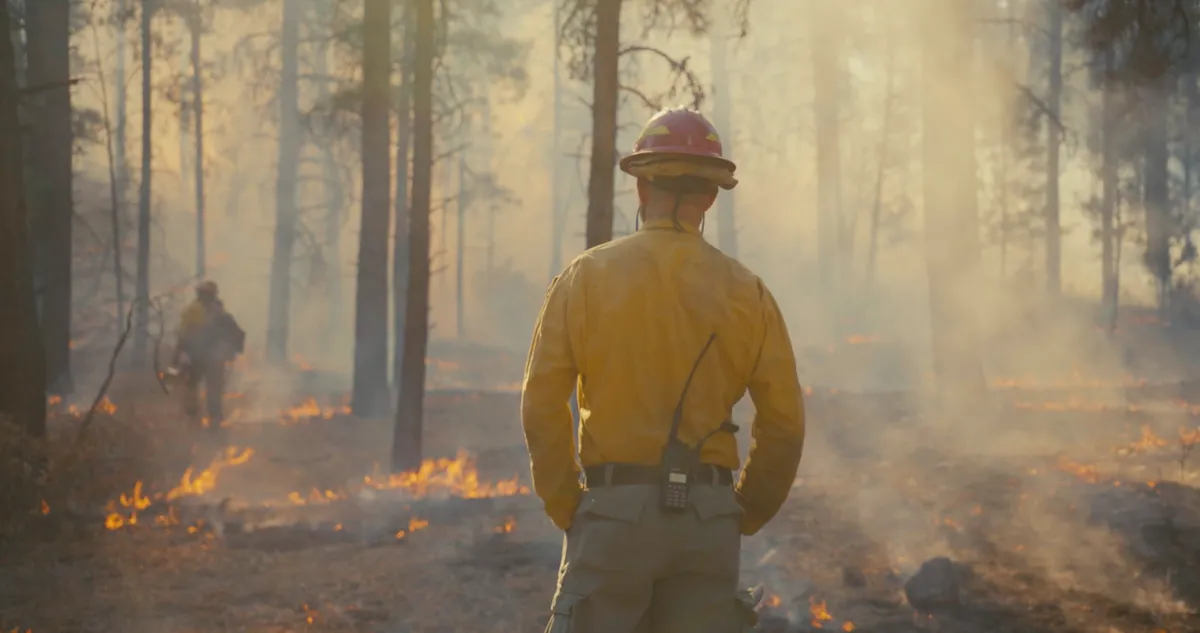
“It’s pretty devastating,” says Hillary Bachelder, a documentary filmmaker whose second nonfiction feature Burn, Scar, about the 2022 prescribed fires that went out of control in New Mexico, would have received significant funding from ITVS if not for the closure of the CPB. (ITVS provides up to US$400,000 to independent documentaries for a co-production agreement for broadcast and streaming rights.)
Burn, Scar was among 13 projects in various stages of conversation for either co-production or acquisition that were recently cut loose, according to an ITVS spokesperson. ITVS, also known as the Independent Television Service, has been the largest co-producer of U.S. independent documentaries since 1991, having co-produced more than 900 features over its more than three decades in existence. Among them are seminal films as Hale County This Morning, This Evening (2018), I Am Not Your Negro (2016), Minding the Gap (2018), and Waltz With Bashir (2008). It’s also the most tied to government support, with 86% of its budget coming from CPB.
ITVS President and CEO Carrie Lozano calls their need to back away from the projects “heartbreaking.” But also says the organization is currently “working” on a potential next ITVS Open Call, “when it’s the right time, when we have clarity, and when it’s clear that we can make good on our commitments.”
According to Lozano, ITVS will fulfill existing contracts and funding for 40 feature films currently in production. It will also present one more season of its long-running PBS strand Independent Lens through 2026, which will consist of 16 feature documentaries. “ITVS has been preparing for a worst-case scenario for over a year, and that includes diversifying our funding, reducing staff, and letting projects go,” says Lozano, who maintains ITVS will remain on a normal delivery timeline over the next 2–3 years.
While Lozano is trying to stay optimistic, suggesting that the PBS system is resilient and remains widely supported by philanthropic institutions and donors, she admits, “The whole industry has to recalibrate. We have to change how we work. Whatever was before—that’s never coming back.”
But what ITVS, Independent Lens, PBS, and many of its documentary broadcast strands look like in the future without their CPB money remains highly uncertain. Since PBS is taking a financial hit, no one yet knows how much the cuts will specifically impact independent documentaries. The long-running PBS indie doc strand POV receives 47% of its budget from PBS, for example, so there’s no telling what money might be trimmed from their budget to pay for, say, PBS’s hit show Antiques Roadshow or buttressing rural, cash-strapped PBS affiliates.
Several vital homes for independent documentaries have already faced severe cutbacks. In addition to changes at ITVS, GBH recently announced the 37th season of its flagship history series American Experience might be its last with original content, with pauses in production of new documentaries. In May, it also announced that its digital WORLD channel would move away from original documentaries. GBH also gave up WORLD’s YouTube Channel to American Documentary, which programs POV, to distribute independent films from strands America ReFramed, Doc World, and Local, USA.
According to a GBH spokesperson, however, independent filmmaking from other producers will continue to have a home on WORLD, whether from strands like POV and Independent Lens, productions from the National Multicultural Alliance, and episodes of America ReFramed, Doc World, and Local, USA. But it is uncertain how many spots will be available to this crowded array of media organizations.
Whatever was before—that’s never coming back.
Carrie Lozano, ITVS president and CEO
“We Have to Look for a New Funding Model”
Black Public Media, which received a little more than 50% of its budget directly from the CPB, has recently launched a grassroots campaign on its website to make up for its $1.8 million shortfall. “We’re trying to get 1.8 million people to donate $5, which would be enough to sustain us for the next couple of years, grow our production fund, and protect us from the political winds,” says BPM Executive Director Leslie Fields-Cruz. Previously, BPM was able to annually fund 14 projects, at amounts ranging from $50,000 to $150,000. “Now,” she says, “we’re just figuring out how to give one project $150,000.”
Black Public Media, a member of the National Multicultural Alliance, is also pausing its long-running WORLD Channel show AfroPoP because the acquisition budget was directly tied to CPB funding, according to Fields-Cruz.
Firelight Media President and CEO Loira Limbal is similarly unsure about the fate of two of their CPB-funded documentary short film series: “In the Making,” produced in partnership with American Masters, and “Homegrown,” produced in partnership with PBS and PBS Digital Studios. “They are under threat of not being able to continue,” she says. “So much of the national programming in terms of independent documentary films, whether long or short form, was supported by CPB either directly or indirectly, so the cascading effects of CPB shutting down are catastrophic.”
For Firelight Media, a nonprofit support organization that received 35% of its funding from the CPB, it is also going to be a struggle to keep its flagship CPB-funded Documentary Lab afloat. “I’m working overtime to raise money to fill that gap,” she says. “In the meantime, we’re going to be doing everything we can in terms of admin and overhead so we can keep these crucial offerings, because now is the time that they’re most needed. The filmmakers of color we support are the most directly under attack at this moment. We have to cut and collaborate where we can."
The leaders of these organizations say these reductions are necessary for their survival. Susan Goldberg, President and CEO of GBH, told Documentary Magazine in a statement, “Innovation is paramount in this moment of upheaval. We need to do everything we can to ensure we can be here for generations to come.” But in the meantime, many filmmakers feel out of the loop, left in the lurch in terms of funding and distribution, and unsure about their futures.
Firelight Films’ Stanley Nelson, the Oscar-nominated director of Attica (2021), says, “We have to look for a new funding model, and I don’t know what that would be.” Nelson and others point to the fact that the money federal funding agencies such as the NEA, PBS, and CPB provided has been crucial to getting projects off the ground for decades. “Even though they didn’t fund the whole production, they provided a solid bedrock,” he explains. “You could say, ‘I have half the money and now I can get the other half later.’ But if you take that first half out and you’re starting from zero, I don’t know how productions will get made.”
“I’m not sure if we’ll be around in 2027,” Nelson says of Firelight Films, which is the for-profit production sister division to Firelight Media. He says a few projects currently in production will carry the company for a couple years, “but I’m not sure how we go forward.” Nelson admits this also has to do with his age. “I’m in my 70s, in my retirement years anyway, and I just don’t know if I want to deal with all the hassle.”
For her project Burn, Scar, which would have had a future ITVS deal, Hillary Bachelder is currently scrambling to fill her financing gaps. Though she received small grants from the Santa Fe Film Foundation, Catapult, and RandomGood Films, she admits, “the grant landscape is also very hard right now, because with other sources of funding drying up, all of these grants are becoming even more competitive. It’s been really, really hard.”
Like a lot of documentary film workers, Bachelder is also worried that the funding cuts will impact her livelihood as an editor on other documentary projects. “PBS is a huge part of my financial ecosystem, so it's not just that they've funded my own work, but they fund other projects that I work on, so it has a huge ripple effect.”
“Distribution Is One Big Unknown”
In terms of distribution, Bachelder sees the only way forward now is the long-shot bid of a big film festival premiere. “With the PBS window closing, it’s like what else do you do besides throw your eggs into a Sundance premiere basket, and pray you make a giant splash and that takes you somewhere,” she says.
Many filmmakers we spoke to on background are concerned that with linear broadcast spots thinning out, many of these documentaries will only be released on PBS-run YouTube channels or its member-streaming service PBS Passport, which could affect filmmakers’ other licensing opportunities. “It’s clear that the long-term viability of linear television is in question,” says a documentary filmmaker who was granted anonymity. “But under existing agreements, documentary filmmakers are often locked into outdated terms that don’t reflect today’s streaming-driven environment, and this mismatch puts both the reach and impact of publicly funded work at risk.”
Rebecca Zweig, co-director of the currently ITVS-funded documentary Jaripeo, is currently focused on delivering their fine cut to ITVS by the fall, hoping the film makes it into the next and possibly final season of Independent Lens and festivals next year. (Negotiations for the 2027 season of Independent Lens are scheduled for next spring.) “Distribution is one big unknown right now,” she says. “I feel like the best-case scenario is that they’ll have a smaller slate. It was already extremely competitive to begin with, and now it’s even more like the wolves going after whatever little there is left.”
Similarly, another filmmaker with a project that’s also currently under contract with ITVS, who spoke under condition of anonymity, worries that PBS may be so emaciated that “there will be so few spots that I’d have to go elsewhere for distribution.” The filmmaker explains: “There might simply be too much competition for the trimmed-down PBS strands. And what happens if there is no one even there to reply to emails? That would be horrible, but it’s not out of the realm of what seems possible these days.”
“There are a lot of unanswered questions for everybody, and it’s been that way since Trump took office,” says filmmaker Luchina Fisher, whose newest project Hiding in Plain Sight won Black Public Media’s PitchBlack event in 2023, along with Firelight Media’s $150,000 William Greaves Production Fund, which comes with a broadcast license for PBS. She’s shot a little more than half of the film, but has been on hiatus since January because the production has run out of money. While she feels confident that her producers at Black Public Media and Firelight are committed to seeing the project through to completion, she is concerned that the uncertainties around PBS will specifically scare some funders away. “I wonder if funders that might typically fund a PBS project now might question whether a project is not viable or feasible because now it might not show on PBS,” she says.
According to Firelight’s Limbal, some 15 to 20 other films still in various stages of production and post-production have received support from the William Greaves Fund, but their PBS distribution licenses remain a big question moving forward.
“What happens with the rights is a question that has to be answered,” she says. “The Production Fund was specifically geared toward building a more inclusive documentary film landscape on public media, but now there’s no clear path forward for many of these films, as they aren’t designed to appeal to the narrow interests of commercial streamers, which prioritize true crime, celebrity, and scandal.”
“We’re accountable to our filmmakers and the audiences for these films, so we’re prepared to stand behind these filmmakers and do whatever is necessary to regain or recover rights and help the filmmakers find a new path for distribution,” continues Limbal. “The work can’t remain in limbo. And that’s something we’re thinking about and are preparing to advocate for.”
If there are no linear broadcasts available, Limbal worries the films may get lost. “It is not enough for these particular films, and it’s not enough for the larger project of pushing the U.S. to be what it says it wants to be,” she says. “And it’s not going to be comparable to reaching the millions of eyeballs that we reach with a PBS broadcast."
Editor’s Note, August 17, 2025: An earlier version of this article reported that the next seasons of Independent Lens and American Experience could be the last ones. The article has been updated to clarify that ITVS is scheduled to negotiate the 2027 season of Independent Lens in spring 2026, and GBH’s 37th season of American Experience is the last one scheduled with original content, as the 38th season will be a best-of past seasons for the U.S. semiquincentennial (250th anniversary of the signing of the Declaration of Independence).