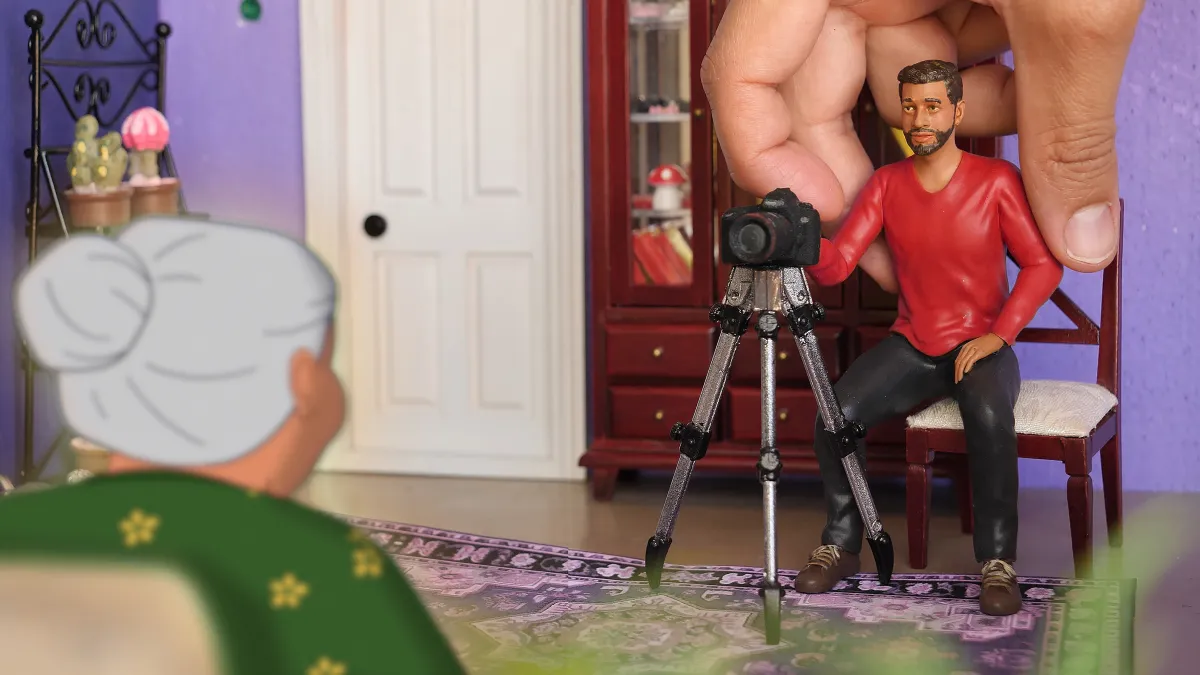


In TheyDream, director William David Caballero transforms memories into something more solid and tangible—more cinematic, even. Live-action footage replicated through miniatures, animation aided by motion capture, home videos and sit-down interviews with family members allow him to preserve snippets of family history, awash in both wisdom and regrets. As the documentary progresses, it gradually becomes clear that Caballero’s use of miniatures is a form of control. Moving around tiny figurines of his family enables him to direct circumstances he had little sway over in real life. The act of creation is his antidote to loss.
The director doesn’t shy away from depicting painful moments from his life. A miniature of his diabetic father at a dialysis centre depicts injections as big as his body. A home video of his grandmother talking about her idea of heaven zooms out to reveal a miniature of her coffin and the mourners at her funeral rendered in animation. Her vision of peace is juxtaposed against the reality of grief and the impact of her loss on those who loved her.
Caballero’s documentary is also a form of cinematic resurrection. Having unearthed old audio recordings of his late dad, he brings them to life by adopting the physicality of his father, then transforming his motion-capture performance into animation. Likewise, his mother’s movements animate the voicemails of her late mother, and TheyDream follows her attempts to get the exact timing and intonation of the elderly woman’s words right.
Ahead of the film’s premiere at Sundance, Documentary caught up with Caballero to talk about the dos and don’ts of working with family, his wish for this to be an unvarnished portrait of those closest to him, and the challenges of his many chosen animation styles. This interview has been edited for length and clarity.
DOCUMENTARY: You have scenes and images from your HBO series Gran’pa Knows Best (2015-16) in this doc, and it simultaneously feels like an extension of your short film Chilly and Milly (2022), which was also about your dad’s ill-health and your mom’s role as caregiver. Did revisiting these themes give you a fresh perspective?
WILLIAM DAVID CABALLERO: Gran’pa Knows Best was a transformative project that I did in 2015. It started with a short film called How You Doin’, Boy? Voicemails from Gran’Pa (2013) because whenever my grandpa would pick up the phone, instead of saying, “Hello”, he’d say, “How you doin’, boy?” in a very enthusiastic voice. Gran’Pa Knows Best was my way of continuing that in an episodic form. So this ride I’ve been on—telling stories about my family—began with him. Then I made the short film Victor and Isolina (2017) about my grandmother. And then I made Chilly and Milly about my parents. TheyDream is very much a natural evolution of taking these short films and being able to tell a deeper story about who these people are, the journeys they’ve gone on, and how they’ve impacted my life.
D: What was the impetus for it?
WDC: I’d been doing short films for so long that I wanted to revisit the prospect of telling another feature-length story about my family. Back in 2010, I’d created American Dreams Deferred, my first-ever documentary, but one that was stylistically very different from TheyDream. It was just me with a camera and included only a little bit of animation. I thought of making a movie about my family, this time with all these new artistic styles that I’d developed over the years. I wanted to create something that was both documentary and art. The initial idea was that everyone in my family would work together to create their first short film—so maybe my cousin would’ve written the script, my mother would’ve acted in it, and my grandmother would’ve handled craft services. But a few months into working on this idea, life happened. People in my family passed away, and so I realized the film had to be about grief and how my mother accompanied me in the active creation of this story.
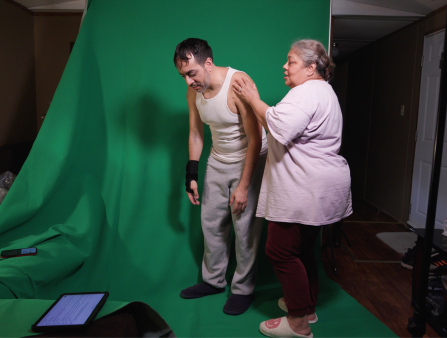
Isolina Aponte and William D. Caballero appear in TheyDream. Photo by William D. Caballero.
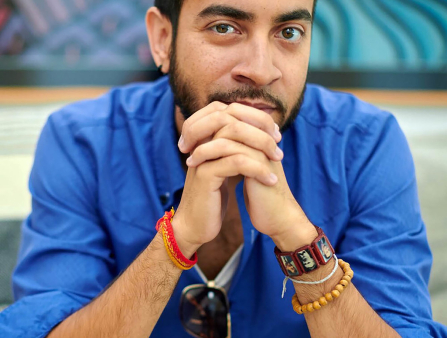
William D. Caballero, director of TheyDream. Photo by Sheldon Botler.
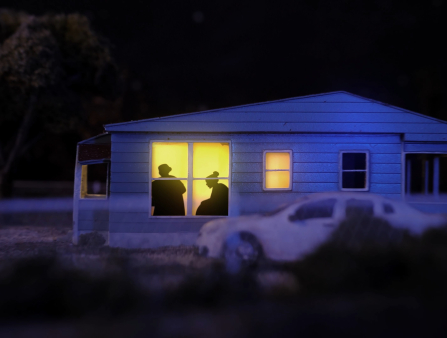
TheyDream. Photo by William D. Caballero.
D: There’s such an interesting and varying mix of animation and 3D modelling, home video footage, and interviews in TheyDream. How did you arrive at this mix of media?
WDC: It’s rooted in me being an only child. I was very bored growing up, and so I’d escape into creative pursuits. There was nothing I loved more than taking a piece of paper and a poster board and trying to make something amazing, for either a school project or for myself. I realized that as computer graphics and technology became more ubiquitous, there was something valuable about returning to handmade projects. I’m a 42-year-old man, and I get excited every time I see a dollhouse. I look into it. I imagine myself living in it. So it’s not just art, it’s also play. It’s like getting in touch with what it was like to have played as a child, but it’s grounded in reality.
D: The mix of media also allows you to place viewers in your dad’s POV—when he’s in pain, exhausted, and not eating, the camera goes out of focus, and the screen becomes gradually enveloped by black from the top and bottom to reflect his slow blinking and disorientation. One of the documentary’s themes is also distance (including you being away from your family), and working with miniatures allows you to compress space and time, to transition from day to night quickly, or bring your grandmother, in figurine form, to your house.
WDC: I view film and documentary as an art. I always want to push the form and craft of what it can be. When you work in animation, you can recreate scenes. You have control over the camera angles. In that one scene you mentioned, I could shoot it in the first-person perspective with all those effects of my dad experiencing double vision. That’s something I’ve never experienced myself because I’m not a diabetic. We can all relate to family members who get ill, especially as they get older, but it’s easy for young people to dismiss them because they feel immortal at that age. As I get older, I’m taking steps to showcase disability, its hardships, but also how people are more than their physical limitations. Suffering is a part of their lives, but it’s not everything they are. What I want to do is showcase the humanity that lies within these people. I want viewers to know and feel what it’s like to have a low blood sugar attack or to have fallen and be unable to get up.
D: Your short film Seed Story also features a cast of hundreds of one-inch-tall plastic figures. What is it about working with miniatures that appeals to you?
WDC: Seed Story was the first-ever project I did with miniatures, and it premiered at the Slamdance Film Festival in 2013. I had seen a book by Slinkachu, a British street artist who took one-inch figures and did these photo installations. I realized that was something I’d love to do. I spent $1,000 buying these figures from railroad hobby stores, and I shot this film at a parking lot in Brooklyn. It was a very experimental short, with no dialogue, but the best thing it did for me was put me in touch with the 3D modeller I work with now, a Korean artist named Chang Kim.
While working on Seed Story, however, I realized the limitations of miniatures. All these figures were already made; they were a bunch of different white people from the 1800s. What I’d actually wanted was one character in many poses—I thought of my grandpa for this because I had all his voicemails, and he was such a funny guy. So Seed Story really gave me that push into making miniatures my creative calling card.
I realized that as computer graphics and technology became more ubiquitous, there was something valuable about returning to handmade projects. I’m a 42-year-old man, and I get excited every time I see a dollhouse. I look into it. I imagine myself living in it. So it’s not just art, it’s also play.
— William David Caballero
D: You started working on TheyDream in 2021. Could you walk me through the craft and timeline of work that went into the motion-capture technology, getting the miniatures made and then the animation?
WDC: Creative Capital was the first organization to fund the film. I also got lucky because I was chosen to be an artist-in-residence at McColl Center in North Carolina, and so I drove cross-country from LA there, and stayed for two-and-a-half months. I had a huge studio space. Back then, the project was more focused on motion-capture, and so I’d also bought this motion-capture rig. I invited my mother, grandmother, aunt, and cousin over and was doing interviews with them. All the interviews in TheyDream that feature a black-and-white Puerto Rican flag in the background were done during this residency. I eventually saw the limitations of this medium, though. I realized that if I made this in 3D, it would never look like Pixar or Disney and would lose its charm. That’s when I took a few steps back.
Two years later, I was at Joshua Tree Highlands Artist Residency. There, I had another huge house and studio space. By then, I’d raised enough funding to be able to hire a miniaturist. So the entire studio space was covered with props (some handmade, some purchased) and all these sets we’d made. The more funding I got, the more I was able to expand the team. I thought very big by creating things that were small.
D: There’s a frankness and open vulnerability to the interviews, like your grandmother speaking of the depression she suffered after losing her daughter, or when your mom breaks down about her mother dying while she was away on a cruise. There’s obviously a comfort and an established rapport when you’re talking to a family member, but how did you approach these conversations? Was there ever any hesitation about being recorded?
WDC: I made American Dreams Deferred when I was in my last year of grad school at NYU. My family has known since then that I’ve been recording them on and off. They’re very comfortable with it. There was never really a moment where anyone was reluctant because they saw I was ethical in how I approached this.
There was this idea that I pushed a little too far in my early work—of breaking the cycle of poverty, compared to one of my cousins, who was my age and had addiction issues. There was a little bit of resentment that I was presenting myself as, “I won and I’m better than you!” I was sorry it came across that way. I was young and coming from this place of wanting to be inspirational. I was saying, “If I came from the same environment as you, then you can do it too.” But when working with family, you have to be respectful. With TheyDream, I made sure to mention that it was about working with my mom and preserving our culture. It’s important for documentary filmmakers to make people comfortable and happy. They need to know that just because you have the power to tell their story, you’re not going to change it, but rather tell it in a way that makes them feel seen and heard. They need to know they’ll be treated fairly.
It’s important for documentary filmmakers to make people comfortable and happy. They need to know that just because you have the power to tell their story, you’re not going to change it, but rather tell it in a way that makes them feel seen and heard. They need to know they’ll be treated fairly.
— William David Caballero
D: You mentioned that every time you’d come home to North Carolina from LA, you’d record a little more of these family conversations. Were these formal sessions?
WDC: I wanted to record my family for ideas. Sometimes I’d take my Zoom recorder and say, “Mom, Dad, can you sit in the kitchen? I’m putting the recorder here, let’s have a conversation.” On one occasion, my mother went to check on my grandmother because we thought she was getting sick, and we suspected COVID because she said she couldn’t breathe. I had my audio recorder and was recording that tense interaction with my grandmother. I asked her later if that was okay, and she said it was fine. So sometimes you plan things, other times you have to press record and ask for permission later.
D: There’s a scene in TheyDream that reveals your late dad’s homophobia during a conversation he had with you. In the context of what you’ve just said about working with family, what went into the decision to include this moment?
WDC: It was important for the film to show that not every memory we have of our parents is positive or well-intentioned. Some can create wounds that last for years and sadly never get resolved. I wanted to show that my dad had hurt me with what he said and never apologized for. I think other people will connect with that vulnerability. I wanted the documentary to have truthful moments and tender moments. Just a few minutes after this scene, I use motion-capture technology to recreate an interview my dad had given a few months earlier, in which he wishes me well and says his only dream in life is that I succeed and take care of my mom. That’s who he is: a homophobic person who still loves me. I weigh who he was and still think he’s a good person who couldn’t get over the disdain he felt for this community.