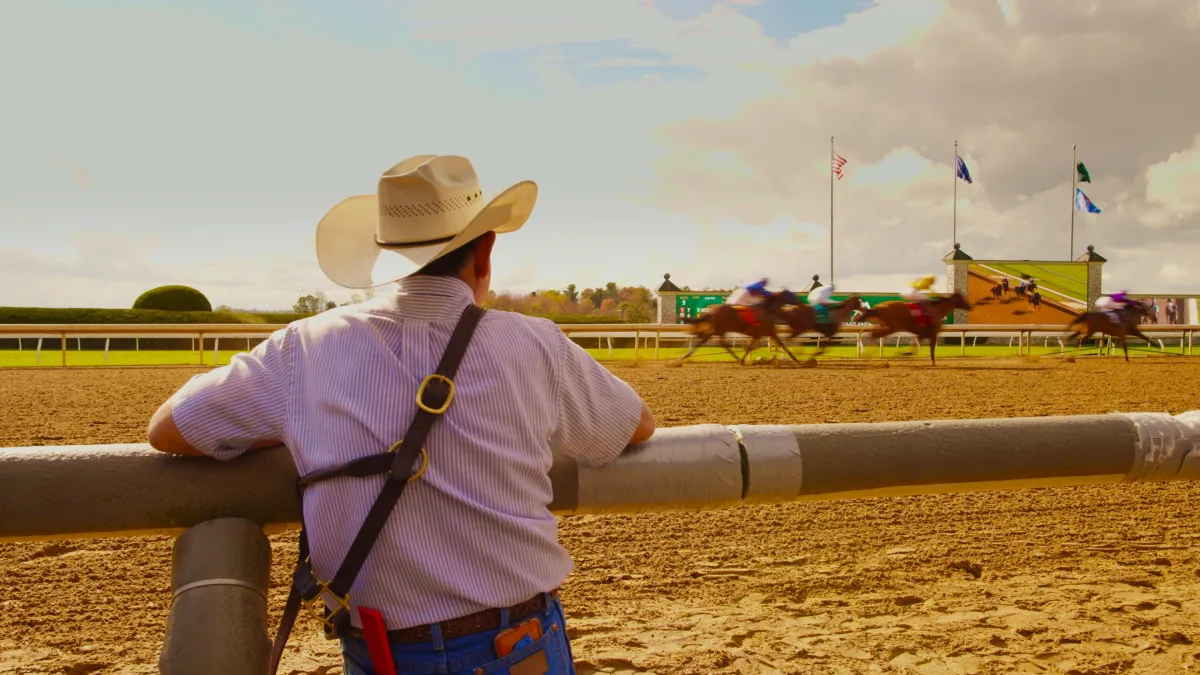

Workers hired by horse trainers to take care of the animals, the grooms at the legendary Churchill Downs racetrack (where the Kentucky Derby takes place) work seven days a week, rain or shine, from March to November. The majority of them are Latino immigrants who’ve found not only employment but community as part of the venue’s inner workings. Originally from Chihuahua, Mexico, the Colorado-based filmmaker Raúl O. Paz-Pastrana closely witnessed their arduous lives over several years, beginning in 2021, which culminated in his latest effort, Backside: The Unseen Hands of Horse Racing. A mostly observational piece (with some reflexive moments casually thrown in throughout), Backside is composed of evocative vignettes filmed during the laborers’ long shifts tending to the horses or in their quotidian, off-the-clock time.
Previously, Paz-Pastrana directed the 2019 feature Border South, for which he collaborated with Mexican-Filipino American ethnographer Jason De León to follow migrants on the treacherous journey across Mexico to reach the U.S. Paz-Pastrana, who migrated with his family at age 13, inherently gravitates to stories of working-class immigrants with the desire to portray them in their emotional complexity and sociopolitical significance. To that end, he also founded Off the Road Productions with filmmaker Alan Domínguez, which focuses on BIPOC stories from the Southwest and the Rockies, as well as migration narratives. Both Paz-Pastrana and Domínguez also form part of the Mountain Media Arts Collective, a Colorado-based organization that seeks to uplift, support, and amplify BIPOC artists in the area.
Speaking via video call recently from his home in Denver, where his mother—a key inspiration for his creative pursuits—was staying with him, Paz-Pastrana shared insights into his personal connection with his preferred subjects and his formal choices in Backside, now playing on PBS’s Independent Lens (and on YouTube). The interview has been edited for clarity.
DOCUMENTARY: How did you become aware of the racetrack’s backside workers?
RAÚL O. PAZ-PASTRANA: My wife is from Kentucky. When we would go visit her parents, from Lexington to Louisville is horse country. It’s got all these beautiful farms and places where they raise expensive thoroughbreds. One day, my wife was like, “Look who is around the horses.” And it was Latinos. That was around 2011 or 2012, and after I saw that, every time we’d go to these farms, my gaze would focus on the workers.
In 2019, Border South was playing at the Society for Visual Anthropology Film & Media Festival in Vancouver, where they also had workshops. One of them was by Rebecca Richart, an ethnographer who was doing fieldwork at Churchill Downs about the grooms. My first intro to Churchill Downs was through her. It turned out her husband, Adalberto Espinosa Bravo, who goes by Beto, is a Mexican groom who has been doing it for almost 30 years. She met him through her research on grooms. He’s the one who guided me to meet the other grooms and trainers. He appears as a field producer in the credits.
D: One early scene shows Cristobal, an elderly groom, and a female groom, acknowledging that there’s a camera filming them. She candidly comments that maybe he behaves differently in front of the camera, while she prefers to be her true self. That moment seems to illustrate the relationship between the subject and the camera.
ROPP: I like to do observational films, but I also like to throw some reflexivity. That’s to me the part where—and this is very personal—where you break the fourth wall just to show that this is a documentary with real people. Those little moments make it more real, and they show they’re dealing with me. Border South starts with a fart joke that the main character, a migrant, is telling the camera, talking to me and the sound guy. It’s letting the audience in on a little secret, like, Hey, this is how we’re filming. To give it a little bit more honesty.
Some observational films are really beautiful, but a lot of times, you’re questioning, This is a documentary, right? There is another scene where Cristobal has the horse coming from the race, and I’m following him, and the horse is very anxious. He looks at me, and he’s like, “Oh, I didn’t see you there.” And he laughs, and he keeps walking. Those reflexive moments also show the access that we have. They don’t even notice us sometimes. Or when they do, they make jokes about the fact that we are there. We become part of the community.
D: Sonically, the loudspeaker announcing the upcoming events for the workers in Spanish provides greater insight into the micro-society that the backside workers have created. Why did you decide to include this detail?
ROPP: The ethnographer I mentioned, Rebecca, is the announcer. She gets paid by Churchill Downs to do the recreational activities, and she loves that job. That bullhorn is a character in itself, which helps us show the life the Latino community brings to the backside. She talks about the English classes. She talks about the Virgin of Guadalupe. She talks about the soccer games, and then we see them. Those things exist because the workers are there and ask for them. They have an Evangelical church there, and some are Evangelical, but the majority are Catholics, so they asked for something else that was not Evangelical.
D: You show the Kentucky Derby from both the perspective of the more affluent attendees and that of the workers watching on TV in the same venue, but in the backside. Talk about your intent.
ROPP: The idea was to show the front side, especially during the Kentucky Derby, without making it about that, and see how the backside actually experiences the Derby. I decided, ‘We’re going to show the two worlds. The grooms and their families are having a carne asada and doing their bets. In the front, there are bets of millions, and with them, it’s only $80. But it’s a spectacle for them as well. Even though they work for the horses, they watch the race, and they are engaged. I didn’t cut that scene at all. It’s just two minutes that you, as an audience, experience through them. Cinematically, it works so well. It was a risk to put the camera next to the TV because I was like, They’re going to look at me. But they didn’t.
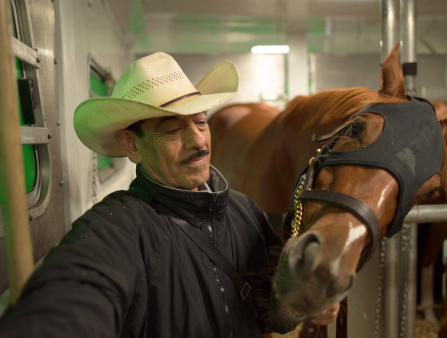
Cristobal taking a horse to a race at a neighboring track.
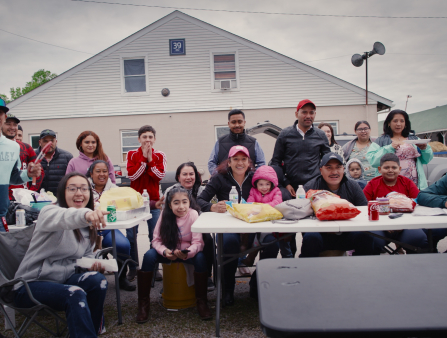
Bertila watches the Derby race with her co-workers and family.
D: Where does your interest in people like the grooms in this film or the migrants in Border South come from?
ROPP: I migrated from Mexico in the ’90s. My mom raised my two sisters and me as a single mom in Colorado. She used to have three jobs so that we could go to school. She cleaned houses, and we would help her sometimes on weekends. She also worked in an industrial laundry at night. My experience in the U.S. is Mexican working-class experience, and those are the people that I was around here in the mountains of Colorado. It’s just organic. Those are the kind of people that I’m fascinated by because I come from there.
D: Even within what people consider “Latino cinema,” there’s a notable class divide between Latino filmmakers in the U.S. and those in Latin America, and even more so when speaking about immigrant filmmakers like yourself.
ROPP: That deserves a bigger conversation, because in Mexico, most people who make films come from the upper middle class. Even in the U.S., you need time or a trust fund to do this, and it’s hard to break in. I’m still trying to break in. A lot of us are trying to. At the same time, by not being able to have working-class voices making films, you’re just getting other people giving their point of view on what the working class is.
I love Alfonso Cuarón’s Roma, but at the same time, I’m like, Oh, I want to know how someone like the nanny would make that film. And we may never know because they never get to make it. It takes time. In New York, there are many kinds of filmmakers, but most of the Mexican filmmakers there didn’t migrate there the way I did. They migrated there because they had the funds and wanted to make movies in New York. I migrated to the U.S. because I was poor.
D: One of your other ongoing projects is the Mountain Media Arts Collective. How did that come about, and what is its aim?
ROPP: When I started making films in the late 2000s, I made a couple of films, and I was also a community organizer for immigrant rights. I wanted to make a living through film, but I couldn’t because every time there was an opportunity to get paid, the company or organization would choose the white filmmakers, usually from Boulder, even though I had made a couple of films that made it to festivals. I was like, I cannot make a living on this because I keep making movies for free. I moved to New York. I went to school there, to the School of Visual Arts for two years, and I got an MFA, and then I stayed in New York working camera and making films. And it was my first time seeing BIPOC directors and Latino directors.
When I came back to Colorado, I met Alan [Domínguez] and Mike Shum, who also had to leave [Colorado] in order to make a living. We were like, We don’t want the next generation to go through what we went through. We wanted to support BIPOC filmmakers and artists in general—in front and behind the camera. The MMAC collective operates as a cooperative, with BIPOC members sharing resources and collaborating on projects. We aim to support BIPOC storytellers in the Southwest—mostly in Colorado, but we also have members in New Mexico, Wyoming, and Oklahoma—with resources, film master classes, feedback labs, and especially networking. It’s also a space where we share our grievances and experiences moving through a mostly white industry, giving each other emotional and professional support.
We started two years ago, and it’s hard now with everything that’s going on in the country. But that’s more of a reason to keep it going. There are more BIPOC kids who are making things here. We are just trying to keep that alive, keep making films in the Southwest, and not be dependent on New York and California.