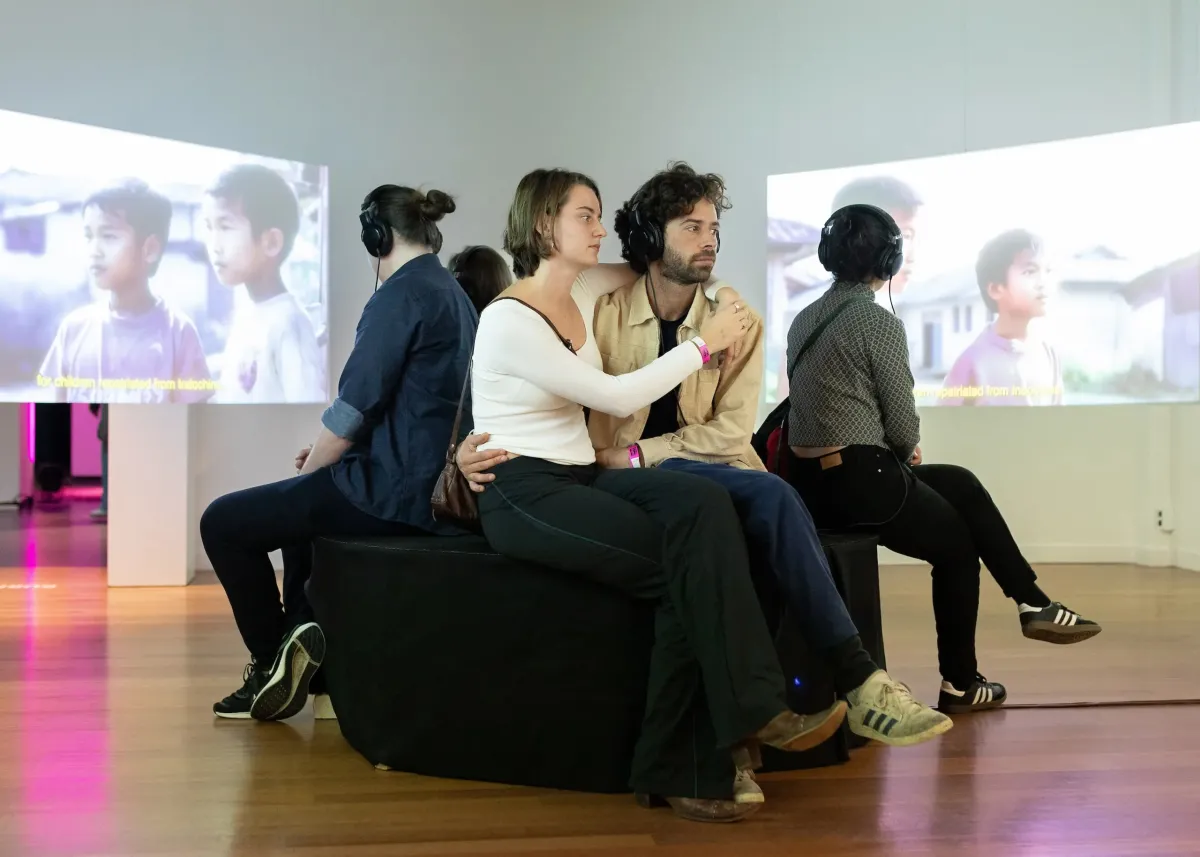
“You Can Cheat on Reality”: Emeline Courcier on Her Immersive Artwork ‘Burn From Absence’
Burn From Absence installed at de Brakke Grond for IDFA DocLab 2024. Image credit: Nina Schollaardt. Courtesy of IDFA
For her immersive artwork Burn From Absence, artist Emeline Courcier creates an archive where there was none. Using artificial intelligence, she recreates a family album, visualizing and verifying a history that has been hidden, documenting it from her perspective. In the four-channel installation, digitally created images illustrate an audio track layering her family members’ memories of life in Laos, the ‘Vietnam’ war, and new beginnings in France. She produced it during an immersive residency at the Phi Centre in Montreal, which is also serving as the work’s distributor.
While AI usually mines and perpetuates the dominant narrative, Courcier completely upends that, building an archive that is a reckoning and a reclaiming and, despite its AI-creation, very real. After its premiere at IDFA last November, where it won the DocLab Special Mention for Digital Storytelling, Documentary spoke to Courcier about truth, archives, and working with deeply personal material. This interview has been edited.
DOCUMENTARY: Did you always intend to use AI to recreate these memories?
EMELINE COURCIER: I think using AI is really the core of the project, but how I treated it really evolved during the process.
In 2023, I had heard about AI, but never used it before. I was opposed to it at first, as a lot of artists were—but I was kind of curious at the same time, because what I like is the fact that you can cheat on reality.
For seven years, I’d been working on my family history. I was educated in a Western way, so to me, the Vietnam War is really influenced by the pictures that were taken at that time. I was trying to engrave my family inside of it. That was not a great experience, because these were not their faces.
We don’t see a lot of pictures that were taken in Laos. My family is Vietnamese, but they are from Laos. I was already sure that I wanted to represent their experience living there, and not the overall Vietnam War, because this is what was missing. I really wanted to put my family inside the “great history,” but it was always something strange, because what I was told from the historical perspective and what my family was telling me was not matching. It’s like a bipolar history, because the war inside their storytelling is really far away.
Each time I experimented, it became more intimate… then I started to mix in what they were saying to me and the AI technology, and I thought, “Okay, there’s something there.” Because I was recreating what had felt empty to me.
D: Do you have family archives from that time?
EC: I only have two family pictures, but there’s always someone missing, so the family is never complete. I have one picture of my grandmother when she was little, and some pictures of my mother taken for government identification. Overall, I don’t have even ten pictures of that time.
I always saw it like a jigsaw puzzle that I’m trying to recreate. But there will always be some void inside of it, because some people don’t want to talk. Sometimes they just don’t have any memories of it, and sometimes they don’t want to have memories of some of the trauma that they have been through.
D: So all the visuals in the exhibition are created?
EC: Almost everything. There are some real pictures of them as adults. I was playing with the fact that some are real, but some aren’t. I still wanted to confuse what is true and what is false, because I was so obsessed with the notion of truth and of veracity. And now I think everything is true and everything is false, because it’s from someone’s perspective, and it will always change.
D: The perspective of everything, all the truths, being completely different based on where you’re coming from, how you’ve been educated, what stories you’ve been told… so much of the archive is also who made it.
EC: I totally agree that the notion of archives is intertwined with the notion of point of view and culture. What really shocked me was how Americans treated their own archives. You can just see it on YouTube, all the video clips with the Vietnam War archives and how they edit them with “California Dreaming” or something from Queen. There is a playlist of this war, literally from the American perspective. Sometimes it’s just from the air and you see a bomb exploding, which is really beautiful when you are not down there. There’s the notion of the other, the distance between one culture and another, and it’s very obvious.
With the notion of archives, I think it’s important to sit in a subjective way. As it is about memories and history, we tend to want to have the truth and to say, “Okay, it is the truth, because we have pictures and archives, and it’s about a country's history and it’s important for us to preserve it.” But it’s time to question ourselves about that, because it’s not that true.
D: AI-generated material sometimes doesn’t have ’texture’, but the texture of your images feels so soft and fluid and emotional. How did you manage to do that?
EC: It was a long process. First, I just iterated on Midjourney to create a composition that I liked. I’m very educated on cinema and photography, so I have this need to have a cinematographical composition. I wanted some images to have that signature, and others to feel more natural or sometimes emotional. Because I really wanted the spectator to be inside the sensations—sometimes as a child or sometimes an adult.
Some of the archives, after the first iterations, already felt great. For example, my grandmother and grandfather are much more recognized by Midjourney than other people.
Then with Edouard Lanctôt-Benoit, who is a programmer with Phi, we started to face swap. Now, I don’t even need a programmer. I just do it myself. It’s really scary and fascinating at the same time. It takes a lot of time to photoshop and edit to get the 35mm grain. You have to lower the quality of the pictures to make it feel like it’s been somewhere, so it doesn’t feel really digital. It needed to feel like it had a life before you saw it.
Sometimes I just try to see the pictures like it’s the first time I see them: if it was just in front of me, and I didn’t know the whole process, would it feel real? I didn’t want the spectator to feel off about the false archives, because I wanted them to actually be part of the family, like they were just discovering these memories and being like “this is my inheritance, this is where I come from, and how does it feel?”
D: How did you weave the AI-generated images and the audio recordings from your family together? Creating the pictures to match the stories? Or did you build the narrative through the pictures and then weave in the audio memories?
EC: Yes, the stories are completely true. They were recorded over seven years. One of my uncles passed away, for example, but I still have his voice recorded. It’s very powerful to have this, because I heard his whole story, it’s the longest record that I have, and he was actually the only man who wanted to transmit the stories to future generations. I think he would be very happy and supportive of the project. It was very emotional to edit his voice on it.
It’s like a testament that they just keep on living like that. I like the fact that now they can exist inside the piece and when you leave, you leave them. That’s also why the movie starts as a family dinner, you can hear the clapping and everyone is laughing. It was the last one after my grandmother passed away—we never did another one like that because I think it was too painful. To me, it’s a testimony of what the family is like, and how it feels sometimes to have absence. They’re talking about “who’s sitting there?” because the dead are invited to eat with us, but as empty seats. Everything is linked—it was very important to me to start with the last dinner that we had and finish with the last words that were recorded of my grandmother.
I tried to have a thread for the story, so the audio is the structure of the movie, and then I did the visuals with the iterations. Some of the images are more from a sensational or emotional place, and some are just how I picture the scene inside my head. That’s why it was a really long process of editing. It’s not like you just take your shots, and say ’here, like this’. No, instead it was ’it’s not working so now I need to iterate this’.
My mother is the only one who saw it as I was iterating. She was looking at the pictures, and at the pictures of her cousin who drowned in the Mekong. It was most important for me to see how she reacted to that. She was really shocked and fascinated by the results, because she doesn’t know anything about AI. And she said, “Wow, it’s just like you gave life to her again.” It was a really beautiful moment. And then she says, “but here in the picture, we’re barefoot, but we’re not supposed to be barefoot. We were always wearing some shoes.” She’s very picky, because she wants it to be accurate. It’s very interesting to see how she perceives it, because she lived it. She recognized her cousin right away. For some of the brothers and sisters, she’s like, “Oh yeah, it’s not really that.” You know, AI and faces—it’s not a great love story.
Maybe it’s her cousin’s features, or maybe it’s because she’s a mix with Western blood. It’s always a mystery, but AI is analyzing her face much easier than others. It’s fascinating how the faces are not treated the same way. But I got better at knowing how to write the code, and the technology is better now for face swapping.
D: Has your family seen it?
EC: I can just send them the videos, but it’s really not the same experience. I want them to see it in the space. I would prefer if they were next to me because I want to feel their emotions, and to also answer questions if they have them.
I hope that they will be happy to see it, and they will understand that it’s a tribute to them, because I think they’re very resilient people and very brave to have been through all they’ve been through.
Karen Cirillo is a cultural worker, documentary programmer and producer, and writer. She is currently based in Istanbul, where she creates multimedia work and events, writes, and manages visual projects for UNDP and other organizations.