

“Their Story Deserved a Film”: Bipuljit Basu Discusses Collaboration in ‘Red Light to Limelight’
Courtesy of Taskovski Films
Red Light to Limelight strikes a fine balance between the tragic stories of individual sex workers in Kolkata’s Kalighat red light neighborhood and the joyous community activity of filmmaking. Bipuljit Basu’s documentary follows CAM ON, a film production collective set up by these women and their children, as they conceptualize and shoot the (fictional) short film Nupur, blurring the lines between their reality and the artifice they’re engaging in. Juxtaposed against emotional stories of abusive fathers and shunned mothers are more practical conversations about filmmaking—is there a glare? Which angle is better? What’s the best way of blocking this scene?
At the same time, the women’s identities as both sex worker and filmmaker appear inextricably linked. One woman alleges that her elderly mother wasn’t cast in the short film because she’s too old to offer its makers sexual services. In another scene, a woman is asked to draw upon her real-life experiences to shape her performance. At the same time, it’s an intriguing role reversal—Rabin Bag, the unit’s founder-secretary and Nupur’s filmmaker, now finds himself being filmed too.
The documentary’s dramatized portions are more, well, dramatic, with plenty of raised voices and tension. Its realistic portions have a palpable melancholy. Even so, the camera doesn’t restrict itself to weaving through the brothel’s narrow lanes, replete with hanging clotheslines and overrun by plastic containers, or affixing itself to the corners of cramped rooms, or just observing the women as they chat up potential customers. It also captures how the area’s night air turns lively through song and dance, or dead quiet when the lanes are empty and everyone but a stray cat has gone home. It follows these women as they go about their lives, at an audition, a humiliating meeting with their lackadaisical son’s school principal or while haggling with a vendor over a bulk order of manufactured clay idols. What emerges is a portrait of community support and encouragement.
Having conceived of the idea in September 2020, during the pandemic-induced lockdown, it took Basu four years to shoot the film. “I started in March 2021 when the situation seemed stable, but then the Delta variant sprung up and we had to pause,” he says. BBC Storyville backed the project, with early funding provided through Hot Docs CrossCurrents International Documentary Fund, the Sundance Institute Documentary Fund, and other international grants. Red Light To Limelight premiered at the Sheffield DocFest. Basu told Documentary about the importance of community co-creation, gaining his subjects’ trust, and arriving at the film’s look. This interview has been edited for length and clarity.
DOCUMENTARY: You’d met the CAM ON community on your first short Midnight Blues and they eventually became the film’s line producers, influencing your script and even details like the actresses’ makeup. What about them compelled you to switch to non-fiction and make a documentary about them? And how much of a hand did they have in shaping it?
BIPULJIT BASU: Midnight Blues was the turning point. I was making a short film about the children living in brothels in 2019, and I was trying to get in touch with different NGOs who could get me inside one so I could shoot inside for greater authenticity. I was talking to people in Kolkata and I happened to meet the CAM ON team. They said they had their own film production house and YouTube channel, and they were willing to help me out if we could collaborate. During the making of Midnight Blues, I realized they had potential. They took responsibility and organized things behind the scenes. I discovered their inner lives—their crises, their creative drives, their agonies, their wounds—and realized I could make a full-length feature documentary about them. Their story deserved a film. What makes the Kalighat community different from any other brothel is that by night, these women are in the hazardous profession of sex work and by day, the same women become filmmakers. Their spirit is indomitable.
As a socially-driven filmmaker, I always want to co-create with my community. The CAM ON members were initially a little hesitant to be part of a professional team, but with Red Light to Limelight, the space of co-creation had been developed such that they weren’t just on camera, they played crucial roles behind it. The biggest challenge with working with a vulnerable community is to retain their support for five years. This isn’t possible unless you get them to participate in the film, you make them believe that we’re all making this film together, that they’re part of my group and not an outsider, that they are my board members.
D: When you say they had roles behind the camera, could you elaborate?
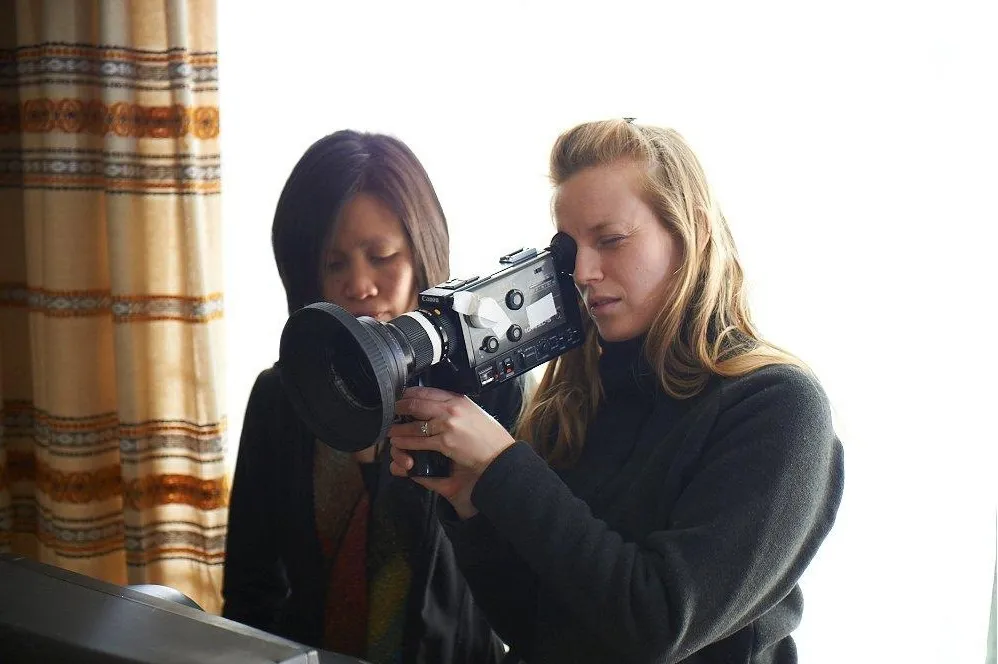
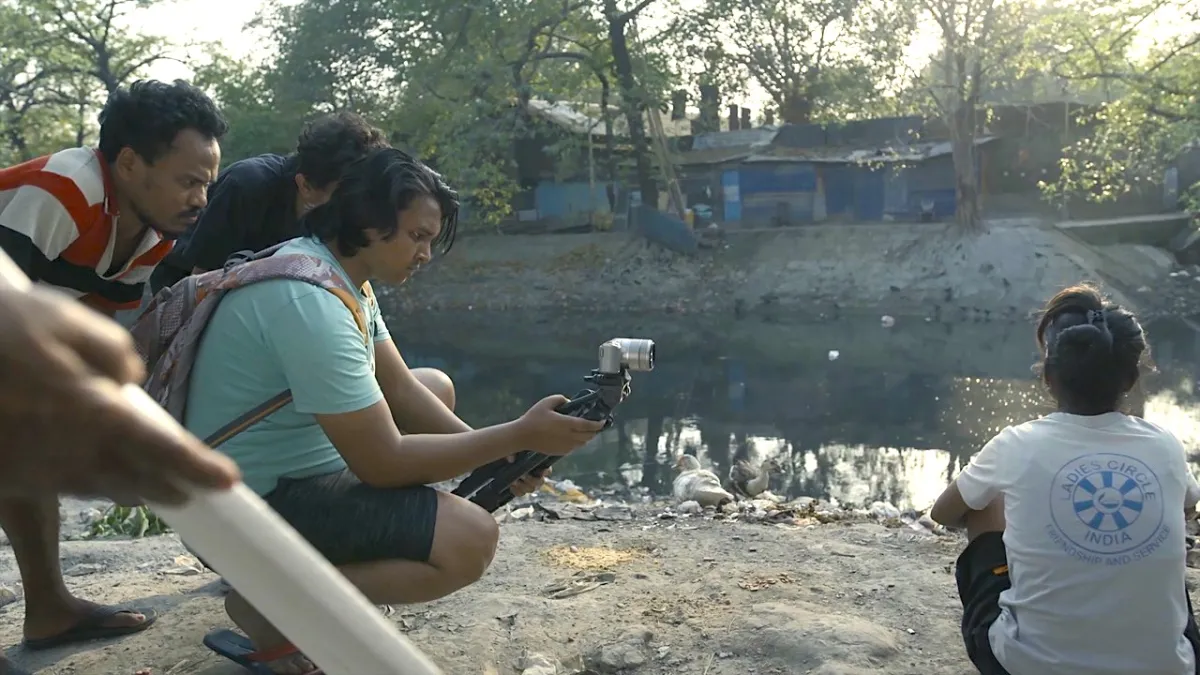
BB: The collective has 36 members. Eighteen are in the film, so in front of the camera. The rest of the group took on production roles—production controller, production manager, edit support. Rupesh Chaturvedi, one of the CAM ON members, became part of my cinematography team, along with two of my cinematographers. He does incredible things with the camera. Around 30% of Red Light To Limelight’s footage was shot by him once I realized his potential. He shot that scene of a woman getting a bucket of water [in which the camera is immersed in the tank, looking up at her] and then walking through the zigzag alley. What a wonderful shot.
It’s not about making one film with CAM ON and then making another film with another community. We have decided to continue this journey—they will be line producers and part of my creative team on my next documentary too. The confidence they developed while working with my team shouldn’t be hindered. Change is sustainable only if they continue working with a professional team because that creates a space for social mainstreaming, so that people can begin to accept them as storytellers and see their potential. They have become seasoned nonfiction film technicians. I don’t want to waste their skills.
D: When it comes to someone like Rabin, he’s a filmmaker, someone used to being on the other side of the camera—what went into getting him comfortable enough to be one of the documentary’s subjects?
BB: That’s an important question. CAM ON makes cinema, but when I wanted to make them the subject of cinema, they were really reluctant. That was my biggest challenge—retaining that inter-community spirit for more than five years till the film was complete. Rabin was hesitant to be part of the documentary because it wasn’t clear to him what the point of it would be or how it would be beneficial in any way—he was already a professional filmmaker. He was like, “It’s better to make a film about a popular subject so you have a readymade audience. Why make a film about us?”
I’m thankful for Indian documentary filmmakers like Shaunak Sen, Rintu Thomas and Sushmit Ghosh. When I started making this film, documentaries like Writing With Fire (2021) and All That Breathes (2022) were screened at Sundance and Cannes. They were nominated for Oscars That’s when CAM ON realized the power of the documentary. The Indian documentary scene has boomed over the past five years.
D: In a previous interview for Midnight Blues, a CAM ON member spoke about wanting to depict reality through the films they made as a group because Bollywood films weren’t accurately reflective of their experience. Were there clichés you consciously steered clear of?
BB: There’s a gap in how conventional films portray sex workers’ issues and the way documentaries do, which Rabin was very aware of. Every time we shot footage and went back to the studio to look at the rushes, CAM ON members were part of the process. They would decide what seemed true to their life and what didn’t. On the basis of their remarks, we’d go back to the location the next day and shoot. They’d look at the footage again because it was very important to them how they were portrayed and what their image was. I wanted our portrayal of the women’s dignity to reflect how I saw them and the way my entire team saw them. That was a challenge because sex workers are quite vulnerable, but I wanted that aspect of their identity to come second. I wanted the documentary to portray their identity as that of a storyteller, of a filmmaker.
D: You film the women at work beckoning potential customers, and then leading men back to their rooms. Can you tell me about how you negotiated your presence there, since it could’ve impacted their livelihood and raised concerns of privacy?
BB: Most of the regular customers that we spoke to were willing to be part of the documentary after the women convinced them. Those that weren’t were shot from behind so as not to reveal their identity. If I hadn’t filmed the women’s nocturnal lives—what they sell to feed their family, there was no point to making the film. Over five years, I began to see the brothel’s philosophical aspects, the women’s values, their integrity, their solidarity. I realized this needed to be part of my film and that I shouldn’t avoid shooting the customers, who were part of their lives.
Some of these customers even contribute to CAM ON’s filmmaking process—they add in 5 or 10 bucks extra as a donation. The customer is an integral part of the brothel’s atmosphere and so should be part of the film. However, it took years to convince them of this and the women were instrumental in doing so since they had developed a rapport with their customers. Once the women realized that Red Light to Limelight was their film and that they had ownership of it, they organized it. That’s why co-creation is important for documentary filmmakers working with any community. Otherwise the situation is such that they lose their access and have to stop filming midway.
D: You had three cinematographers on the film. Could you talk to me about creating the documentary’s look? There are times I couldn’t tell it apart from the staged CAM ON short film—like when that man begins verbally abusing his daughters. Was it a conscious decision to not treat the two separately in terms of visuals, because even the short fiction film is, after all, based on the women’s real-life stories?
BB: That scene was completely made on the editor’s table. It wasn’t shot in that manner. Editing plays a mammoth role in shaping a documentary’s narrative. We had shot almost 240 hours of footage. But from the very beginning, the cinematographers and I decided that the approach should be: intimate, intuitive, reflexive. There was a shortage of space in that brothel. It’s a clumsy, tiny, shabby area full of lanes and bylanes so it was very difficult to move around with a camera, with a crew, with the boom mic, etc. But we decided that the space shortage should not hinder our filming at all. We made the filming lucid and accessible to the community participating in the film.
Gayle Sequeira is a film critic and reporter whose work has appeared in The Guardian, BFI, Sight and Sound, Vulture, GQ, and more.