


Welcome to The Synthesis, a monthly column exploring the intersection of Artificial Intelligence and documentary practice. Co-authors shirin anlen and Kat Cizek will lay out ten (or so) key takeaways that synthesize the latest intelligence on synthetic media and AI tools—alongside their implications for nonfiction mediamaking. Balancing ethical, labor, and creative concerns, they will engage Documentary readers with interviews, analysis, and case studies. The Synthesis is part of an ongoing collaboration between the Co-Creation Studio at MIT’s Open Doc Lab and WITNESS.
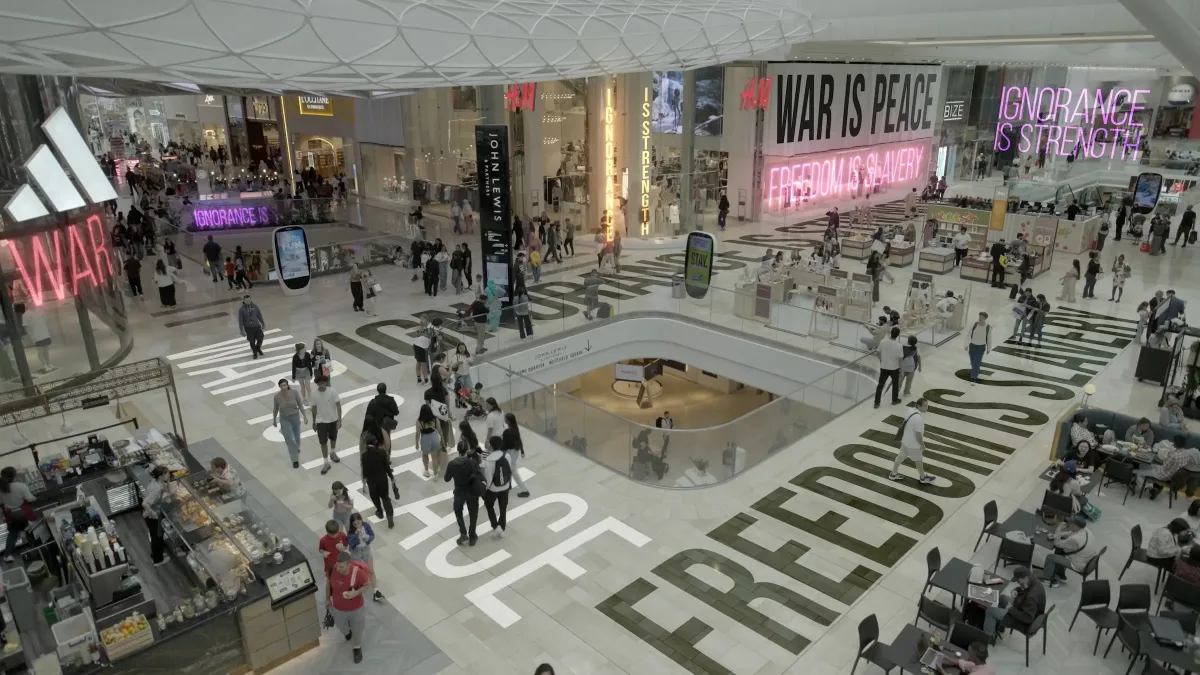
In his new film, Orwell: 2+2=5, Raoul Peck draws on the signature style he honed in his most well-known documentary, 2016’s James Baldwin biographical doc I am Not Your Negro, which weaves text together with scenes from classic fiction films and archival interviews. But for the Orwell film, Peck also knits in several new layers, from voiceover read by the actor Damien Lewis to incorporating scenes generated with AI. In doing so, Peck creates a strikingly timely yet timeless cinematic tapestry about the literary legend and his prescient observations on totalitarianism.
To learn more about how Peck grappled with AI technology in the context of Orwell and why he played it for laughs, we spoke with Peck by Zoom from his film tour stop in New York City, as Orwell: 2+2=5 is currently expanding in theaters across the U.S. The following interview was edited for length and clarity.
DOCUMENTARY: Let’s start with the AI-generated music video you created for Orwell: 2+2=5. How did you choose to make it, and why?
RAOUL PECK: I built the film layer by layer. Even though I knew the different thematics would be in the film, I took my time, because I was working on a dramatic storyline, not a news report. I knew that I couldn’t talk about Orwell without going into AI—that would have been totally misconstructed. I had to bring something original while avoiding mystifying AI technology, which is for me just another technology: more efficient, more destabilizing, and more deregulated.
I asked a Belgian filmmaker friend, Vincent Lannoo, who is engulfed in AI and is playing with apps and AI tools. I said, “Here’s your assignment. Start working on this and let me see what it is.” I didn’t want to spend nights on it myself. After several months he sent back a trove of material, but I didn’t want to use it because my instinct was to see what the machine can do. I realized those short AI videos don’t work for a film because right now, you cannot replicate a shot or even replicate the face the same way twice. The continuity you need for a film—I am not saying they won’t be able to do it later—but at this stage, I didn’t feel that it was an instrument that I could use.
But the fact that this system exists and what people are doing with it for profit, for entertainment, for amusement—I knew I had to have it in the film, but I needed to be totally transparent about it.
D: May I ask what exactly you gave as the assignment?
RP: Once I saw what it could do, I started building that sequence about AI. I wanted something bizarre, but embedded in reality because I’m in reality. At some point, we had so many clips of Trump where you can’t believe your ears with what he’s actually saying. It’s worse than Charlie Chaplin doing The Great Dictator [1940]. It’s beyond parody, beyond irony. I had to find a way to see how AI reacts to that.
Vincent showed me an example of how he writes music and words with AI, and then we tried stuff and that music video came out of it. Then we cut it with real Trump clips, and the mixing of the two is totally unrealistic. You start with AI and then you come to reality, but you feel reality could have been AI because of the level of absurdity at the moment where he said, “In four years you don’t need to vote anymore,” or “Black people are running everywhere with my mugshot.” His skill is to turn around anything to make it go his own way. It’s incredible. He is the AI machine himself, you know?
D: And so you started with Trump, or were there other tests that you did before that?
RP: At that time, Trump had taken a lot of space in the movie. In fact, I took out a lot of Trump-related pieces because I didn’t want to date the film. It’s not a film about Trump. It’s a film about how authoritarianism can happen everywhere and how it is happening now in the U.S. and elsewhere. I want you to be able to watch this film in 10 years, in 20 years, in 30 years, as if you’re watching a testimony of a time. I had to keep the universality of the story.
D: What was the process between you and Vincent?
RP: I was in Paris, he was in Belgium. So he would send me clips he had worked on. And we would talk about it on Zoom.
D: How did you relate to the machine? Was it like an editor or was it something different?
RP: I avoided going into the machine myself, because I knew it would eat my time. Vincent was hired specifically to do this. He’s so crazy about the creative possibility of AI, he would spend the whole night on it. In our conversations, it was me bringing him back to reality. I needed to stay credible in this film, I didn’t want to overplay the creativity of this instrument.
That is also the fundamental point: the absence of regulation, the absence of aesthetic or ethical rules. That’s why I was always careful to stay transparent when we use AI, whether it’s in image, sound, or edit. I don’t just use it and throw it out there.
D: What are the aesthetic and political affordances and limitations of Gen AI when critiquing authoritarianism?
RP: It’s an incredible weapon in the hands of people who want to deform reality. You can basically do a whole political campaign with it. Orwell says something very important about language: if language doesn’t mean anything anymore, or if words can be twisted and don’t mean the same thing between two different people, there cannot be democracy. The very core of democracy is to be able to have a discussion with your neighbor, your allies, or to convince people that the solution you’re bringing makes sense. But if you don’t even speak the same language, it’s impossible to agree on anything. We can imagine how it can be misused.
But the most dangerous part of it is that any new technology is just a technology. It’s not God. That’s what people are selling you, because we live in a capitalistic society. And like every new discovery, if you don’t control it, but let it control you for profit, it’s not developed for the better of humanity. The first use of publicity was to sell cigarettes. In those images, doctors in their white clothes and with stethoscopes were leisurely smoking, pushing the idea that smoking was good for you. By the time the state starts to provide studies and all the interest groups start to to resist or to show the dangers, 10 years have already passed. It’s already gone.
All of my documentaries, even some of my fiction films are always embedded in the rendering of reality. I cannot function on fantasy. From where I come from, Haiti, I’ve been in several different types of dictatorships or repressive regimes. I grew up in Berlin in a time when there was a sort of political censorship. I know the feelings. I know the instrument they use. I’ve always made sure that I’m strongly footed in the ground. The fact that I would fabricate a different reality never occurred to me, but I could use AI for research. But I have to dominate the instrument. If it’s an instrument, you have to be the one using it and not the other way around.
D: In this film, you have this beautiful recurring Raoul Peck touch of treating cinematic layerings of many film renditions of 1984. How does Gen AI fit in the way that you used it to portray authoritarianism in relation to previous cinema?
RP: It’s a parallel storyline through those clips, and those choices show how you can make different films with the same book, and how time influenced the rendering of that book. We didn’t use it in the film, but there were different endings depending on what country they were made in. The ending in Germany was not the same as in France or the United States. They basically changed the ending of the story, making it more optimistic. Or very dark.
Orwell also has been misused. When Animal Farm came out, the first film [adaptation, the 1954 animated feature produced by Halas and Batchelor] was sponsored by the CIA, because they saw in it a perfect vehicle to attack the Soviet Union. Even in my own mind, I always thought Orwell was always attached to a propaganda machine. But it was a misuse of his work because his work is against totalitarianism from anywhere.
D: What form of global resistance to AI-powered authoritarianism can we take? What is the resistance?
RP: Because of the massive appearance of those big companies that are all over the whole planet—basically all of them are American—there is a sort of backlash in Europe. The European Union is probably the first entity to start working on that and have now a few rules that they are setting up to protect Europeans from a certain approach. If the EU establishes these rules, it will be very difficult for American companies to continue unregulated.
In the film, we have Geoffrey [Hinton], the godfather of AI, say it himself. If it’s made for profit, profit was never the best way to promote evolution and progress.
D: You’ve been on the road with this film for three months now. Have there been any surprising reactions to the use of AI in your film?
RP: People laugh at the AI parts because the best way sometimes to fight something is to point to it and say it’s ridiculous. There is a quote in the film where I say, “The [Nazi] goose step would never have been possible in England because the people would have laughed at it,” and this is exactly what I think is the best response to all of this. We give them authority over us by taking seriously “2+2=5.” There is no limit to bullying or to exaggeration, as long as you let it continue to happen.