

Co-director and protagonist Soraya Akhlaghi begins A Fox Under a Pink Moon by addressing Mehrdad Oskouei, one of the most internationally acclaimed Iranian documentarians, in a video diary: “November 19th, 2019, from Istanbul’s Zeytun Burna Dormitory. Hello, Uncle Mehrdad, I hope you’re doing well.”
What follows is an account of five years of her life, through multiple attempts to cross the border from Turkey into Europe, her livelihood as a house cleaner in Tehran, her autodidactic artistic practice, domestic abuse from her husband, and their longing for their Afghan homeland as it is retaken by the Taliban—they are refugees twice over.
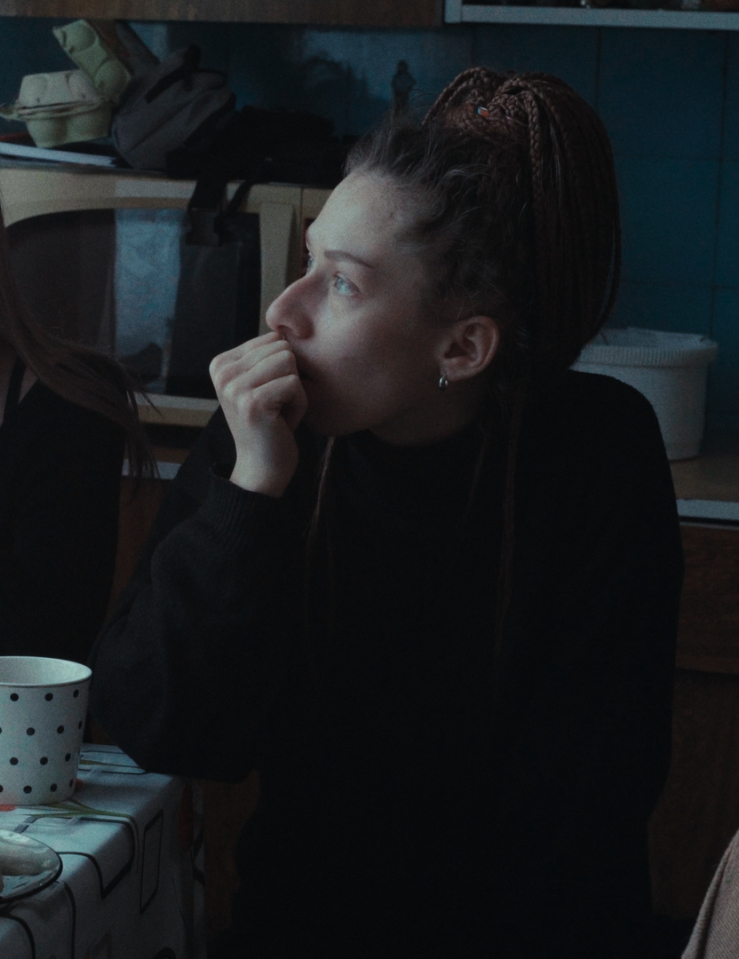
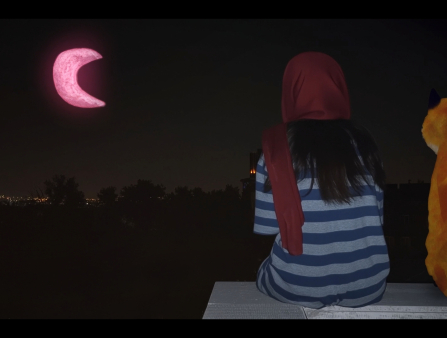
If this description seems to doom Fox within multiple inspirational porn documentary tropes, rest assured that this cynic has never seen an example as supremely assured, visually stunning, and longitudinal as this film, which is filmed entirely on two cell phones by Soraya and incorporates many of her drawings into animated sequences built on top of the vérité footage. (“Filmed #withGalaxy,” the opening intertitle reveals.)
Though Fox reunites Oskouei with many of his regular collaborators—from producer and writer Siavash Jamali to composer Afshin Azizi and editor Amir Adibparvar—and the subject of young people’s lives in the margins of Iran continues, the result is far more associative and aesthetically playful than Oskouei’s celebrated tetralogy of youth in Iranian prisons. In films like The Last Days of Winter (2011) and Starless Dreams (2016), which sit squarely in the observational social documentary form, Oskouei’s personal interactions, kind interviews, and patient eye drive the story. After completing the four-film series with Sunless Shadows (2019), Oskouei visited an outsider sculptor for development research where he met two assistants working in the sculptor’s studio. One of them was the teenager Soraya, whose artistic aptitude was immediately apparent. Oskouei pivoted the project to focus on her. But given Soraya’s controlling husband and their dangerous cross-border journeys, Oskouei needed to find a different way of working. So Soraya films herself and what she sees, while squished in the back of a smuggler’s truck (the trips are referred to by the euphemism “playing a game”), after brutal beatings, and in creative self-expression for her own music videos.
Remote-directed documentaries, where an established filmmaker directs a protagonist or crew to self-film, have recently surged in international acclaim and commercial success. Examples range from The Territory (2021), with director Alex Pritz sharing cinematography and producing credits with the Uru-eu-wau-wau subjects, who filmed a significant portion of the documentary’s visuals, to this past year’s Oscar winner Mr Nobody Against Putin (2025), whose co-director Pavel Talankin, a Russian schoolteacher, under the guidance of David Borenstein, secretly filmed the indoctrination of his students. (Borenstein joined A Fox Under a Pink Moon as an executive producer over the summer.) But the technique has a long-standing history in documentary and ethnography, where participatory forms borrow from the autoethnography and the self-reflexive first-person filmmaker voiceovers. Moreover, in this lineage, there’s a robust strand of filmmaking workshops training Indigenous storytellers in camera equipment, editing strategies, and participatory methods dating back to Jean Rouch’s Human Pyramid (1961), in which the high school student protagonists not only narrate their experience but also criticize and shape the direction of the film.
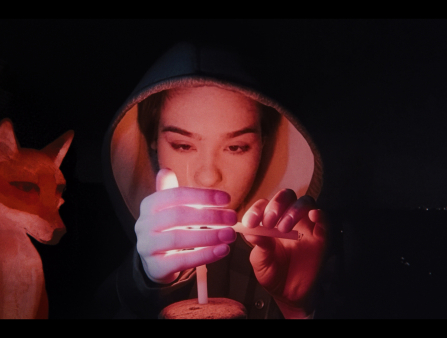
A Fox Under a Pink Moon.
In the ’90s, with the proliferation of consumer-grade video camcorders, Spencer Nakasako engineered an early digital form of participatory filmmaking. At that time already an established filmmaker (and repeated collaborator with Wayne Wang), for 15 years Nakasako taught refugee children at the Vietnamese Youth Development Center in San Francisco to make movies about their lives, part of a wave of nonprofit interest in producing youth media. Four of them became the camerapeople, protagonists, and sometimes co-directors of a “refugee trilogy” of feature documentaries built from their observational footage and video diaries. The first, A.K.A. Don Bonus (1995), is considered a classic for Nakasako’s distillation of the 70 hours shot by Sokly “Don Bonus” Ny, and the violent reality of life in the projects that Don captures.
But the most complex and satisfying of them is Kelly Loves Tony (1998), which balances two co-protagonists (the titular Kelly Saeteurn and Tony Saelio, a young couple navigating parenthood) with different vocal and visual registers. Nakasako’s initial impulse was to make a Rashomon-style documentary where the same events would be told and understood differently by two points of view. But Kelly and Tony filmed utterly differently from each other, and they each filmed different things. Like Oskouei, Nakasako pivoted, and the resulting feature is a riveting portrait drawn from the lived realities and expanded capabilities of its most introspective and promising subject, the 17-year-old Kelly.
Is there anyone better to put together in conversation with Oskouei and Akhlaghi? In this occasionally self-deprecating interview with the pair, Nakasako draws on his experience to explore what it means to share ownership, how to divide roles within a shared structure, what can be transmitted and taught, and enlivening hybrid forms of documentary such as animation.
A Fox Under a Pink Moon has played dozens of film festivals after winning IDFA’s international competition last year and is set to be distributed in the United States by Kino Lorber later this year. The following conversation has been edited for length and clarity, with Jamali serving as Akhlaghi’s translator throughout. —Abby Sun
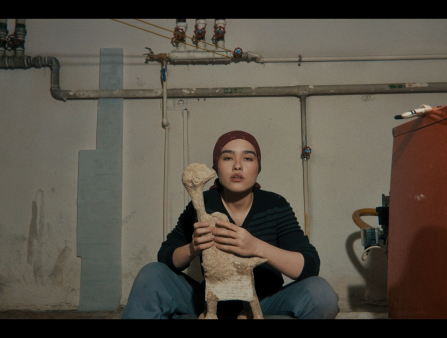
Soraya Akhlaghi poses with one of her sculptures in A Fox Under a Pink Moon.
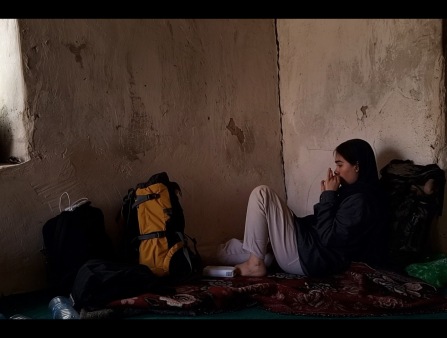
The film follows Soraya as she aims to flee her life in Afghanistan.
DOCUMENTARY: I made the mistake of rewatching the film last night, so I would be prepared. It’s the second time I saw it, and so I didn’t sleep at all. From the first frame, a bunch of emotions went through me. I flashed back to 30 years ago, and working with Don Bonus. I have no idea what you guys went through, but I feel this kinship with you; there seemed to be an incredible level of mutual trust. That’s the only way these kinds of films get made—to let the director do his work, and the camera subject do her work, and somehow make it come together. And that’s not easy.
SORAYA AKHLAGHI: It was very difficult for me as an amateur filmmaker, but I think it was far more difficult for Uncle Mehrdad as a professional filmmaker, because he was guiding me. I was just listening and trying to do what he said. Since the beginning of this project, Uncle Mehrdad was teaching me how to shoot and how to direct. Besides his teachings, he asked me to start taking three online classes—on photography, lighting, and other aspects of filmmaking. Also, day by day, he provided me with photos and paintings to help me learn how to shoot and understand the emotion. He sent lots of music and said, “Listen to this music. It will help you to shoot. It will help you to develop your emotions.” If you pay attention to the beginning of the film, my shots are not very good. But step by step, you can see I am developing, and the shots are evolving, and that’s because Uncle Mehrdad was teaching me every day.
D: He was a better teacher than I was! A.K.A. Don Bonus mirrors the first part of your movie and stays that way. [Laughter] Yours really improves. Mehrdad should market that online teaching. But I also sense an incredible talent on your part, Soraya; some of that you can’t learn online.
MEHRDAD OSKOUEI: I want to tell you something, Spencer, about power—about giving power to the protagonist. With Siavash as an executive producer, we worked on four films about boys and girls in rehabilitation and correctional centers in Iran. Two films about boys and two about girls. That’s where I learned that I could give more power to my protagonist. In the beginning of making my third film in that series, Starless Dreams (2016), I showed the girls my two previous films about boys in prison, and I said, “Look, I want to give you all of my power as a director to you, and you can do anything you want to do, for example, if you want to take the camera, or you want to take a microphone, if you want to say something.” And it was incredible.
After this tetralogy, I wanted to make a film about an Afghan man who was a sculptor in the center of Tehran. After six months of researching, I didn’t trust him, and I wanted to stop my research. Then one day, I met a very talented, very beautiful, and very special artist there: Soraya, who asked me one day, “Could you please give me your opinion about my paintings and my sculptures?” I couldn’t believe she made these sculptures, and she was with another girl. They were the assistants of that sculptor. [Soroya] was very shy. And, at the same time, she makes very strange, very beautiful, and small sculptures. I said to myself, Wow, she is very talented. And she said, “It is nothing.” She was 15 at the time. At that moment, I changed my mind to make a film about her, not her master. And I told her, “We can make a film together, but we have to trust each other. You have to be patient because it will take a long time.” And she promised me that time.
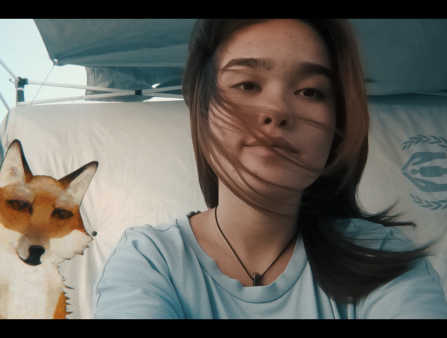
Soraya Akhlaghi shot the entire film on two cellphones.
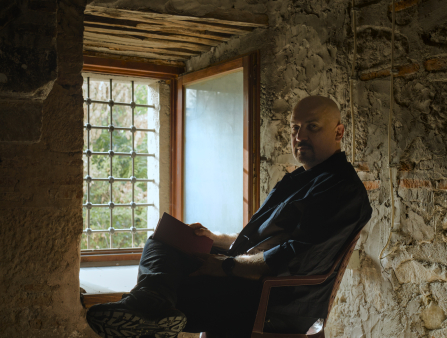
Mehrdad Oskouei in Skopje, Macedonia. Photo credit: Oli Kamenarovska.
D: I’m just curious about that sense of responsibility on both of your parts.
SA: Uncle Mehrdad is not just a filmmaker or a director. For me, he is “Uncle Mehrdad” because he is a big supporter. From the beginning, whatever was happening in my life, I talked to him about it. Over the seven years, we had a mutual respect and mutual understanding.
MO: Every day at night after 12 o’clock, we talk together because she was on the roof and her now ex-husband was asleep. And I’d ask, “What’s your plan for tomorrow, for next week? What do you want to do?” And when she talked about it, I’d say, “Okay, you can put the camera here, camera there, and catch every little detail.” It was very important for both of us. For example, when she was in the house in Turkey in her first “game,” I asked, “Please let me know about the situation of your house, the room,” and she told me everything. I said, “Okay, we need a shot from the toys on the floor. We need the shots from the shoes of people when they sleep, and from many different things.” In our mind, we had many different shots, many different single shots.
There’s one shot where she puts her blue scarf on her face and closes her eyes. Soraya, do you want to tell Spencer how you recorded that shot?
SA: I lay down on the floor and with the help of my feet, I put the smartphone here [points above herself] and started recording that scene with my feet.
MO: She was always thinking about how to find a better solution for recording—even in many dangerous places. For example, when she was in the minivan for the first time recording everyone inside it as an observer. When I watched that shot, I cried and said to myself, Okay, Mehrdad, you don’t know anything about documentary filmmaking. Look at her shot! I was kind of going to university. She taught me a lot because it was pure response—all the shots were. It was very pure.
SIAVASH JIAMALI: And I have to add this. Sometimes in photography or film, there is an idea that too much studying and learning will ruin that purity. If Mehrdad or I were there, we would have done it differently. But Soraya’s shots are very, very pure.
MO: I put one sentence from my master Abbas Kiarostami on my refrigerator. He said, “It will be very good in the future if the character’s eyes record everything.” It impressed me very much. And always, during our time shooting, I was thinking about that sentence.
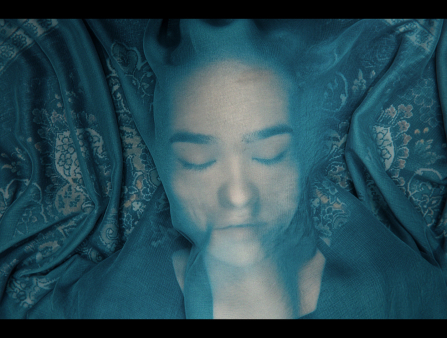
One of the most striking shots in A Fox Under a Pink Moon finds Soraya Akhlaghi draped with a piece of sheer blue fabric.
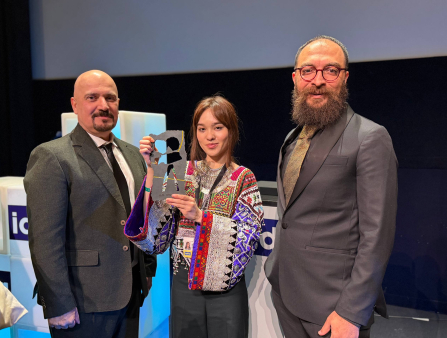
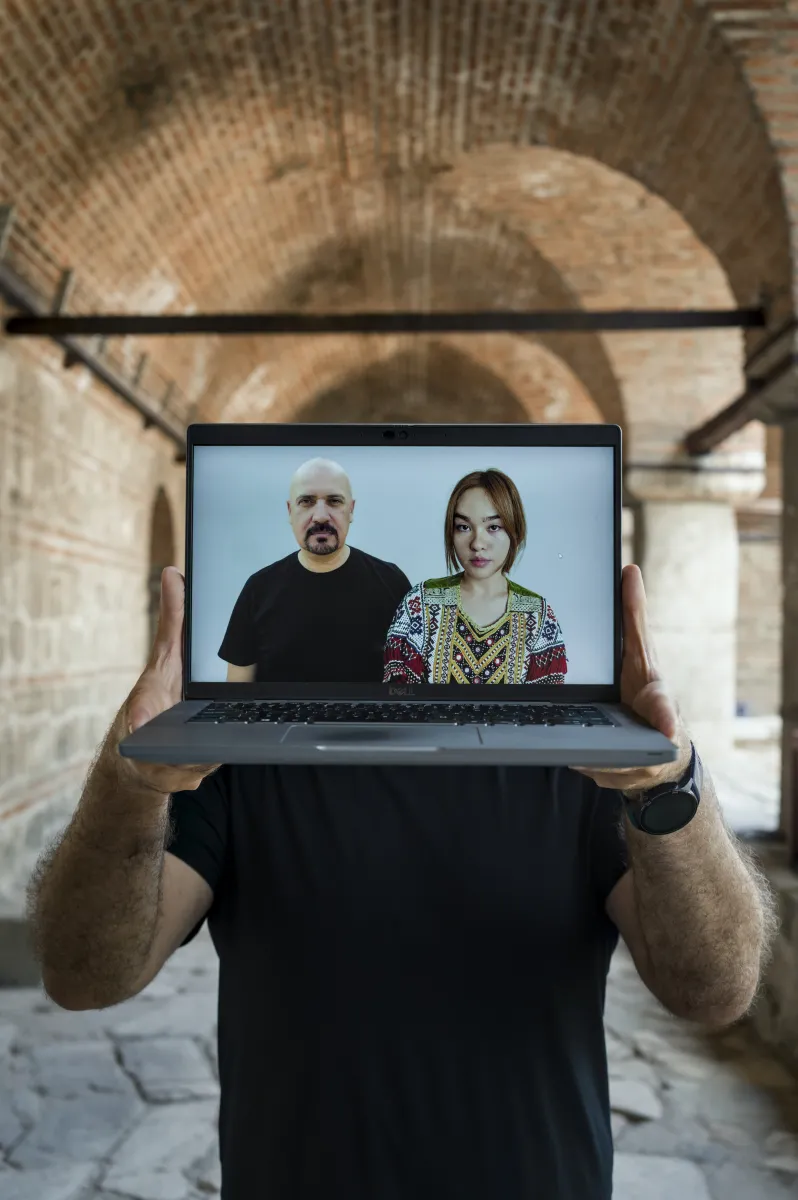
(L to R) Mehrdad Oskouei, Soraya Akhlaghi, and Siavash Jamali at IDFA 2025, where their film won Best International Documentary. Photo credit: Hamidreza Fatourehcian.
D: I tip my hat to your editor because you were all able to find the language of the film, so the viewer is just experiencing the film.
MO: In this kind of filmmaking, we start editing at the same time we’re shooting. A year or two in, I realized we had a lot of material. But you have a lot of single shots. You don’t have sequences. You’re not there as a director, so you can’t think, Well, I’ll record that at the beginning, and then I’ll record that. So I asked my editor to join us early on. Together, we made different little scenes.
Sometimes we’d ask Soraya to record voiceover—and she talked about her paintings, her life, and many different things. After two or three years, I wanted to show her paintings and put voiceover in. I wanted to explore something about her inner emotion—her inner world. One day, I asked her, “Please, close your eyes and talk about your paintings from the bottom of your heart.” And she said something very special, and it moved something in my head. I talked with my editor, Amir [Adibparvar], and with Siavash about how we can use animation. For us, making films is not about putting everything in. For me, creativity is putting out only very pure material. I want to say more with less.
D: I have a bit of a pet peeve with the way filmmakers today use reenactment and animation to illustrate a scene they don’t have. Almost every time, I hate it, but with yours, it was so integrated, like it was in concert with Soraya. It was a part of her. For a cynic like me, that was incredibly successful. Because it was driven by emotion.
SJ: When we wanted to have animation, we had one question: Is it going to be dramatic or decorative? If it’s dramatic, put it in there. We felt the paintings were something we had to animate because they’re going to show something we cannot show and will help the audience feel Soraya’s inner world.
MO: At the beginning of the process of making an animation of Soraya’s paintings, I told my director of animation, Mohammad Lotfali, “Please read magical realism authors like Jorge Luis Borges and Gabriel García Márquez because we need animation with that kind of style.” And Soraya really liked that.
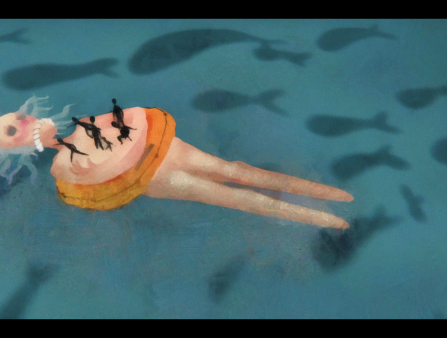
SA: There is an animation at the beginning of the film when the immigrants are on the boat, and when I saw the animation, I watched it more than 50 times. I couldn’t believe how close it was to my own feelings. It was shocking. I couldn’t believe the magic of animation and how it could convey my feelings so completely.
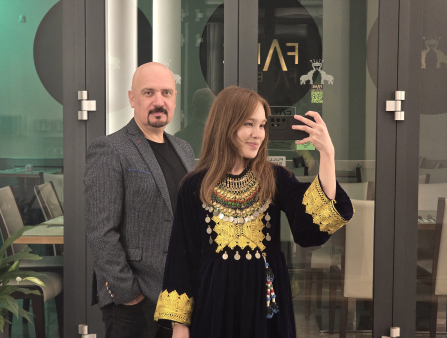
Co-directors Mehrdad Oskouei and Soraya Akhlaghi pose together in Prague, June 2026.
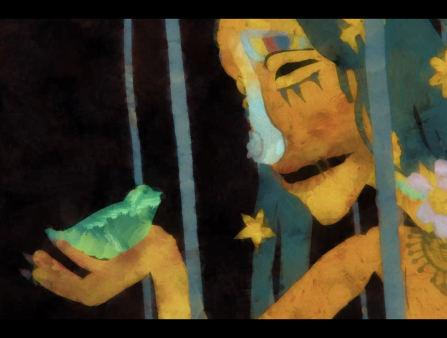
The filmmakers created animated sequences from Soraya Akhlaghi's own illustrations.
D: I took a lot of shit when I finished A.K.A. Don Bonus because it was a whole new way of looking at film and breaking down the hierarchy. I felt like people thought I was doing it out of pity, but I did what I thought was real: I gave Don Bonus a co-director credit. It was like, “Well, did you do nothing, then? I mean, why’d you give the kid credit? What did he do specifically?” I found myself spending a lot of time talking about that, and people not understanding what I was trying to say. I’m curious if you’ve encountered anything like that.
MO: Yeah, two, three festivals in the beginning of our journey said, “Okay, Soraya, she did everything by herself; what’s your role?” And I’d say, “I am co-director. We worked together on this project.” I said, “You can’t believe how much work is behind Soraya.” And not just me—our crew, Siavash, our editor, our composer (who worked for years on this project, many times changing the music). I said, “You can record everything in your life. You have lots of material, but you don’t have a film. It’s like a diary. Everyone can write their diaries, but they don’t have a book.”
SJ: I have to add, sorry. But Mehrdad and Soraya had 430 shooting sessions for Fox over seven years.
MO: Not for shooting—for talking.
SJ: In all those days and nights, they talked about what was going to happen tomorrow. They talked about the shots Soraya sent. They talked about paintings. They talked about music. They talked about photos. They talked about artists. They talked about drama. They talked about storytelling. It’s a kind of mutual filmmaking. And Mehrdad listened completely to what was happening in Soraya’s life. Then, we had to think, How can we convey it, transform it into art and filmmaking? As Mehrdad pointed out, if there is no filmmaker or director, it’s just a diary. In today’s world, everyone has a smartphone. They can record everything. Everyone has a pen. But are they going to publish a book? No. You need to know how to develop a narrative structure. How to develop a field. You need all of this knowledge, and mutually, Soraya and Mehrdad evolved it.
MO: Without Soraya, there is no film. Without me, there is no film.
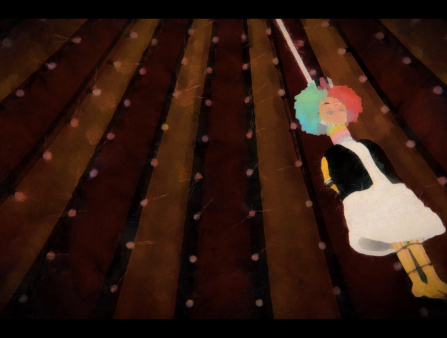
Mehrdad Oskouei worked with animator Mohammad Lotfali to create sequences inspired by Soraya's artwork.
D: Since we’re talking about cinema and technique, sometimes when I was working with Don Bonus I’d get caught up in the film and would forget how different it was for him. We’d do check-ins. We would meet weekly, have a meal, and just sit and look at the footage he’d shot that week. I was always amazed by his resilience and his ability to pick up the camera, just like Soraya. If he was walking through a rough gang territory in the projects, he’d put the camera in his backpack so he wouldn’t get mugged for it, but he’d also record the sound—and I included that in the film because it shows the intensity of just walking home. One day, I asked him, “Don, why are you doing this?” And he gave me the best answer: “It gives me something to do.” Soraya, you went through an incredible journey, and I don’t know if I fully appreciate that you also filmed it all.
SA: When we started this project, it was very difficult for me because I am very introverted. But after a few months, I came to think of the smartphone as a very close friend. I can talk with it about my pains, and it was listening. Step by step, I found that it was going to give me a meaning. I knew that I was in a very bad situation, suffering domestic violence, but I kept thinking about the day when this film would be released, and other girls who are suffering the same situation as me could watch it and feel like there was a way to survive.
MO: Our whole crew wants to dedicate this film to Soraya. She is the main character, cinematographer, director, and co-director, and at the same time, she is one of our best friends. She has an old soul. She has a big heart. On her Instagram, she always supports girls and women in Afghanistan. At all these different festivals, she talks about the plight of women in Afghanistan.
SA: I have a dream that everyone on the face of the earth will watch this film, but especially men in Afghanistan. They have to see it and witness it. They have to accept the changes in the world. They have to see what we are going through. There is no way other than acceptance of the new world and our dreams.
This piece was first published in Documentary’s Fall 2026 issue.