

Notions of lineage loom large for the prolific editor and sometimes director Mary Stephen. She was born and raised in Hong Kong, schooled at Concordia in Montreal, and thereafter based in Paris, where she made several narrative shorts and features, and also served as Eric Rohmer’s go-to editor for over twenty years. In a prolific editing career, she also cut films from Lixin Fan (Last Train Home), Ann Hui (Love After Love), and many others. In recent years, she’s become a regular editing mentor at film labs.
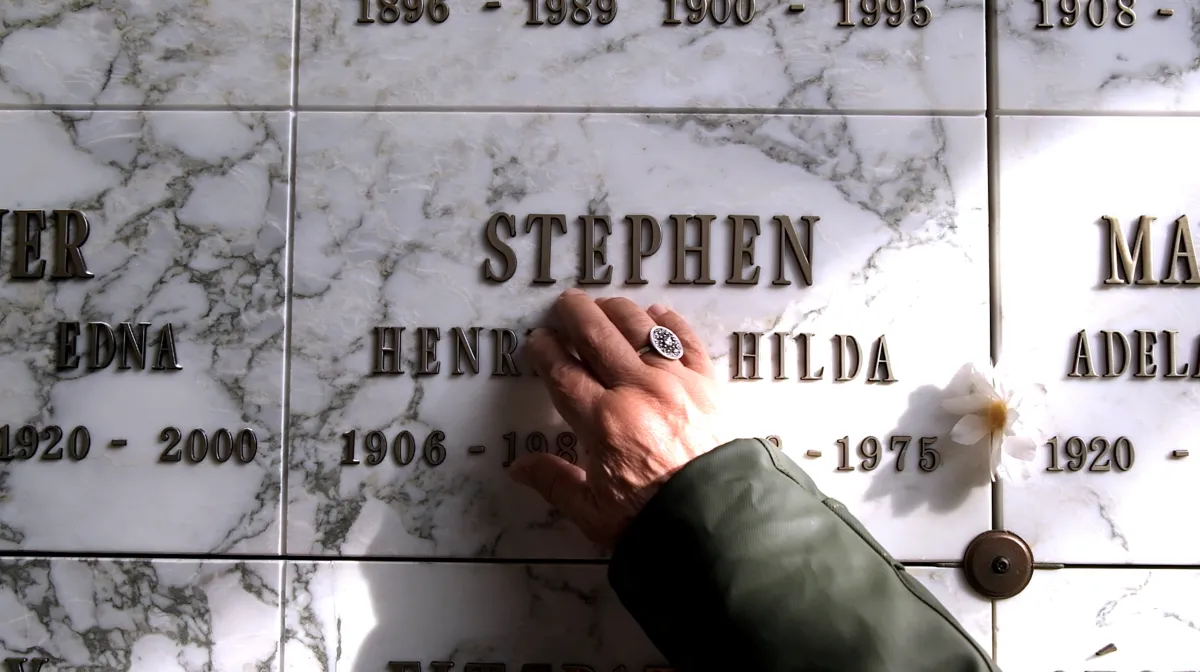
Stephen spent most of her life navigating the continuities and conflicts between an upbringing in East Asia and a career in the francophone West. The question of how her Chinese family ended up with an English surname is a barbed and complex one, shaped by decades of competing colonial histories in her home country, as well as the enigmatic qualities of her parents. It was the driving force behind Stephen’s newest film, Palimpsest: The Story of a Name, an essayistic portrait of her ever-evolving family legacy that attempts to untangle a web of distortions, coincidences, and compromises.
Appropriately for a filmmaker, invention and embellishment run in the family: Stephen’s mother Hilda wrote for magazines under a pen name, while her father Henry made exhaustive records, both verbal and filmic, of his life, business, and family as they scaled the social ladder in mid-century Hong Kong. Hilda and Henry doctored these records, inscribing false histories into Henry’s comprehensive journals: conflicting accounts describe an Australian aboriginal grandfather, a Catholic Priest named Stephen who became Henry’s adoptive father, and a nomadic adolescence. Fate connected one family of storytellers to another; many years after Virginia Stephen married into the name Virginia Woolf, her nephew Julian Bell began an illicit romance with a married Chinese writer while studying abroad. Hilda, it seems, was at one point a liaison for this affair.
As Stephen sifted through traces of her parents’ pasts, Henry’s trove of film stock in particular, she was understandably doubtful of the extent to which she could trust these archives. Throughout Palimpsest, Stephen’s musings, observations, and contemporary footage run counter to the wealth of archival material at her disposal.
Stephen twists the facts to give her mother more agency in the concoction of these false histories, playing into her parents’ legacy of historical manipulation before eventually coming clean to the audience (a late twist reveals the Stephen surname actually appears on a passport dated before Henry met his wife). Knotty, digressive and clear-eyed, the film is fascinated and perplexed by the elaborate fictions of family and nationhood that past generations spin for posterity.
With a series of her films titled “Between East and West” screening at Metrograph from October 3–19, Stephen spoke with Documentary about the personal, logistical, and formal facets of Palimpsest, which recently premiered at TIFF and screens again on October 5 as part of the retrospective. This interview has been edited for length and clarity.
DOCUMENTARY: Can you walk me through the process of how the film came to be, how it developed over time, and how long it took to complete?
MARY STEPHEN: The central question had haunted me for all my adult life, but I started really researching it 20 years ago when a friend of mine—a Chinese writer who lives in Paris—was visiting me and saw all my Virginia Woolf books, and he’s a big fan of hers, and he asked, “did you know that Virginia Woolf’s maiden name is Stephen?” I didn’t. I did a bit of research and found out that her nephew went to China and had this affair. I thought that was very interesting since my mother wrote all those things under a pseudonym.
Then a few years ago, the production company 24images in France, which takes films that are half finished and hooks them into the funding networks, asked if I had a project that’s ready to go. They know I make films once in a blue moon, even though I’m so busy with other people’s. We decided to do [Palimpsest]. There were two major turns in the project: one was when we secured funding from a French-German broadcaster, and the other was when we digitized all of my father’s footage, which played a major part in shaping the visual construction of the film.
D: Do you see a resonance between your mother ghostwriting your father’s journals, or choosing to publish her own writing under a pen name, and the decades of your own career that you spent as an editor for Eric Rohmer?
MS: Yes, definitely. Between their story and what I’m doing today, I don’t know whether you can call it a coincidence or karma, but I end up doing the same thing, telling my tall tales.
D: Obviously a crucial difference is that you moved beyond your relationship with Rohmer and established yourself as an editor and a filmmaker on a global scale. How have your work and outlook shifted over the years?
MS: Rohmer’s filmmaking is so specific, and people would imagine it being so different from anything else that it would be difficult to imagine getting out of that world. For example, with his regular actors, the men would get other roles, but the women were stuck in the Rohmer formula. I think it was the same for his essential crew. For a long time, I couldn’t get work outside of that. On the other hand, coming back to your question, it was wonderful training. Nowadays, when I do my cuts and analyze them, they are very much Rohmer cuts—they don’t linger and go on forever, they’re rhythmic and sharp, and that’s how working with him shaped me.
D: There’s a whole tangle of binaries that you evoke in Palimpsest; day and night, east and west, the self and the other, as noted in the PK Leung quote, but also man and woman, individual identity and communal identity, archive and artifice, and so on. You seem to complicate and traverse these dichotomies as the film goes on—how has this in-betweenness shaped your work?
MS: That’s a complicated question! There are so many things in it, you know. I teach and I do a lot of mentoring, and in this film, I’m doing everything that I tell my mentees not to do: “Don’t have too many threads, don’t edit your own film, et cetera.”
In my career as an editor, this was the most difficult job; the first draft is completely different than the finished film. Originally, Palimpsest was much more intellectual and dry, with a lot more literary and academic quotes, and struck a more distanced tone. Then I started putting more of myself in it.
At one point, I was really exhausted in terms of editing, and I thought it would be wonderful if I had a “me” for myself. It was suggested very gingerly, “Wouldn’t you like a writer or an editor to help you?” and they were assuming that I would definitely refuse, like all directors with immense egos. But that’s exactly what I was thinking!
I selected Chaghig Arzoumanian, who is Lebanese-Armenian and a visual artist and director [Geographies, 2016]. When we worked together, she told me to trust my material. In my first draft, I had been rushing through the archival clips because when you’re telling your own story, you start to think everybody will be bored with it. She looked through all my father’s footage with me from one end to the other, over many, many hours, and we sifted through and pulled all this really fascinating stuff. That extra set of eyes was essential in getting me to sit down and really construct it with my father’s footage.
D: So much of the film is made up of your father’s visual and verbal records, but the rest is filled with your presence—the images you offer the viewer. Do you see your and your father’s records as at odds with each other?
MS: I hope that they are, you know? There are some hints toward the end of the film that what we see on screen may not be what we experienced in real life, and may not align with our real memories. My childhood memories are definitely not like this wonderful, luscious archival footage that shows happy faces and so on. I didn’t want to make a sort of psychoanalysis out of it, so my voiceover hints at certain things, but doesn’t get too explicit.
D: Toward the end of the film, you admit your manipulations of the material towards the “better story”—one that gives your mother more agency in the fabrication of the family history. Are your distortions an homage or a contestation to your parents’ legacy of fabulation?
MS: A friend who was involved in the film said I was scolding my mother. I said that I wasn’t—I was feeling pain for her. We have two different takes on the same scene. It’s all open to interpretation. We all reproach our parents for something.
In this case it’s very ambiguous because, as children, we were all against our father; we knew that he was manipulating what we thought was the truth, that there was this double life and these complicated things going on. In one scene in the film, I realized that my mother was an accomplice in this and that she was lying to her own children. How does that work?
Some people at first blush think that my father is this fascinating character. As a first impression, that’s not what I wanted. But I have to accept that people see it differently. People think that I was not happy about what my mother was doing, but in fact, I was extremely close with her. I actually made another short film [A Very Easy Death, 1975] when she passed away, which has been restored and is going to be [at Metrograph]. In fact, what I was expressing was an analysis of her, of what she did—which is still very mysterious—and how we perceived it, how it impacted us as children, and especially as young girls.
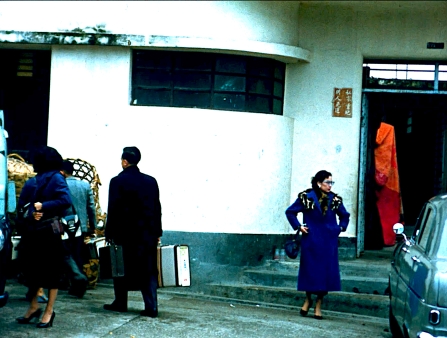
Palimpsest.
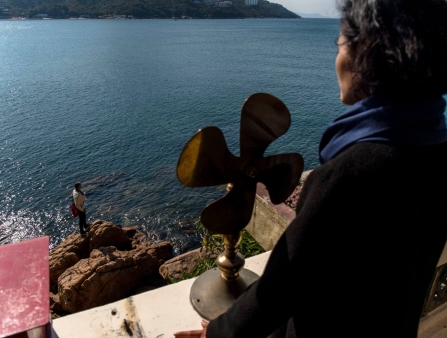
The Memory of Water.