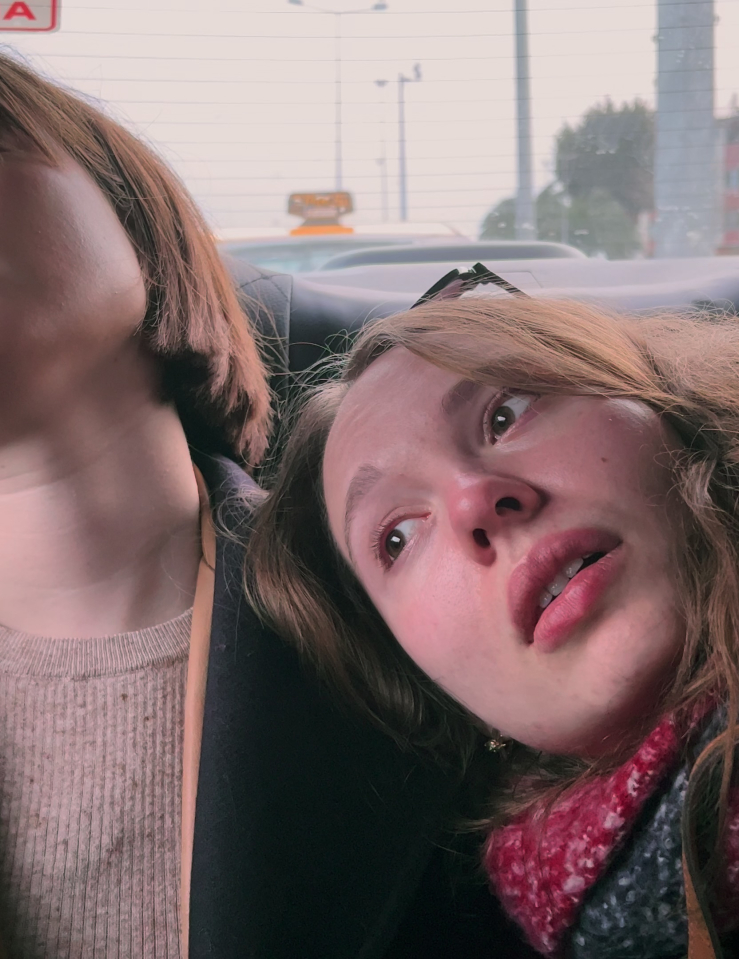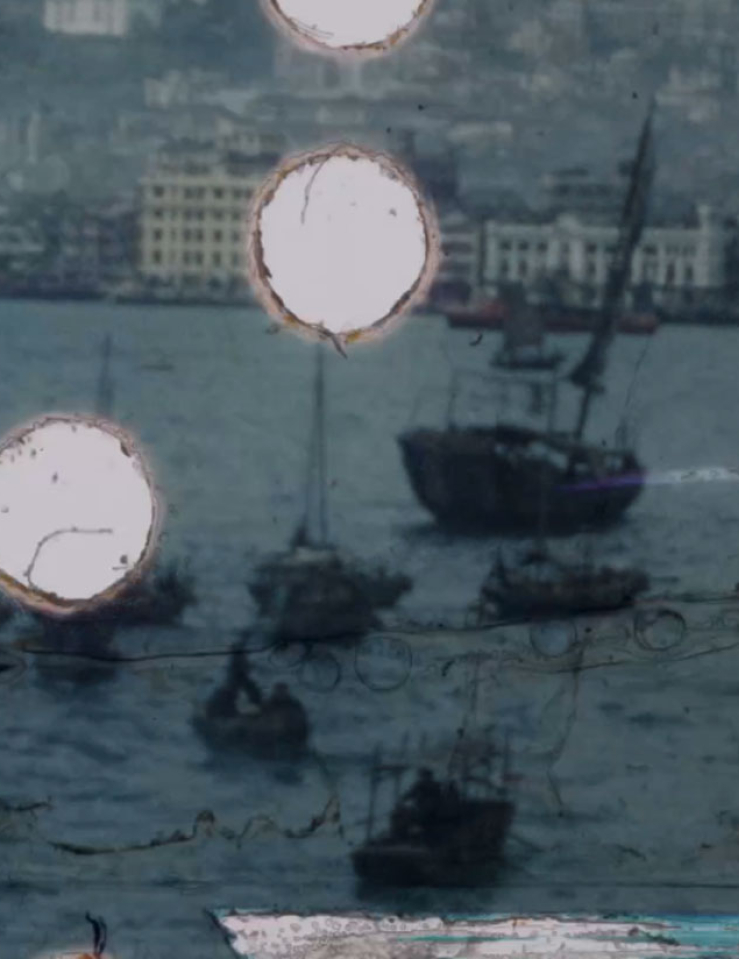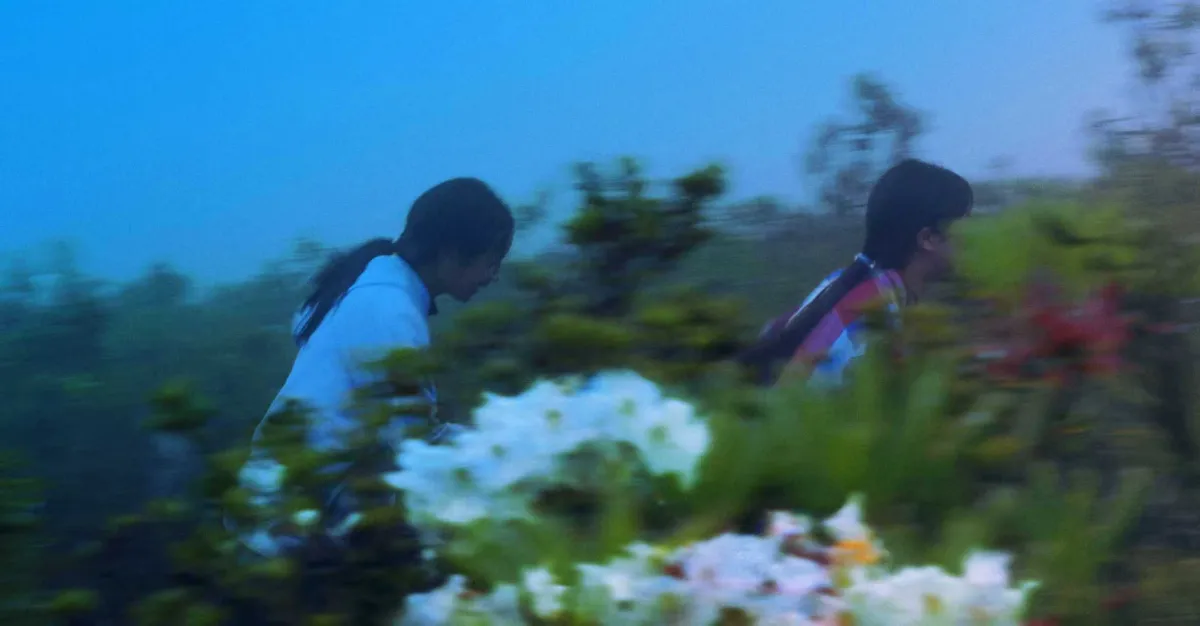


In the remote Liangshan mountains of China, there are many kids who are left to their own devices while their migrant worker parents roam the country for jobs. The burden of the adult world comes early to them and so their days of running wild and happy through picturesque landscapes are numbered. Among them are Qihuo, a bright-eyed sixth grader who feels an impending change in her life, and her two closest friends, Atnyop and Itgop, who become the protagonists of Dongnan Chen’s sophomore feature documentary, Whispers in May, that won the top prize at CPH:DOX in March.
Some viewers have noted the similarity of Whispers in May with Deming Chen’s Always, another Chinese documentary about the fleeting final moments of childhood that won the same prize at the same Danish festival last year. But the similarity arguably ends in their choice of subject matter. Whereas Always is in the observational mode, Whispers in May relies heavily on improv and collaboration with the three Yi minority girls in rural Sichuan.
The film begins when Qihuo has her first period and the trio of friends embarks on a journey to a different town in order to buy a skirt for a traditional ceremony marking the beginning of womanhood. At once a coming-of-age documentary and a road film, the hybrid project imbues its narrative with almost a mythic quality as the girls encounter strangers, some with many tales to tell and others with none left. Chen’s poetic direction of the girls’ story proves significantly different from her previous verité docs (such as the 2021 feature Singing in the Wilderness and 2023 well-traveled short 14 Paintings) and results in a beautifully moving film.
Documentary spoke with Chen, who was on her way to Visions du Réel for the Swiss premiere of Whispers in May, about the collaborative process of making the film and the sustained engagement with ethnic minority communities and stories across her oeuvre. Whispers in May continues its festival run at Hot Docs, Margaret Mead, and DOK.fest München. This interview has been edited for length and clarity.
DOCUMENTARY: I understand that Whispers in May was shot in May 2022, but it had its world premiere four years later in 2026. Could you share with us what the process of completing the film was like?
DONGNAN CHEN: Yes, we did the major shoot in 2022 because we had to act fast. Qihuo was on the verge of being recognized as a woman in her community, and the secret of her menstruation wouldn’t stay hidden for long. We spent one month on the ground doing research and building trust with the girls, their families, and the school, followed immediately by a month of production. The deeper reflection happened in the edit. I spent a great deal of time with my editors, Sisi Chen and Tao Gu, experimenting with different approaches to explore the meaning within the material. After the first cut, I stepped away to let the project settle, focusing on 14 Paintings in 2023. Much time was also needed to find the right creative and production partners and secure the necessary funding. Ultimately, it feels like a better time to release now that the girls have turned 18 and have an evolved understanding of the film.
D: As you’ve mentioned elsewhere, a considerable portion of the film is composed of improv and staged scenes, including the road trip that the three girls embark on. Why a road trip?
DC: Because it was Qihuo’s wish. When I first met her, her teacher showed me things she had written, including the sentence: “I’ve made many wishes, but none has ever come true.” When I asked her about those wishes, the biggest was to escape: to go as far from home as possible and see a larger world. So, I had a very simple concept: to make a film that acts as a wish.
I thought about what would be meaningful for the girls at this time of transformation, one that often happens silently and is so rarely witnessed. I felt a purely observational documentary wouldn’t serve them. Documenting their reality might make for a meaningful project, but it wasn’t necessarily meaningful for the girls themselves. Compared to my previous work, Whispers in May is a film more driven by agency with an attempt to break through the constraints of reality through the filmmaking process.
The girls were passionate about the road trip, but they were perhaps even more passionate about the act of making a film about it. They took up the space of the film to tell their own stories; sometimes they would direct the DP [Ming Xue], telling him how to frame a shot or asking him to follow them more quickly. It was a collaborative process of building a space for the last moments of their childhood.
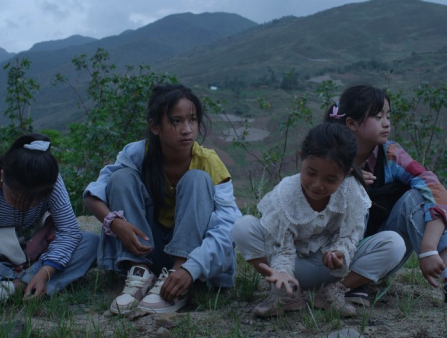
Courtesy of CPH:DOX
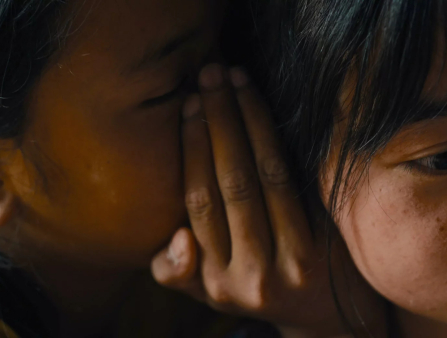
Courtesy of Visions du Réel
D: The girls’ parents are all migrant workers who are laboring far away from Liangshan. In this case, how does consent and collaboration work when working with minors? Do you talk with the parents, grandparents, or even the school?
DC: We approached the school and the Liangshan education administration first, as obtaining permission is essential to filming there. The school then helped us contact the parents. It was a lot of work to explain our intentions, as they were unfamiliar with the concept of filmmaking; that’s why we needed a full month of preparation to talk them through the steps. With the support of the teachers, the parents gradually came to trust the process, though their feelings often fluctuated. There was a lot of back and forth: one day they would encourage the girls to wash their faces and look good for the camera, and the next they would demand they come home immediately for chores or other things.
In the film, you see Itgop and her sister were called home during the road trip; that was a real situation the filmmaking team faced throughout the process. At the time, we told the parents about the road trip but did not disclose Qihuo’s secret. It wasn’t until two years later, when she chose to share it, that the parents got the full picture of everything. We had another long talk after that.
D: I was just about to ask about that. Was it always the plan that the girls wouldn’t reach Buxte in the film? Just as they’re on the brink of reaching the town, the girls decide to get off the car and play in a field of flowers, almost as if they’re clinging onto the last moments of their childhood.
DC: In the end, we actually just couldn’t make it to Buxte, the skirt town, because we didn’t have enough time and had to send the kids back to school. It was also their idea to go see the Soma flowers instead because they’ve seen them on social media but never in real life.
D: Previously, both your 2013 short film The Trail From Xinjiang and 2021 feature Singing in the Wilderness were also about ethnic minorities in China, Uyghur and Miao, respectively. What interests you to continuously engage with ethnic minority communities and their stories?
DC: I know it seems like a deliberate path, but to be honest, I didn’t choose these stories; they were born from a series of coincidences. Some began as short film commissions, others from an encounter at exactly the right moment. I’m reluctant to label them as ‘ethnic minority films’ because I don’t see them as ethnographic studies, but as a search for a shared resonance of living.
However, I am indeed attracted to the social margins. To me, the margin isn’t just a place; it’s a state of being. Being on the periphery means being ‘out’ in a way, and that ‘out-ness’ offers a raw, unpolished freedom that the center doesn’t have. Yet, that freedom is fragile. It is in constant tension, forever being pulled and tugged at by the central power. I’m interested in this friction between the freedom of the margins and the inevitable struggle that comes with it.
For Whispers in May, I wanted the girls to look as grand as they felt inside. They aren’t characters in a social issue; they are simply children being themselves, navigating the complexities of life between reality and a tale.
—Dongnan Chen
D: I think that’s also clear in Whispers in May. If I’m not mistaken, it’s never explicitly stated in the film that the people are an ethnic minority.
DC: That’s true. At times, I don’t even feel we need to mention Liangshan. The story can happen anywhere, in Italy, Bolivia, or any corner of the world. I feel that the specific location or ethnicity tags can possibly limit how we see the girls. Of course, Nuosu culture is present because it is their specific environment. But it’s not the most important part of the story. The film is about the whispers of childhood that begin to be drowned out by the codes of the adult world. It isn’t a loud transition, but it belongs to everyone.
D: You’ve mentioned elsewhere that you opted for beauty in making Whispers in May, deliberately avoiding the roughness and focus on social problems often associated with many Chinese documentaries, including perhaps your earlier, formally more traditional, and observational docs such as The Trail From Xinjiang and Singing in the Wilderness. What led you to shift your approach to a more poetic, collaborative one?
DC: For Whispers in May, I wanted the girls to look as grand as they felt inside. They aren’t characters in a social issue; they are simply children being themselves, navigating the complexities of life between reality and a tale. As filmmakers, we start with a faith in the power of cinema. We aren’t so naïve as to think it will change the whole world, but we believe in its lasting impact. However, after The Trail From Xinjiang and Singing in the Wilderness, I carried some quiet unease. I was confronted with the lightness of a film against the gravity of reality: the tangible pressures of day-to-day living, and the limitations of a much larger world. So with Whispers in May, facing these young, energetic girls with so much imagination, I didn’t want to wait for an impact later. I wanted the cinema to be an active gift in the present, right then and there.
Beyond that, there is the limitation of language. I began to feel more and more that “nonfiction” and “fiction” are very rigid categorizations. And when a film is something in between, we have no better words than “hybrid” or “docufiction,” which still forces us to constantly think about what is real and what is not. But the greatest power of cinema is its ability to create a life parallel to real life: a space that blends our secrets, real experiences, and imaginations. Sometimes the real looks unreal. Sometimes you need the unreal to reach the real. In the end, a film is simply a film. It’s beautiful and tempting precisely because it’s not just real life, but it’s not totally fantasy either.
D: Have the girls seen the film? Where are they now? What are they doing?
DC: Yes, they’ve watched the film, and they felt they were “old” now. They felt their childhood was indeed gone and that they are now in a completely different phase of their lives. They thought they looked so ugly in the film because they’ve since learned how to do makeup and dress up. Sometimes they hope I only show the film in far places, while other times, they are looking forward to a wide cinema release for people to see it. It did bring back a lot of sweet memories. They talked about how pure that time was when we first met and made the film.
Soon after filming, Atnyop and Itgop faked their parents’ signatures and dropped out of school, as mentioned at the end of the film. They have a strong wish to leave home and make money in the cities. They have been touring China a lot, changing jobs in different kinds of factories. They know how to do packaging, how to make fans, phone cases, even drones. As for Qihuo, she graduated middle school last year. I helped her get into a high school about nine hours’ drive from her hometown because she wanted to run away from an arranged marriage. She was there for one semester and this winter vacation she went to work in a factory to make some money for her tuition fee. But a month later, she told me she didn’t want to go back anymore. She wanted to stay in the factory and be further and further away from home.