

In Waves and War opens with a scene at Stanford University’s Brain Stimulation Lab, where combat veterans tell a research scientist why they’re leaving the U.S. to try a controversial therapy. They’ve endured depression, PTSD, and traumatic brain injuries. After exhausting medical treatments in the U.S. that weren’t effective, some considered suicide.
Marcus Capone had been in their shoes. Feeling desperate, the Navy SEAL veteran traveled to Mexico to undergo a regimen of psychedelic medicines, including 5-MeO-DMT and ibogaine—the latter is what the veterans in the Stanford study would try. These naturally occurring psychedelics are illegal in the U.S., but have been used abroad for centuries by Indigenous communities.
Capone described in an interview how psychedelic therapy helped him alleviate stress and anxiety. “The medicine cracks you open and gives you a new white canvas to paint whatever you want on there. It changed my life forever,” Capone said. But, he said, it’s a misconception that simply taking a pill makes everything better. The most difficult work, Capone stressed, follows the treatment. “You have to put a plan in place and conduct consistent integration sessions with an experienced coach/therapist to help process your psychedelic experience. Otherwise, you potentially can go back to the way things used to be.”
Capone’s years-long struggle is common among veterans but not often voiced in a military culture that stigmatizes asking for help.
Buried trauma and insufficient treatments have fueled an epidemic in which members of the military are more likely to die by suicide than in combat.
So, when Capone finally experienced relief, he and his wife Amber founded Veterans Exploring Treatment Solutions (VETS) to help veterans access psychedelic therapy. In Waves and War tells the Capones’ story and that of two Navy SEALs who welcome cameras to document their psychedelic experiences. They share past traumas and hallucinations, which are illustrated by their personal archives and animation. Psychedelic therapy, they say, gave them hope and a capacity to heal.
When Diane Weyermann met the Capones in 2019, she knew she had found her next project. As Participant Media’s chief content officer, Weyermann cultivated documentaries to inspire positive change in the world. But she needed the right filmmakers. So, she tapped Bonni Cohen and Jon Shenk, founders of Actual Films, who for more than two decades have communicated how trauma, from sexual abuse (Athlete A) to genocide (Lost Boys of Sudan), affects the human experience.
Cohen, Shenk, and producer Jessica Anthony opened up about their challenges making In Waves and War, including how, after Weyermann died and Participant Media closed, they pivoted to carry out the impact campaign that Participant had promised. Now, they’re building partnerships and events to destigmatize seeking mental health treatments and influence legislation that supports veterans unserved by America’s healthcare system.
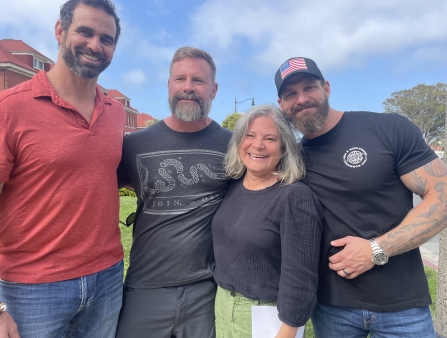
(L to R) Marcus Capone, Matty Roberts, Bonni Cohen, and DJ Shipley.
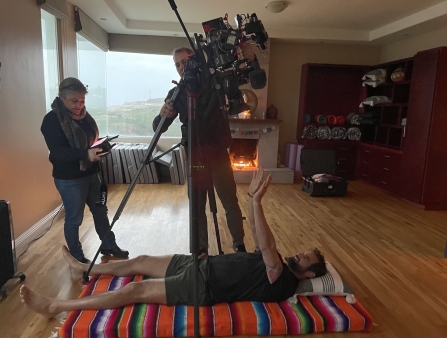
Bonni Cohen (L) and Jon Shent (C) film in Mexico with Marcus Capone.
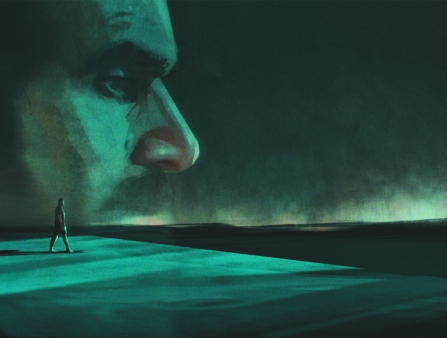
Still from In Waves and War.
March 2019
Bonni Cohen (Producer/Director): Diane Weyermann brought Marcus and Amber Capone to meet us at our San Francisco office. They described how Marcus’s PTSD and traumatic brain injuries had affected their family. Psychedelic therapy in Mexico was the last stop for Marcus after trying several other interventions. Because many Navy SEALs and their families had suffered similar traumas, the Capones founded VETS. Their nonprofit helps veterans afford psychedelic therapy abroad. But it felt like an injustice. Why should veterans who defended the U.S. have to leave it for medical care? This film, they hoped, would help inform the public about the crisis underway and convince lawmakers to support research on psychedelic medicines that could become FDA-approved treatments for trauma and other mental health conditions.
Spring 2019
Jon Shenk (Producer/Director): Participant contracted us to flesh out access and scope in a development deal, including funding for initial shooting.
Fall 2019
Cohen: Marcus and Amber opened doors to members of the SEAL community who are taught a code of ethics and to remain private. We were asking the SEALs to share some of their darkest secrets, so they had to trust us. Our relationship with the Capones was our only way in.
Early 2020
Shenk: We interviewed several retired SEALs who helped us understand what they endured during combat deployments to Afghanistan and Iraq. Among them was Greg Hake, whose best friend had died by suicide. Greg also considered suicide before he tried ibogaine therapy. During his psychedelic journey, Greg recalls telling his deceased friend, “This experience is about you.” But Greg’s friend said, “No brother, it’s you.” Then, Greg fell through a green tunnel that, to him, resembled a sequence in the science fiction film Stargate. Eventually, he got spit out in a basement, where, in real life, Greg had experienced abuse. A voice pointed out that the basement was now empty, so he could move on: “See, there’s nothing here anymore. There’s no one here.”
We had an epiphany that this was not just a film about soldiers getting over PTSD but that it would also get into the psychology of who they are and what led them to join the military to become “protectors.” We were stepping into intimate details of their lives that, in some cases, remained hidden even to themselves. We realized we would have to be mindful because these guys were doing deep psychological work. Greg’s story is not in the final movie, but his vivid memories inspired our process, including an ambitious animation plan.
Spring 2020
Shenk: By the time we submitted the development materials, we had done some shooting. But we paused at the beginning of the COVID-19 pandemic when the world got turned upside down.
June 2021
Jessica Anthony (Producer): We brought on Marcus and Amber as consulting producers to acknowledge their contributions. They added legitimacy to our work and continued introducing us to film participants and collaborators.
October 2021
Anthony: At the Capones’ house, we met Matty Roberts, a Navy SEAL veteran who was not yet considering psychedelic therapy. It was his first introduction to the film. Our relationship with Matty would take a while.
January 2022
Anthony: Marcus and Amber introduced us to Patsy and DJ Shipley after we heard DJ’s story on a podcast. DJ is a Navy SEAL veteran who had been to Mexico for psychedelic therapy. He saw the film as a way to help his community and jumped in. Patsy hesitated.
February 2022
Anthony: Jon, Bonni, and I flew to Virginia Beach. We had dinner with Patsy and DJ to get to know each other and talk about our film plans.
Cohen: Patsy had a lot to add but wasn’t sure that going public with her story would be the right thing for her family long-term. So we did something we’ve never done. We said, “Why don’t we film this interview, and then you can decide whether you want to sign the release. But at least tell your side because it’s as important as DJ’s.” We knew that any piece of Patsy’s story would be better than none. Both DJ and Patsy let us interview them on that trip.
April 2022
Cohen: We shared with Patsy her interview transcript. She struck a few lines that she felt were not totally accurate, and agreed to have her story included. We felt that collaboration was important—after all, it’s their life story.
Shenk: We realized that her freedom to speak openly, without that interview being final, allowed her to say things she might never have otherwise.
Anthony: We sat down for our first embargoed interview with Matty. He was still unsure about participating. He didn’t want this to be about him, but rather thought of it as a way to help his military brothers and prevent suicides.
We also began filming with several veterans enrolled in Stanford’s ibogaine research study before they traveled to Mexico for treatments.
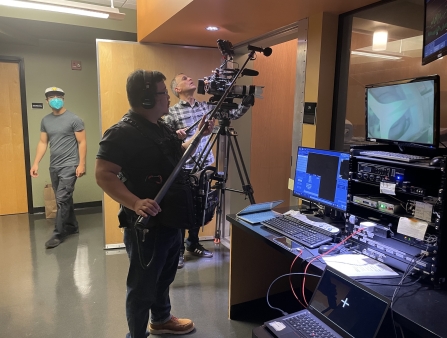
Jon Shenk (behind camera) and team filming at Stanford’s Brain Stimulation Lab.
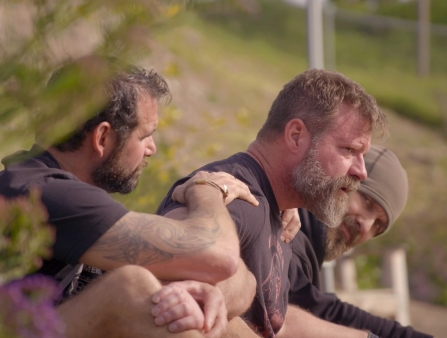
Still from In Waves and War.
November 2022
Anthony: Blake Mycoskie, founder of TOMS Shoes, came on board as an executive producer. He was drawn to the stories in our film and saw its impact potential. Psychedelics helped Blake process difficult things in his life, and he has pledged to donate millions of dollars to support research into psychedelics as medical treatments as well as other initiatives, including a psychedelic documentary fellowship.
Early 2023
Anthony: We began working with Studio AKA on the animation. We went back and forth with our guys, asking granular details about battles and their psychedelic journeys. At one point, DJ sent videos of himself sketching on a whiteboard to block out a battle sequence, which the animation team referenced for the re-creation. I was constantly texting our guys to verify the right kind of night goggles, the proper aircraft carrier, the exact visualization and feelings they had when under the influence of ibogaine and the 5-MeO-DMT. It had to be accurate.
February 2023
Shenk: After Matty’s military brothers gave him their blessing, he began to feel more comfortable, and we filmed Matty going through psychedelic therapy treatment in Mexico. Two weeks later, we did an interview with him. We thought we had what we needed to finish the film.
April 2023
Shenk: Matty called and said, “I don’t think my story is done.” When we interviewed Matty shortly after his treatment, he was still recovering. But several months later, he began making tremendous breakthroughs, including a better understanding of his survivor’s guilt, childhood trauma, and lack of spiritual belief. He wanted this part of his experience to be documented for people who may not view ibogaine as an option. Because, he said, “I was that guy, too.”
July 2023
Shenk: So, we filmed with Matty and his therapist. I just love that scene. It became the ending of the film. Matty was right!
January 2024
Anthony: Stanford’s research findings were published in Nature Medicine, a highly selective medical journal. Most veterans in the study, and some we filmed with, said that a single ibogaine therapy treatment significantly improved their mental and physical health.
February 2024
Anthony: One of our executive producers, Geralyn Dreyfous, introduced us to Peter Palandjian and Eliza Dushku Palandjian, who came on board as executive producers to support the impact campaign. They are very involved in Boston’s mental health space, funding and advocating for psychedelic therapy research. Eliza herself underwent psychedelic therapy to help process and overcome PTSD.
April 2024
Shenk: Participant announced publicly that it would close, which seemed out of the blue. I think it took the employees at Participant by as much surprise as it did us.
Cohen: Participant financed the bulk of the production budget, along with funders brought in by Actual Films and Chicago Media Project. But Participant would no longer be producing the impact campaign. So, we took it upon ourselves to raise additional funds and build an impact team to do this work.
June 2024
Anthony: We completed the sound mix and color to finish the film.
July 2024
Anthony: Amber and Marcus introduced us to Waco Hoover, a Marine Corps veteran, who has advised our impact strategy. Waco chairs the American Legion’s “Be the One” campaign, which is focused on ending veteran suicide.
July 2024
Cohen: Participant, which still exists as a business entity, chose Josh Braun at Submarine as the sales agent and made all the business decisions around how the film would go out into the world.
August 2024
Shenk: We premiered In Waves and War at Telluride. Several distributors saw it there, which got the conversation started. But we didn’t walk away with a sales offer. It has been twisty-turny with the distribution world imploding on us. We’re living in a period where business decisions seem to be taking precedence over art or social issues.
January 2025
Anthony: Netflix approached us to offer a hybrid licensing deal as part of an effort to acquire six documentaries that performed well at festivals.
February 2025
Anthony: We collaborated with the Capones’ nonprofit VETS to organize an In Waves and War screening for Texas lawmakers who would vote on a $50 million bill to help bring ibogaine through clinical trials. Sherri Reuland, a Texas Ibogaine Initiative consultant, saw our film and wanted to use it to push the conversation forward. Her organization paid for the reception and our team’s travel expenses. That synergy was possible because everyone was after the same thing.
March 2025
Anthony: Amber, Marcus, Matty, Nolan Williams (who led the Stanford study), Jon, and I attended an In Waves and War screening with Texas lawmakers.
April 2025
Anthony: The Palandjians hosted a screening in Boston that raised over $900,000 for Home Base, a nonprofit that provides healthcare for veterans at no cost.
May 2025
Anthony: Two months after our screening, the Texas Senate and House of Representatives voted to pass the ibogaine bill.
We hired Jamie Shor, president of PR Collaborative, to garner press around the issues of our impact campaign.
June 2025
Cohen: The Netflix deal was announced. In Waves and War will begin streaming in November. We are grateful, because the bottom line is that we hope our films get to be seen by the biggest audience possible.
Anthony: For more audience building, we screened In Waves and War at Psychedelic Science, a conference that attracts thousands of researchers and advocates in the psychedelic space.
Texas Governor Greg Abbott signed the $50 million ibogaine bill into law, which, according to advocates, is the largest state-funded psychedelic research initiative in history.
With philanthropic donations from about a half dozen individuals, we hired impact producer Chris Albert [current board secretary of IDA, which publishes Documentary] of Albert Media Group to build out an ambitious plan. Chris will remain on through the wide release.
July 2025
Anthony: We are planning nationwide educational screenings centered around World Mental Health Day and Veterans Day. We are also collaborating with veterans service organizations that will encourage their constituents to turn out.
We are organizing an educational screening on Capitol Hill in October before our Netflix release. Members from both parties—including Rep. Dan Crenshaw (TX) and Rep. Alexandria Ocasio-Cortez (NY)—have been uniting around these issues, so we feel it’s the right time.
We’re also planning educational screenings at state capitols, including in California, North Carolina, Virginia, and Georgia, where lawmakers are considering legislation that would help fund and advance psychedelic therapy research leading to FDA approval. The Capones and VETS are helping us identify legislators who are interested in the topic, including members of the Military and Veterans Affairs committees. We’ll ask these lawmakers if they would co-host screenings and if insiders could spearhead the events.
It used to be that we would finish a film and get on to making the next one. But it’s hard to replace yourself when you’ve been the constant inside this journey and care deeply about both the subject and the participants who put so much on the line.
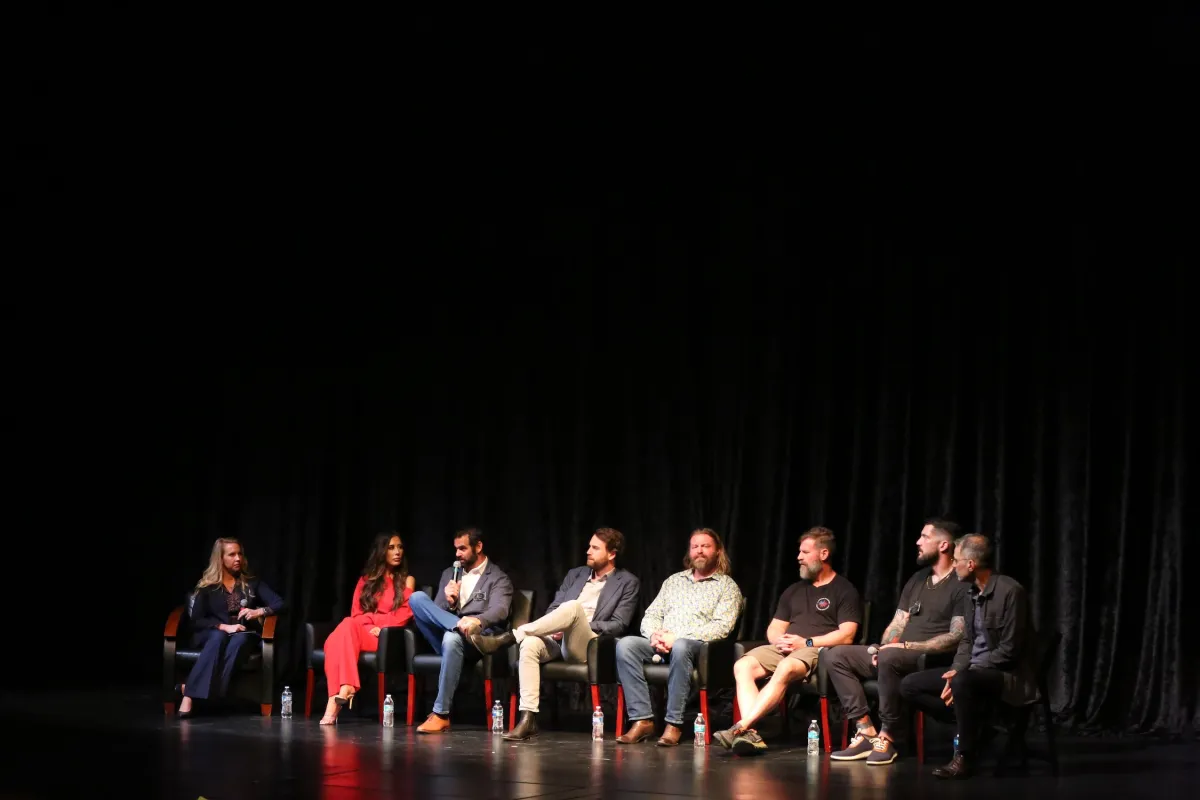
After the March 2025 private screening of In Waves and War for Texas lawmakers, this panel discussion featured conversation between (L to R) AnneClaire Stapleton (journalist), Amber and Marcus Capone (co-founders of VETS), Nolan Williams (director of Stanford University’s Brain Stimulation Lab), Bryan Hubbard (CEO of Americans for Ibogaine), Matty Roberts (a Navy SEAL veteran), Robert Gallery (former NFL player), and Jon Shenk (director/producer of In Waves and War). Image credit: Robin Berghaus. Courtesy of the writer
This piece was first published in Documentary’s Fall 2025 issue.